Underdog Best Ball Strategy For The 2026 Big Board Pre-Draft Contest
Peter Overzet runs through eight strategy pillars he's adhering to in his early 2026 Underdog best ball drafts.
I always like to take a little break from drafting after the season ends, but eventually I succumb to the siren song of drafting teams way too goddamn early.
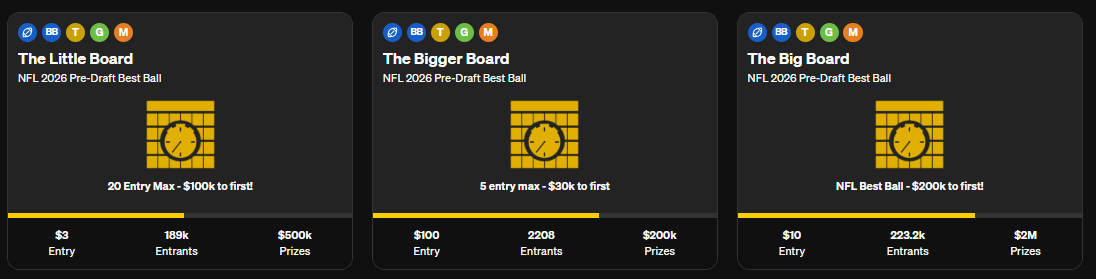
It is legitimately crazy to be drafting teams before the NFL Draft even occurs, and yet the fill rates for the three Pre-Draft Best Ball contests in the Underdog lobby seem to indicate that drafters have zero reservations about firing bullets before these rookies find their new home:
I'm now eight drafts deep (all of which I've streamed on my YouTube channel during Best Ball Breakfast) and after plenty of trial and error, I'm finally starting to see the board a bit more clearly.
Here are eight quick lessons I've learned through my first 8 drafts…
Lock Up Three QBs By Round 13
I don't know what got into everyone lately, but the QBs absolutely fly off the shelves in these early drafts. I've learned this lesson the hard way—repeatedly—and been forced to Frankenstein together a third QB at the end of drafts with guys who are no guarantee to be the starter for 17 games.
Now that I've learned my lesson, here would be my ideal way to play QB:
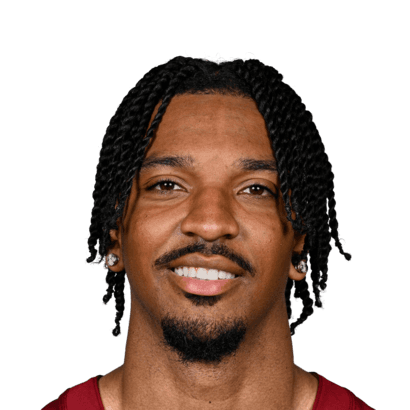
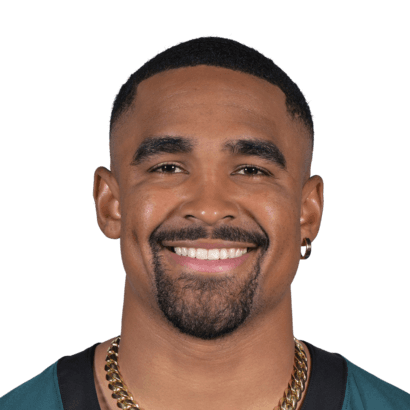
- One QB through 7 rounds: I really like the prices on Jayden Daniels (63.3) and Jalen Hurts (70.1) right now.
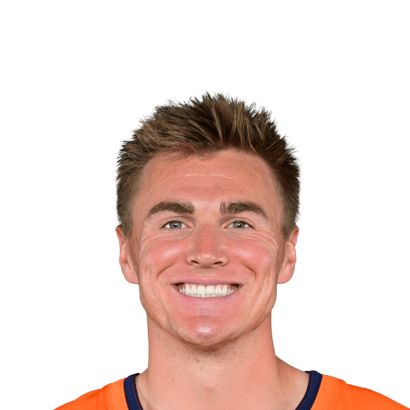
- Add a second QB in rounds 8-10. There are plenty of options in this range, but I prefer the guys on the cheaper end—Bo Nix (104.7), Jared Goff (106.2), Jordan Love (108.9) and Kyler Murray (113.5).
- Add a final third QB by Round 13. Your options here include Sam Darnold, C.J. Stroud, Fernando Mendoza, Bryce Young, Cam Ward and Daniel Jones.
After Jones comes off the board, you find yourself in true question mark territory … and forced to text retired NFL QBs to see if they might return to the league. Don't be me and randomly end up with an absurd bag of Michael Penix Jr.:

Prioritize Two RBs Through Round 4
The QB avalanche is real, but so is the thirst for RBs. 18 RBs go off the board in the first three rounds and I've really disliked my teams when I don't snag at least two of them early.
After Bucky Irving comes off the board (ADP 33.7), we quickly enter the RB dead zone (more on that in a second).
As we get more information throughout the offseason, Zero RB and Anchor RB strategies will become increasingly attractive in large field tournaments, but the uncertainty at the position right now makes it very tricky to pull off.
Embrace your High-T selves and RB max early right now.
The RB Dead Zone Is Back
It appears as if the RB Dead Zone—a pocket of the draft board that has historically featured overpriced RBs who are pushed up solely for volume purposes—is alive and well in 2026. Not all of these backs fit the typical archetype of a Deadzone back, but they are all scary as hell to click:
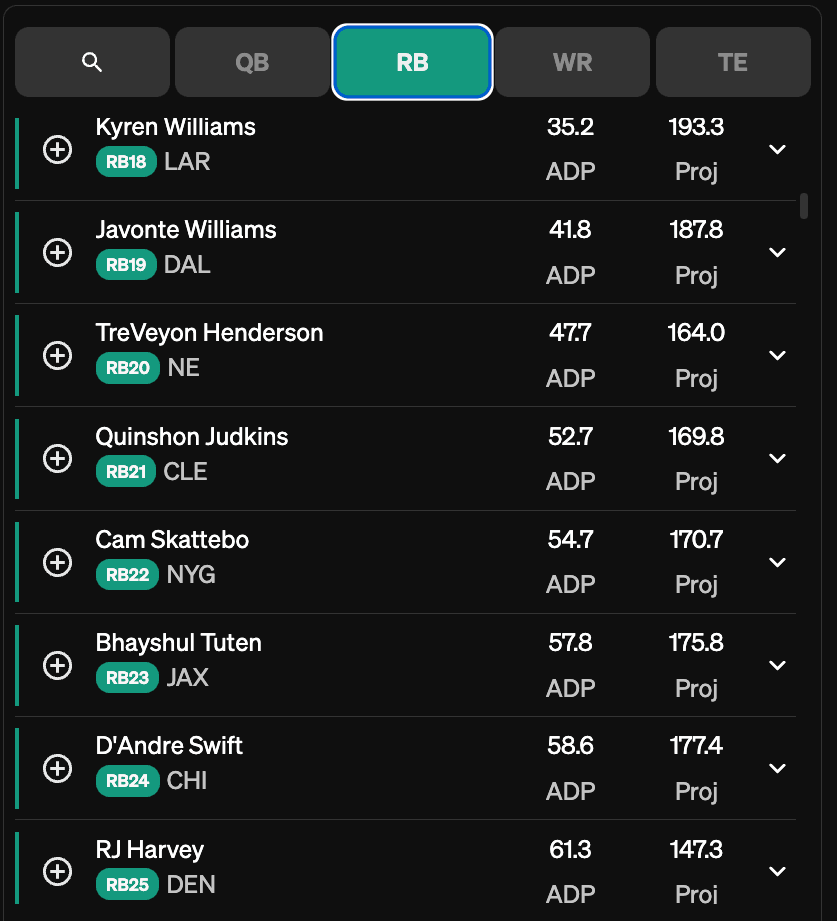
Kyren Williams might be the worst pick on the board, as there is no way he should be going 65 picks ahead of Blake Corum (100.2).
Javonte Williams completely faded at the end of last year and seems likely to face more rookie competition this year. I was sick to my stomach the one time I clicked him.
The second-year backs are fun but come with tons of question marks–injury concerns for Quinshon Judkins and Cam Skattebo, as well as committee worries for TreVeyon Henderson, Bhayshul Tuten and RJ Harvey.
Ideally, I'd like to mostly avoid this range in drafts, but if I do take the plunge, my preferences would be the cheaper sophomores without injury concerns, Tuten and Harvey.
Elite TE Is Tricky To Pull Off
I love Brock Bowers and Trey McBride as much as the next guy, but it is legitimately tricky to build strong, balanced teams when you take the detour for an Elite TE in Round 2 or 3. Similar to Zero RB, I'll be mixing in way more Elite TE builds as the summer progresses, but for now, it's tough to pass up on all of the late-round TE value. You can easily put together a strong TE room by taking three after Round 9.
Some of my favorite TEs to target late: George Kittle (122.8), Dallas Goedert (145), Hunter Henry (159.9) and Gunnar Helm (201.7).
Rookie WR Arbitrage
Carnell Tate (56), Makai Lemon (62.9) and Jordan Tyson (67.4) are rightfully the first three rookie WRs off the board, but I do struggle taking them over some of the proven veterans in that range like Christian Watson and DJ Moore, as well as a few of the Elite QBs I mentioned previously.
Looking at Matthew Freedman's recent 2026 NFL Mock Draft, he has three other WRs going in Round 1:
- Omar Cooper (Pick 21; ADP: 153.5)
- Denzel Boston (Pick 24; ADP: 127.6)
- KC Concepcion (Pick 26; ADP: 126.4)
Over the past few years, rookie WRs who get drafted in Round 1 are a lock for top-90 selections in post-draft contests. Provided Freedman continues his reign as the best mock drafter in the world, all three of Cooper, Boston and Concepcion are smash selections who are likely to see huge ADP spikes after the NFL Draft.
The Travis Hunter Reward Outweighs The Risk
I can't really think of another player in the pool whose value can swing as wildly as Travis Hunter's. All it takes is one quote from James Gladstone to move his ADP 100 spots. It's basically like that old game with flower petals … "He's a WR, he's not a WR … He's a DB … he's not a DB."
Anyways, last year everyone was convinced Hunter was a full-time WR, and he went at pick 50. This year, everyone is convinced he's a DB, and his ADP is 152.1. There's basically zero downside risk at those prices to FAFO on Hunter's role in 2026. I've selected him in half my drafts.
Four Mid-Round WR Targets
In the same way I like targeting the cheaper rookie WRs, there is a quartet of talented wideouts going after pick 90 that I don't think are much different than the ones going in the 50s and 60s:
- Jordan Addison (92.1) - Elite downfield burner who gets a QB upgrade with Kyler. We've selected him much higher than this previously for good reason.
- Xavier Worthy (104.2) - Another legit talent we've previously drafted 60 spots higher. Throw in Rashee Rice's murky long-term outlook and Travis Kelce's age cliff, and Worthy strikes me as a screaming buy.
- Jayden Reed (107.3) - No more Romeo Doubs could mean a starting role in 2-WR sets for Reed, who has always been highly efficient on limited routes.
- Josh Downs (131.6) - He was going in the 90s last year and now Michael Pittman Jr.—the pass catcher with the most overlap with Downs—is gone. Easy click.
The Cheap Offense To Target Late
You can stack up the entire Titans passing game after pick 100.
Start with Wan'Dale Robinson (102.6), grab Cam Ward (145.1) in the 11th or 12th round, snag one or two of the WRs—Calvin Ridley (177.8), Chimere Dike (179) and Elic Ayomanor (210.4)-and then round it out with TE Gunnar Helm (201.7).
If Ward takes a step, every single one of these players is grossly mispriced.

Join Our Newsletter
Trusted by 400,000+ fantasy football players. Get access to Fantasy Life's free award winning newsletter and tools, all in one step.
By registering or logging in, you agree to our Terms of Use and Privacy Policy.
Players Mentioned in this Article
 GunnarHelmQTETEN
 JaydenDanielsQQBWAS
- PPG
- 0.0
 JalenHurtsQBPHI
- PPG
- 0.0
- Proj
- 19.0
 BoNixQQBDEN
- PPG
- 0.0
- Proj
- 15.8
Published Updated