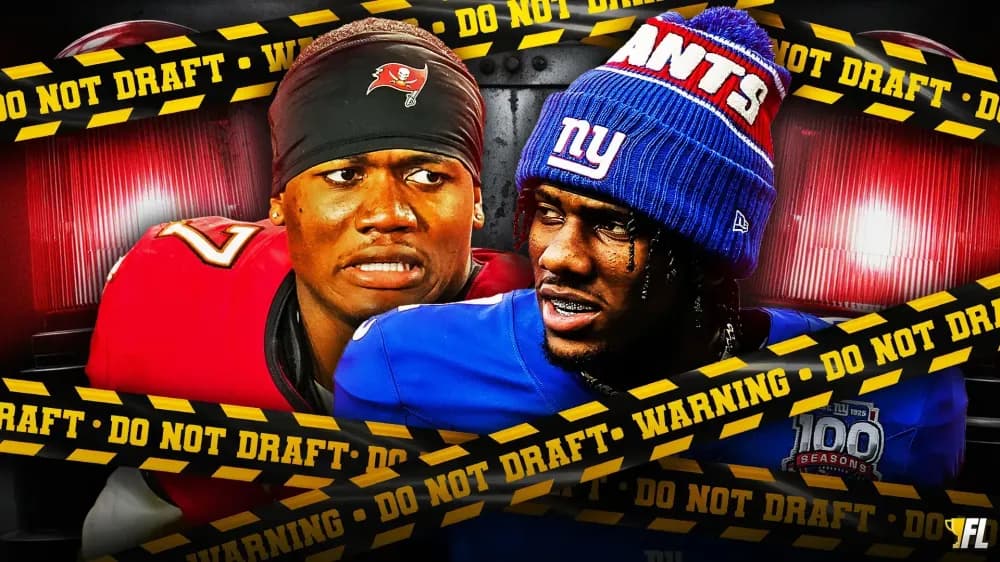
Do Not Draft These Players In Fantasy Football 2026: Jordan Love, Bucky Irving And More
Chris Allen compiled one player at each position for fantasy football managers to put on their Do Not Draft list for this season.
We all have targets when it comes to fantasy football drafts. When we look at rankings and ADP to make determinations on which players we want to select in the ranges we’ll be picking in each round. But we also have players we’re avoiding, who would have to drop significantly for us to even consider drafting them. And even then, we’d think about passing. Here are four players to put on “Do Not Draft” lists.
Quarterback Do Not Draft
 Jordan Love | Green Bay Packers
Oh, boy. Jake Trowbridge and the rest of Packer Nation are not going to like me for this one.
So, here's how I'll couch my stance on avoiding Jordan Love, aka "The Last QB I Know I Can Draft Before Talent Falls Off A Cliff." First, on a positive beat, he's performed like a top-10 passer in every season since becoming the starter. Love's had high marks in EPA per dropback and passing success rate, even as his supporting cast has evolved. However, the shifts this offseason carry the most concern.
Green Bay's offensive line took a step back, putting Love under duress on a career-high 39.5% of his dropbacks, and they're returning four of the five starters. And the Packers' pass-catching corps? Well, let's go with hope as a plan. Romeo Doubs, the WR responsible for 20% of Love's passing yards and a quarter of his explosive plays and TDs, is in New England.
Doubs' replacement? Well, that's a good question. Matthew Golden functioned only as an outside receiver in five of 12 games. His target share crested 10.0% in two of them. Christian Watson is a vertical threat as a flanker. And Jayden Reed, even if he did play on the perimeter, has still struggled to play a larger role in the offense. All of this before we get into how Tucker Kraft, the TE1 through Week 8, may or may not be coming off his ACL injury.
Again, I have no doubt HC Matt LaFleur and Love will cook up some way to make their way through the NFC North. But after back-to-back seasons outside the top 12 QBs, I'll root for Love in real life, while letting someone else handle him in fantasy.
Unlock Our Tools!
Stop hitting the paywall. FL+ gives you access to our premium in-depth content, expert rankings & projections, mock draft simulator, and all the tools you need – all personalized to your league.
Running Back Do Not Draft
 Bucky Irving | Tampa Bay Buccaneers
I need somebody to change my mind about Bucky Irving. Actually, I'll try to do it myself. Because I can hear the Bucky Irving stans already.
He was injured!
He played more than 50.0% of the snaps for only half of the season!
First off, kudos for knowing his snap rate. Second, there's some merit to that argument. I can understand the Bucs' coaching staff not wanting to overload their RB1 after his return from injury. Irving has had the offseason to heal. There's a chance his workload will return to normal. Even better, his peripherals didn't take a complete nosedive in the final month of the regular season.
- Rushing Success Rate: 33.8% (Weeks 1-4), 45.7% (Weeks 15-18)
- Adj. Yards After Contact per Att.: 2.58, 2.34
- Forced Missed Tackle Rate: 21.1%, 10.0%
But effectiveness doesn't always translate to more opportunity. And not all touches are created equal. So, like everyone else, I got concerned when the fantasy-relevant parts of Irving's usage took a step back.
- Target Share: 15.0% (Weeks 1-4), 8.0% (Weeks 15-18)
- Red-Zone Rush Rate: 87.5%, 38.9%
- Two-Minute Snap Rate: 75%, 59%
What's worse is that the players who stepped in for Irving were better in their new roles. Rachaad White, as a receiver, averaged a full yard more after the catch. Sean Tucker turned a third of his goal-line carries into TDs. White might be gone, but the addition of Kenneth Gainwell (and his hilarious 19% target share over the final two months) has me out on Irving as a draft target in 2026.
Wide Receiver Do Not Draft
 Malik Nabers | New York Giants
There's a level of certainty that should come with an early-round WR. Essentially, they should have one of two traits (both would be nice, though). One, being in a situation that precludes them from missing out on fantasy-relevant touches. Or we can project them for a weekly floor of targets that, somehow, will land them in the WR1 discussion each Monday.
Malik Nabers might have neither of those attributes in 2026.
The obvious showstopper for drafters should be the lingering concern around Nabers' return-to-play timeline. After suffering a torn ACL and meniscus in Week 4 of last year, expecting a Week 1 start might be a stretch.
But let's say No. 1 suits up for the season opener. Studies have shown an average 10.0% drop in targets and production for players in their first year back from an ACL reconstruction alone, which casts some doubt on Nabers' ability to return his lofty top-10 cost. Plus, his competition for targets isn't the same either.
- Darnell Mooney: 13.9% (Overall Target Share), 15.0% (RZ TPRR), 30.0% (DeepTS)
- Calvin Austin: 12.0%, 19.5%, 23.3%
- Isaiah Likely: 11.9%, 17.9%, 9.1%
Individually, none of the Giants' FA additions moved the needle. Out of the three, Mooney finished the highest in the EOS positional ranks (WR44). But collectively, they're a step above what Jaxson Dart had, chipping away at Nabers' total domination over the looks. Plus, with HC John Harbaugh bringing his emotional support fullback from Baltimore, passing scores might be at a premium in 2026.
Tight End Do Not Draft
 Jake Ferguson | Dallas Cowboys
We knew going into last season that the Cowboys would be the NFC version of the Bengals. High-end offense with a porous defensive unit, forcing constant passing scripts. Accordingly, pieces like Jake Ferguson were coveted draft targets due to their price relative to their projected opportunity. And through the first two months, gamers rostering Ferguson were happy with their TE1.
- Targets per Game (Weeks 1-8): 7.4, 2nd (among all TEs—min. 100 routes)
- RZ Target Share: 24.1%, 7th
- FPPG: 15.0, 3rd
But remember. CeeDee Lamb missed a month of action. Both Ferguson and George Pickens benefited from his absence. However, as it's often said, earning targets is a skill. Simply being on the field isn't enough. And Ferguson's midseason peripherals hinted at a loss of work unless the performance improved.
Of the 13 TEs with a similar target share and route deployment, only Mark Andrews averaged fewer yards after the catch per reception. Breaking tackles was optional. Consequently, as Dak Prescott needed more from his pass catchers down the stretch, the focus shifted away from the veteran TE.
- Target Share: 21% (Weeks 1-8), 14% (Weeks 9-18)
- Targets per Route Run: 25%, 16%
- Play-Action Target Rate: 42%, 29%
Prescott was still averaging 38-39 dropbacks per game. Lamb and Pickens were top-24 options each week. Said another way, the offense was the same. But without anything to add, Ferguson became an ancillary part of the offense, making him an overvalued option in drafts for 2026.

Join Our Newsletter
Trusted by 400,000+ fantasy football players. Get access to Fantasy Life's free award winning newsletter and tools, all in one step.
By registering or logging in, you agree to our Terms of Use and Privacy Policy.
Players Mentioned in this Article

Published Updated