2026 NFL Draft Notebook: Is Kyle Louis The Most Interesting Defensive Prospect In The Class?
Gene Clemons catches you up on what you need to know for the 2026 NFL Draft and what to focus on that may be going overlooked.
Without all the glamorous, high-profile names we normally associate with the NFL Draft, it has forced novice football scouts or casual onlookers to dig deeper into areas that are typically eschewed around this time because they are likely to go higher and more frequently than normal. Linebackers and interior offensive linemen are two groups that you need to know more about. The X receivers in this draft may not be household names, but so many have starting ceilings and special teams floors that it has become fun, and a little maddening, to study. We have also entered a world where people are questioning the NFL Combine measurements. Let’s open up the notebook and explore.
RELATED: 2026 NFL Draft Guide
What To Know For The 2026 NFL Draft
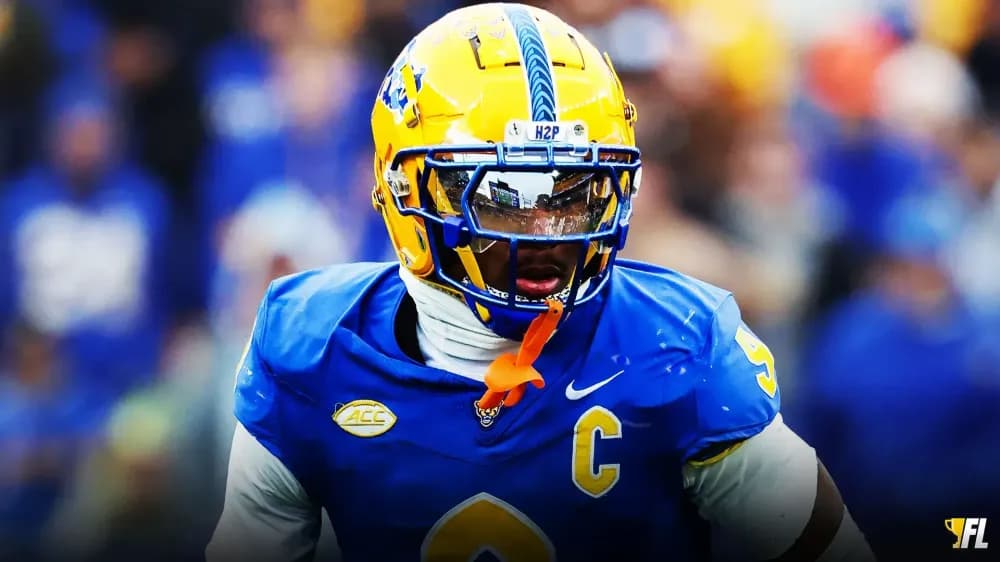
Pittsburgh’s Kyle Louis may be the most interesting defensive prospect in the draft
Louis is one of the most intriguing prospects that we have in this draft cycle. He has been compared to Buccaneers greats like Derrick Brooks and the recently retired Lavonte David.
His draft stock has ranged from an early third-round pick all the way to a late first-round pick. When the process began, many believed that Louis was destined to be a Day 3 selection, and now he is being looked at as a guy who can go with a premium top-100 selection.
The reason he is such an enigma is that at 6-foot and 220 pounds, he is the size of a strong safety, but he has been projected to be a linebacker in the NFL.
His ability to play the "star" role at Pittsburgh—a position that allows him to move between being a linebacker, a slot defender and an outside rusher—gives him the versatility to be a big nickel in the NFL. If he can play the third linebacker in a base set, but be athletic enough to still cover like a defensive back, he gives the defense versatility in their position groupings. He can essentially play the slot in a three-linebacker system, or he can be the weak-side linebacker in a two-linebacker dime look.
He has the speed and explosiveness of a safety, the tenacity of a linebacker and the production to back up his metrics. In 2024, he recorded 101 tackles, seven sacks and four interceptions. He followed that up in 2025 with 81 tackles, three sacks and two interceptions. In both seasons, he finished with three passes defended and a forced fumble.
This is the prospect that personnel guys just have to close their eyes and turn in the card. When they open their eyes, they will see an extremely valuable defensive chess piece.
Pro Day workouts leave more questions than answers
CJ Allen, Linebacker, Georgia
When you turn on the film and watch Georgia linebacker CJ Allen perform, there is no doubt about his ability to play the position at a high level.
He has an elite IQ for the game and he is a downhill thumper who makes plays all over. His game speed is faster than his testing might suggest, especially when you consider the speed at which he processes the game. The issue is with Allen's Pro Day performance.
During his on-field drills, Allen struggled to show fluidity. He looked visibly stiff in the hips and did not move in and out of his breaks very well. When he turned and opened up to run, it was a lumbering run that made it seem as if he would have trouble carrying tight ends and big slots vertically.
The question becomes, which will win out: the film review or the workouts in shorts and t-shirts?
For me, it's always the film.
Jordan Tyson, Wide Receiver, Arizona State
Jordan Tyson came into 2025 as a top-10 pick after a massive 2024 season. But during the pre-draft process, he's been a major letdown for evaluators who wanted to see what he could do.
After a 2025 season where he struggled with injuries, it seems that these soft tissue issues—which have plagued him throughout his career—have evaluators second-guessing where he should go in the draft.
The film says he's a first-round draft pick who has the upside to be one of the best prospects in the class. However, his injury history makes people want to put the brakes on bringing him onto the team.
The medicals will likely cost him the opportunity to be the first wide receiver off the board. The question is: will it cause him to fall all the way out of the first round?
I think it would be difficult for me to take him unless it is a luxury pick and I do not need him to hit the ground running immediately.
We are still not talking enough about these X receivers
Bryce Lance, North Dakota State
Bryce Lance is more than just the brother of Trey Lance (the backup quarterback for the Los Angeles Chargers). He is a talent all his own, and he hasn't been talked about enough during this process—especially after wowing scouts with his speed and explosiveness at the NFL Combine.
One of the reasons why he's been overlooked is that he went to school at North Dakota State, a program not known for its high-end receiving talent. However, Packers receiver Christian Watson has proven that you can find talented receivers at North Dakota State.
It is not only the stigma of playing at a lower level that affects his draft stock, but the fact that his brother, Trey, has failed to live up to his first-round pedigree. This has somehow tarnished the younger brother. But at 6-foot-3, 209 pounds, running a 4.34 40-yard dash at his pro day and bolstering a vertical jump of 41.5 inches, it's hard to understand why more people are not talking about this elite athlete who comes from a winning program.
Malachi Fields, Notre Dame
Fields seems to have hit a ceiling with his upward trajectory based on his slower 40-yard dash time at the Combine. His 4.61 was something that didn't endear him to a climate where everyone's looking for the next 4.3 speedster.
But Fields is a throwback to the old-school X-receiver bullies who have an ability to win with their bodies and with ridiculous catch radiuses. He is a guy who has upside because he can be a legitimate possession receiver at the first and second level, but also win 50-50 balls over smaller, less physical defensive backs deep.
A lot of evaluators are looking for the "do-everything" receivers so much that they forget that an X receiver has a particular feel and look to them. It's impossible to ignore that Fields fits the mold of your prototypical X receiver.
Ted Hurst, Georgia State
It has been a slow burn for Hurst ever since he arrived at Georgia State in Atlanta. Before that, he was an unranked receiver out of Savannah, Georgia, who took his talents to Division II, where he was a red zone merchant for two seasons.
When he joined Georgia State, he immediately became a deep threat and a field-stretching option; in 2025, he cracked the 1,000-yard mark as their leading receiver. His 6-foot-4, 206-pound frame, along with a ridiculous 11-foot-3-inch broad jump, shows he has not only the size but the explosiveness to get off the line of scrimmage against press coverage and to immediately win when attacking the third level.
His 4.42-second 40-yard dash is faster than the 4.45-second 40-yard dash that he ran at his pro day. That means that if he catches the ball, nobody is catching him. Yet, you still see people choosing to focus on other receivers over Hurst. That is because the competition in Division II and at the Sun Belt level isn't always respected by evaluators.
Why are we questioning the NFL Combine’s measurements?
There has been a lot of discourse regarding Utah offensive tackle Spencer Fano's arm length. At the combine, his arms measured 32 1/8 inches, but at his pro day, his arm length was measured at 33 1/4 inches.
The difference in arm length is really more important to us in the public than the actual teams that want to draft him, because they can always just measure his arms for themselves. Ultimately, the idea that arm length alone will disqualify Fano from playing offensive tackle and therefore drop his draft status is crazy.
When you turn on the film, you see someone who is a tactician: a guy who understands how to compete and plays extremely tough. His arm length will only come into play if, for some reason, he can't compensate with all of the other tools that make him a great offensive lineman.
The real issue is why people were so quick to say that the NFL Combine's measurements were wrong. The NFL Combine plays no favorites; they have nothing invested in any individual player. They only want to record the information so that players can be evaluated successfully.
Meanwhile, these college programs have every reason to fudge the numbers for their athletes because they are the ones who have everything to gain from their athletes going higher in the draft. They obviously care more about the individual and want to see them put their best foot forward or be painted in the best light.

Join Our Newsletter
Trusted by 400,000+ fantasy football players. Get access to Fantasy Life's free award winning newsletter and tools, all in one step.
By registering or logging in, you agree to our Terms of Use and Privacy Policy.
Players Mentioned in this Article



Published Updated