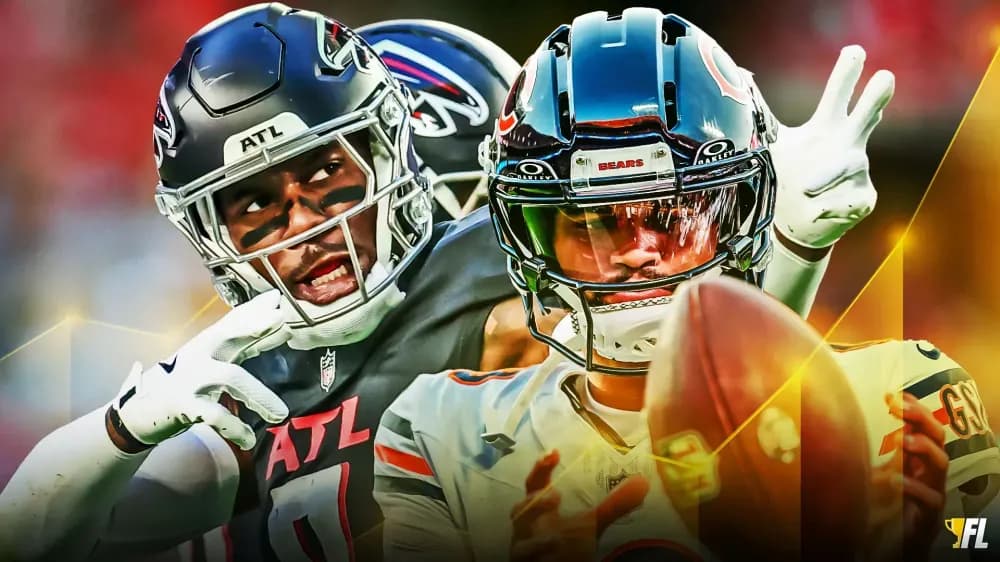
Dynasty Fantasy Football Sell-High Candidates: Pump The Brakes On Caleb Williams
Jake Trowbridge breaks down three players to sell in dynasty leagues before their value comes back down to Earth.
If there’s one thing dynasty managers are great at, it’s convincing themselves to trade away a player at the first sign of production. “Selling high” is often viewed as the subtle art of refusing to be happy with players actually scoring points on your roster. So I get that some folks are skeptical of articles like this one.
But the bummer about fantasy football is we don’t get to copy and paste last year’s stats onto this year’s dynasty teams. I’ve tried. And not every player’s arrow continues skyward. Some start coming down pretty quickly, and we don’t want to be the ones riding it toward the ground.
Time to get out while the getting is good.
Players To Sell High In Dynasty Fantasy Football
 Caleb Williams | QB | CHI
You can’t see me right now (hopefully), but I’m taking off my diehard Packers fan hat and putting on my unbiased fantasy analyst beanie. That’s how you know I’m serious when I say that Caleb Williams being valued as the dynasty QB3 on KeepTradeCut might be the greatest overreaction to a single season of wacky football I’ve seen in a very long time.
Although Williams looked stellar on opening drives and outrageously fortuitous in the closing seconds of close games, he was pretty shaky in between. Among QBs who threw at least 200 times, Williams’ completion percentage was above only Shedeur Sanders. So that’s … hold on, just double checking … yep, I’ve confirmed that’s a big yikes.
Chicago was also aided by one of the easiest schedules in the league, and Williams benefited from a turnover-heavy defense that afforded him those famous last-minute heroics. And hey, you can’t blame someone for cashing in on those opportunities. But you also can’t bank on them in the future.
With rushing upside that’s much closer to Patrick Mahomes than Lamar Jackson, Williams will need to improve drastically as a passer to overcome a presumed decrease in good fortune. As we so often do, it feels like we’re wishcasting a Josh Allen-esque growth as a passer in his third season. And maybe that happens with the help of Luther Burden and Colston Loveland growing into their roles. But there’s too much hope baked into Williams’ current dynasty value for me.
 Alec Pierce | WR | IND
Pierce’s ascension to WR30 on KTC was as sudden as it was overblown.
Look, I’m always in favor of players getting paid, so first I want to offer a heartfelt kudos to Pierce for walking away from free agency with a cartoonishly large bag of money. But $114 million is a hefty sum for a guy who’s never grabbed 50 receptions in a year and just notched his first 1,000-yard season. I should also note that four of his six touchdowns in 2025 came in two games without Daniel Jones at quarterback. Good thing they didn’t bring that guy back, eh? WHOOPS.
“Follow the money” can be a solid adage for dynasty managers, but what happens when GMs clearly value different things in a wide receiver than we do in fantasy? Frankly, I would’ve been more keen to buy into Pierce if he’d changed teams this offseason, even if he was paid less.
I don’t think that Michael Pittman leaving in free agency is the automatic boost to Pierce’s target share that many seem to. If anything, that should benefit Josh Downs and tight end Tyler Warren, or whichever rookie receiver Indianapolis ends up drafting (might I recommend Denzel Boston, whose comp is literally Michael Pittman?).
Maybe see what you could get for Pierce in addition to Ricky Pearsall, Parker Washington or Matthew Golden.
 Kyle Pitts | TE | ATL
Death, taxes and me advocating to trade Kyle Pitts after a drastic ballooning of his value.
Here’s the simple argument: More than 20% of Pitts’ fantasy production in 2025 happened in one game where Drake London was sidelined. Simple as that. In every other matchup, Pitts basically offered fantasy managers a younger and slightly worse version of Dalton Schultz.
I know some very smart folks are excited about Kevin Stefanski coming to town. They see the success of David Njoku and Harold Fannin in those Cleveland offenses and they get the downstairs tingles. And I get that. But just to splash a little cold water on the situation, isn’t it entirely possible that Njoku and Fannin are just … very talented tight ends who lacked real target competition? Isn’t it plausible that they made Stefanski look good, more than the other way around?
London and Bijan Robinson are still positioned as the top two target-earners in Atlanta. Maybe Pitts secures a bigger role under Stefanski. But there’s a pretty big risk that he falls back into his 35 yards per game ways of the previous three seasons.

Join Our Newsletter
Trusted by 400,000+ fantasy football players. Get access to Fantasy Life's free award winning newsletter and tools, all in one step.
By registering or logging in, you agree to our Terms of Use and Privacy Policy.
Players Mentioned in this Article




Published Updated