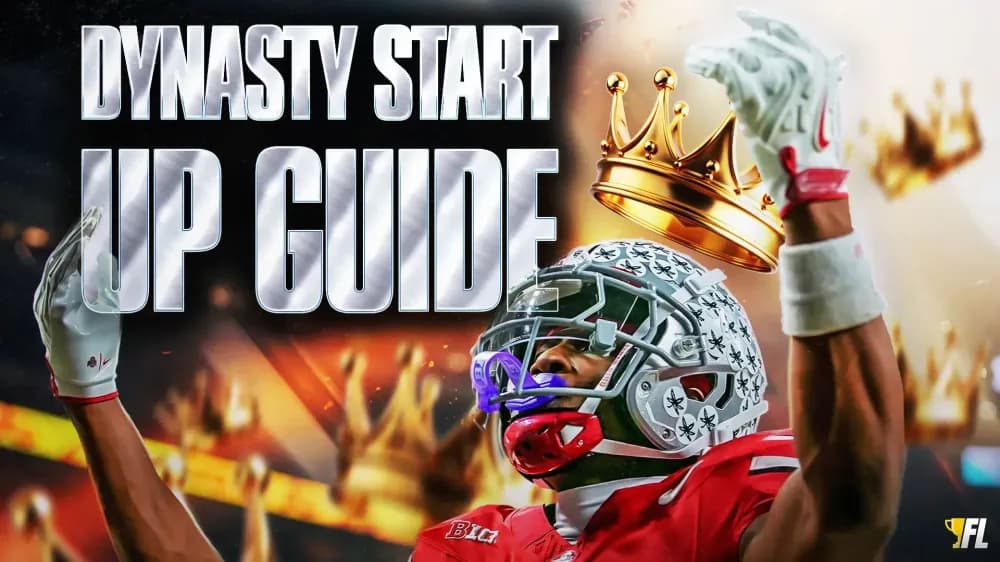
Dynasty Fantasy Football Startup League Strategy: Beware Of Rookie Fever
Jonathan Fuller breaks down the pillars to setting yourself up for long-term success in dyansty fantasy football startup leagues.
Dynasty fantasy football startup drafts are one of the most fun experiences in all of fantasy football. It's kind of like your favorite home league draft but on steroids. They are usually at least 30 rounds, and you are drafting players who could conceivably be on your roster for the rest of their career.
If you are looking to join a dynasty league or talk dynasty strategy, I would highly recommend the Fantasy Life Discord server, where we have channels for every format of fantasy football, and you can find people organizing or trying to join a league. It's a great community and a fun place to chat about all things fantasy.
In this article, I am going to run through startup strategies and important concepts to keep in mind when preparing for a new dynasty league. Whether you are a first-time dynasty manager or someone who is already in too many leagues, these are helpful tips to make sure you get the most out of your startup draft.
RELATED: Get ahead of the 2026 dynasty rookie class with our comprehensive, free NFL Draft Guide.
Strategy Pillars for Startup Dynasty Fantasy Football Leagues
Make sure you understand all your league settings
This may seem obvious, but there is even more to understand than in a normal fantasy league. Not only do you need to know the roster rules, starting lineups and scoring settings, but you also need to know the rules of the draft. Are rookies part of the startup draft, or is there a separate rookie draft? Do you select picks for the rookie draft as part of the startup draft? Is there a taxi squad?
You should have answers to all these questions and more before you start drafting. Ideally, the best dynasty leagues have formal bylaws that spell out all the league rules so there is no confusion over time. This is especially important if you are playing in a dynasty league with a unique structure.
It is far more common for dynasty leagues to have some weird wrinkles to them. I play in several massive leagues with multiple copies of each player, including one league that has a World Cup-style tournament every four years that you have to qualify for. I also play in a devy league where you can draft the rights to players who are still in college, and the value of those picks seems to vary widely from manager to manager.
Whether your league is more plain vanilla or has some crazy settings, taking time to think through how it impacts scoring and player values is important. For example, I am in a league with a 0.25 point per rush attempt setting. This is a significant boost to workhorse RBs and really helps level the field between RBs who don't catch passes and those who do. Derrick Henry and Jonathan Taylor both went over 300 rush attempts last year, giving them an extra 75-80 fantasy points over a league without that scoring system.

Unlock Our Tools!
Stop hitting the paywall. FL+ gives you access to our premium in-depth content, expert rankings & projections, mock draft simulator, and all the tools you need – all personalized to your league.
Know ADP … but have your own rankings
The old saying, "luck favors the prepared", really does apply to dynasty startup drafts. A little bit of preparation goes a long way to making sure you draft a team you are happy with. Most importantly, that means spending some time looking at the default rankings/ADP of the site you are drafting on, and comparing that to a set of rankings that you trust. At Fantasy Life, we have you covered with comprehensive dynasty fantasy football rankings as well as ADP from a variety of sites to help you prepare.
We are all humans who suffer from anchoring bias. When there is an ADP or rank listed for a player on the site you are drafting on, it is going to influence their perceived value. Having a separate set of rankings to reference can help you overcome that anchoring bias and find values on the draft board.
Another important component of dynasty startup rankings is identifying where the tier breaks are. If you can make a trade up and add an extra player or two before there is a significant drop-off in the talent available, that can be a huge boost to your roster.
Another important part of knowing the ADP of the site you are drafting on is anticipating and getting ahead of positional runs. This is particularly important in superflex and TE premium leagues, where talent can dry up quickly and leave you at a major disadvantage if you miss out.
Commit to your strategy
One of the fun things about a dynasty startup draft is that not everyone is necessarily trying to win in year one. This makes it much easier to trade because there is a wider range of values for the same player. Some managers might only be interested in selecting young, ascending talent, while others will be looking to win in year one with proven production. After the first few picks of the draft, you should have a clear idea of whether you are building a team that is trying to win in year one or trying to build a roster that will be a juggernaut a few seasons down the line.
I generally bucket my startup strategy into one of three categories:
- Year one championship favorite
- Youth + future draft picks
- Stars and scrubs (i.e., trade up from middle rounds to add extra early picks)
Once you have made that determination, you should go all in on it. If you are only taking young players and stockpiling future rookie picks, you should be solely focused on that path. On the other side of that coin. If you are building for the first year or two, do everything you can to add as much production to your roster right away.
There is no worse fate for a dynasty manager than being stuck in the middle. You should either be one of the favorites to win the championship or rebuilding, nothing in between. This is much easier said than done. It is easy to want to hedge your bets and balance your roster between unproven youth and productive veterans, but this is tough to pull off without ending up as a middle-of-the-road team.
To be clear, going for a championship in year one doesn't mean you can't draft young players, but they need to have clear roles and proven production as a pro. The strategy of going all in for a year-one championship generally shows up in the middle and later rounds when you have to decide between declining veterans and young players with potential.
Beware of rookie fever
I get it, we all love rookies. The upside is limitless, and they have their whole career ahead of them. All things equal, I would love to draft several of my favorite rookies in a dynasty startup. The problem is that things usually aren't equal. You often have to pay a premium for rookies (or rookie picks) in a startup draft. Everyone wants them, but they are usually higher-risk picks to pay up for because they have never played a down in the NFL.
If rookie fever gets out of control in your startup draft, you need to be ready to pivot. You can still draft a young, exciting team even if you need to pass on rookies for better values. Targeting second and third-year players can often be a great way to arbitrage that, especially if they have had some ups and downs. Guys like Brock Bowers and Brian Thomas Jr. are great targets because they have shown tremendous playmaking ability on an NFL field, but some of the excitement has worn off after slightly disappointing second seasons.
Of course, you want to be careful with guys who look like busts (that's your music, J.J. McCarthy) and make sure you are getting them at a major discount if you are going to take someone that looks like a bust.
Another group of players that I like to target in dynasty startup drafts is players who are younger than they seem. Kyle Pitts and Kyren Williams are two good examples of this. Both guys are 25 years old but feel like they have been around forever. They aren't the exciting picks that they were earlier in their careers, but they should have several good seasons still ahead of them before they start to decline. Those are the types of players that are regularly overlooked in a startup draft that you will be very happy to have when the regular season rolls around.
Don't get too attached … and don't be afraid to trade
These are two pieces of advice that apply to existing and new dynasty leagues. You want to have players you like, but you also can't get too attached to the players on your roster. That kills the trade market and causes managers to hold players for too long.
Dynasty startup drafts are a long process. Having an active trade market makes them much more exciting. As I mentioned earlier, it should be easier to trade in a dynasty startup draft because there is a wider range of strategies being applied than in a typical redraft league.
If you don't have a ton of experience in startup drafts, finalizing a trade can be a bit nerve-racking. You want to make sure you aren't getting a bad deal and won't have other managers coming out of the woodwork to say they would have given you a better deal. You can't worry about those things happening.
Nobody knows how a trade is going to look a year or two from now, and I generally don't believe it when people say they would have given you a better deal. If they really wanted to trade, that is just as much on them as it is on you. That being said, shopping around for a deal is a smart idea if you have the time to do it.
One of the things I had to get over when I was doing my first startup draft was the idea of trading away a player I just drafted. Once you select them, it is only natural to imagine how great they are going to be for your team. But that is a dangerous trap to fall into. You might get an offer a round later that involves trading away that player and picking up a lot of value on picks in subsequent rounds, or adding future rookie picks. Rejecting a good deal just because you got attached to a player you recently drafted is bad business.
For more dynasty content, strategy and analysis, be sure to check out the dynasty section of the Fantasy Life website.

Join Our Newsletter
Trusted by 400,000+ fantasy football players. Get access to Fantasy Life's free award winning newsletter and tools, all in one step.
By registering or logging in, you agree to our Terms of Use and Privacy Policy.
Players Mentioned in this Article







Published Updated