
32 Fantasy Football Stats For 2026: Dalton Kincaid Breakout, Ashton Jeanty Bounceback and More
Adam Pfeifer goes team by team through all 32 NFL teams, highlighting one pertinent fantasy football stat that could have an impact on the team's 2026 outlook.
Stats and fantasy football go together like lamb and tuna fish.
Any Big Daddy fans out there? Is this thing on?
There’s nothing I love more than diving deep into data and applying it to fantasy football. Except maybe chicken parm. There are so many stats that can help review or forecast a player’s fantasy prospects. And with so many players, you can get lost in the data. But for now, let’s focus on one key stat from every NFL team as we approach the 2026 season.
Even the goddamn Jets.
Note: A large portion of the utilization data comes directly from the amazing Fantasy Life Utilization Report.
RELATED: 2026 fantasy football rankings
One Fantasy Football Stat For Every Team Ahead Of 2026
 Arizona Cardinals
- Stat: The Cardinals led the NFL in dropback rate over expected (6%)
The Jacoby Brissett-led Cardinals offense was the fantasy gift that kept on giving last year. From Week 6 on, Arizona was the pass-happiest team in football, leading to stellar fantasy production from Trey McBride and breakout star Michael Wilson. But that volume also propelled Brissett to 19.3 fantasy points per game during that span, good for QB9 in all of fantasy. Arizona’s passing ranks with Brissett under center were very fantasy-friendly:
- 40.6 pass attempts per game (1st)
- 309.2 air yards per game (2nd)
- 6% dropback rate over expected (1st)
- 65% pass rate when leading by 4-plus points (2nd)
- 55% inside 10-yard line dropback rate (10th)
From Week 6 on, only the Jets trailed by at least eight points for more plays than the Cardinals, forcing Brissett to take to the air early and often.
 Atlanta Falcons
- Stat: Bijan Robinson handled just 48% of Atlanta’s inside the five-yard line carries
Shockingly, Robinson ranked just 24th among qualified running backs in that department. Both Robinson and Tyler Allgeier saw five goal-line carries, while Robinson’s 31 red zone totes trailed the likes of Kareem Hunt, Kyle Monangai and Chris Rodriguez. With Allgeier now in Arizona, Robinson should finally be able to dominate the short-yardage usage, helping him improve on his 11 total touchdowns from 2025.

 Baltimore Ravens
- Stat: Mark Andrews has run a route on 79.2% of dropbacks without Isaiah Likely since 2024
That is a notable step up from the 64% route rate in games with Likely active during that same span. Likely’s emergence led to more of a part-time role from Andrews as of late, but that could change this season. With Likely and Charlie Kolar gone, Baltimore’s tight end room is suddenly pretty barren, which should help Andrews flirt with an 80% route rate again. And in three games with Likely sidelined last year, Andrews averaged about three more fantasy points per contest.
 Buffalo Bills
- Stat: Dalton Kincaid was targeted on 24% of his routes this past season
The good? That tied Harold Fannin Jr. for the highest rate among all tight ends with at least 100 routes. The bad? Kincaid only ran a route on 51% of Buffalo’s dropbacks, which ranked 33rd among qualified tight ends. On a per-route basis, Kincaid’s analytics scream elite fantasy tight end.
- 1st in TPRR (24%)
- 1st in YPRR (2.8)
- 1st in 1st downs per route run (0.14)
- 1st in yards per target (11.7)
Injuries and a deep tight end room in Buffalo have kept Kincaid from full-time usage, thus limiting his fantasy potential. The Bills gave Dawson Knox a three-year extension, while Jackson Hawes' run-blocking chops got him on the field for 42% of the snaps as a rookie. If Buffalo can somehow bump up Kincaid’s routes, there’s top-seven upside.
But that might be an uphill battle.

 Carolina Panthers
- Stat: Following Carolina’s Week 15 bye, Jalen Coker posted a 22% target share
This includes the playoff game against the Rams, where Coker caught 9 of 12 targets for 134 yards and a touchdown. Coker was just flat-out better than Tetairoa McMillan down the stretch of last season (small sample size, I know), and an early-season quad injury derailed a potential breakout sophomore campaign. Luckily, we tend to see wideouts emerge in year three (hello, Michael Wilson), giving Coker plenty of sleeper appeal, especially if Dave Canales dials up the pass more in 2026.
 Chicago Bears
- Stat: The Bears utilized shift-motion 14% more often in 2025
Undoubtedly a Ben Johnson stat, Chicago’s shift-motion rate climbed from 46% in 2024 to 60% this past season, the seventh-highest rate in the NFL. Improvements to the offensive line, as well as the installation of a more creative scheme, helped the Bears transform into one of the best rushing attacks in football. Just 13% of Chicago’s runs were stuffed at the line of scrimmage, while the Bears ranked fourth in the league in EPA/rush.
 Cincinnati Bengals
- Stat: Chase Brown averaged 19.4 PPR PPG in games with Joe Burrow last year
Following an early-season injury to his star quarterback, Brown was shaping up to be one of the biggest busts in all of fantasy. But Burrow finally returned in Week 13 and, as usual, Brown posted terrific fantasy numbers. Overall, Brown averaged just over 19 PPG with Burrow active, but during the final six weeks of the season, he was the RB2 in all of fantasy, averaging 22.3 points per contest. Brown is arguably my favorite target in Round 2 of fantasy drafts.
 Cleveland Browns
- Stat: Quinshon Judkins logged 11% of the two-minute snaps in 2025
From Weeks 3-15, Judkins absolutely dominated the carries for the Browns. During that span, he handled 79% of the rushing attempts, while averaging 19.2 touches per game. Still, he ranked outside the top-20 fantasy running backs due to a lack of pass game usage. Judkins’ fantasy ceiling will be capped without a serious boost in receiving work, especially in what projects to be a bad offense.
 Dallas Cowboys
- Stat: 43% of George Pickens’ targets came off in-breaking routes last year
Thank you, Dallas.
After watching the Steelers deploy Pickens as a sacrificial X wide receiver far too often, the Cowboys decided to use their uber-talented pass catcher in a variety of ways. What a novel concept. In 2024, just 23% of Pickens’ targets were off in-breaking routes, while sporting a 22.4% target rate. But in his first season in Dallas, 43% of Pickens’ targets came off in-breakers to go along with a 27.3% target rate.
 Denver Broncos
- Stat: JK Dobbins averaged 2.1 runs per game of 10-plus yards
Dobbins was efficient, but his season was cut short due to injury.
Water is wet.
Before a Week 10 foot injury, Dobbins commanded 51% of snaps, 65% of the rush attempts and 70% of the inside the five carries. During that span, despite offering very little in the pass game, Dobbins was the RB17 in fantasy. RJ Harvey will surely dominate the passing downs, but Dobbins should once again be the lead in Denver.
 Detroit Lions
- Stat: Jahmyr Gibbs has averaged 27.4 PPR PPG in six career games without David Montgomery
With Montgomery traded to Houston, Gibbs is set to be the unquestioned lead running back for the first time in his career. And on top of the 27.4 PPG he’s averaged with Montgomery sidelined, Gibbs is also averaging:
- 19.7 carries
- 5.2 targets
- 110.8 rushing yards
- 36.5 receiving yards
- 24.3 touches
The Lions signed Isiah Pacheco, but a one-year, $1.81-million deal suggests he won’t come close to the 14 touches per game Montgomery averaged during his Detroit tenure.
 Green Bay Packers
- Stat: Romeo Doubs saw 32% of Green Bay’s targets from inside the 10-yard line
That was good for the eighth-highest rate in all of football, while his 37% end zone target share ranked 16th. His departure creates plenty of touchdown equity elsewhere in Green Bay, with Christian Watson and Tucker Kraft being the two most likely candidates.
 Houston Texans
- Stat: Jayden Higgins ran a route on 56% of dropbacks as a rookie
It was frustrating to constantly watch Xavier Hutchinson get more run than Higgins, whom Houston spent an early second-round pick on. And yet, he was fourth among the Texans’ wideouts in route participation. Christian Kirk is gone and while Tank Dell could make an impact this season, Higgins needs to be on the field a lot more in Year 2.
 Indianapolis Colts
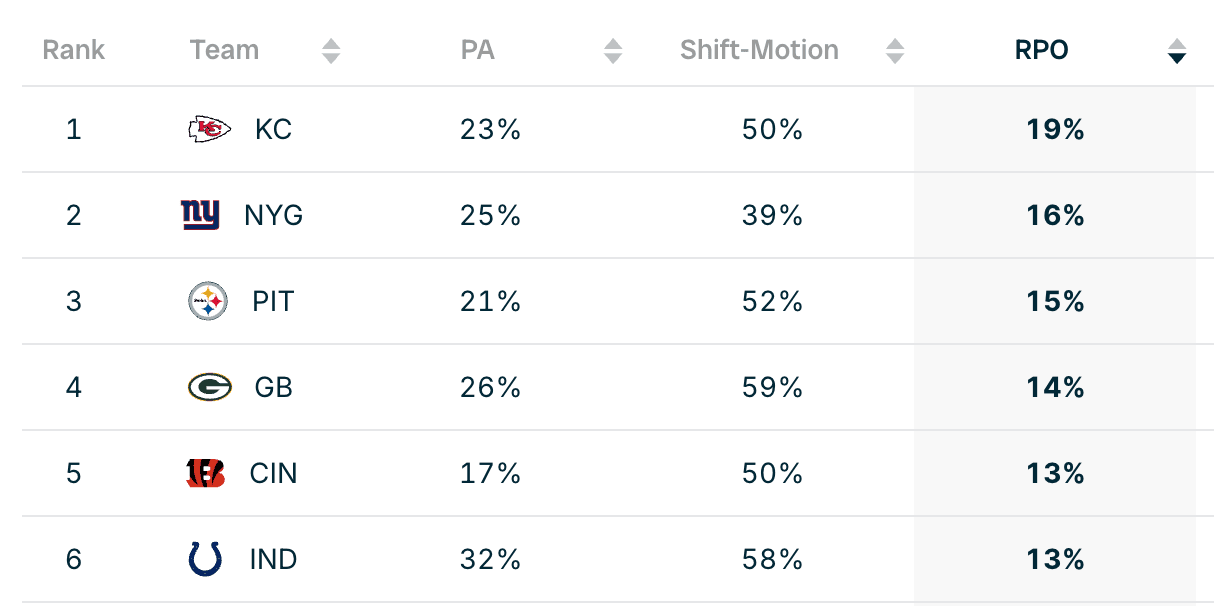
- Stat: Michael Pittman Jr. saw the third-most RPO targets in 2025 (14)
Why does this matter?
When teams pass out of RPO concepts, the play is really only designed for one player. In Indianapolis’ case, that player was Pittman, who was always the read on quick slant routes to avoid potential ineligible man downfield penalties.
With Pittman gone, this role could belong to Alec Pierce. Mainly a deep threat so far in his career, Pierce should be in line for more creative usage, especially now that the Colts are paying him as a top-12 wideout. Shane Steichen will continue to dial up RPO designs, as Indianapolis utilized the concepts 13% of the time last year (tied for fifth-most).
 Jacksonville Jaguars
- Stat: From Week 10 on, 35.4% of Brian Thomas Jr.’s targets came 20-plus yards downfield
What happened in Week 10? Jacksonville acquired Jakobi Meyers. And between his arrival and the emergence of Parker Washington, Thomas was relegated to more of a field-stretching role. Go routes and back shoulders on the boundary suddenly made up Thomas’ route diet, as he averaged just 5.2 targets and 8.9 PPR PPG during that stretch, while never seeing more than seven targets in a game.
 Kansas City Chiefs
- Stat: Kenneth Walker faced stacked boxes on 27.6% of his carries
Walker has been the Joey Gallo of running backs—he’s either hitting a home run or striking out. No in between.
A move to Kansas City should lead to fewer strikeouts.
Last year, Walker saw eight-plus defenders in the box on nearly 28% of his carries, per NFL Next Gen Stats. But playing alongside Patrick Mahomes in Kansas City, Isiah Pacheco saw stacked boxes just 14.4% of the time, the third-lowest rate among qualified running backs. The Chiefs’ run game is about to get a whole lot more explosive.
 Las Vegas Raiders
- Stat: Ashton Jeanty averaged 3.3 YPC on inside runs
Seemingly every Jeanty carry felt like a battle behind the Raiders’ putrid offensive line. Not only did he average just 3.3 YPC on inside runs, but his 27.6% success rate on such runs was comfortably the lowest among qualified rushers. Getting LT Kolton Miller back is huge, but the addition of Tyler Linderbaum will make a massive difference for Jeanty in Year 2.
 Los Angeles Chargers
- Stat: Justin Herbert was pressured on 43.3% of dropbacks
It was the highest rate in the league, as the loss of both starting tackles absolutely crippled the Chargers' offense. The return of Rashawn Slater and Joe Alt should help propel this offense to new heights in 2026.
 Los Angeles Rams
- Stat: The Rams utilized 13 personnel a league-leading 30.4% of the time
Once a three-wide-centric offense, the Rams have shifted to more of a heavy, power offense lately. Sean McVay changed the meta, leading the NFL in use of three tight end sets last season, which is great for the run game, but elite for whoever the lone wideout on the field is when the Rams do pass out of 13 personnel. And more often than not, that receiver is Puka Nacua.
 Miami Dolphins
- Stat: Malik Willis has a 6.7% checkdown rate over the last two seasons
The sample size obviously isn’t huge, but Willis is a drastically different quarterback than Tua Tagovailoa, who has a checkdown rate of 14.5% during that span. His play style and tendencies have helped De’Von Achane average 72.5 receptions and 86 targets over the last two years.
 Minnesota Vikings
- Stat: Justin Jefferson posted a 67.4% catchable target rate last year
Yikes.
That ranked 63rd among qualified wideouts, as the duo of J.J. McCarthy and Max Brosmer absolutely plummeted Jefferson’s fantasy ceiling. Jefferson ended the season averaging just 11.9 PPR PPG, while scoring just two touchdowns. Here’s hoping Kyler Murray can help Jefferson return to his rightful place among fantasy’s elite.
 New England Patriots
- Stat: TreVeyon Henderson played just 31% of the snaps during the postseason
Much to the dismay of the fantasy community, Rhamondre Stevenson played a lot last year. And he played well, ranking third in yards per touch (5.9), 10th in yards per route run (1.45) and first in rushing yards over expected per attempt (+1.4). Inconsistent pass protection limited Henderson’s playing time as a rookie, and in the most important games of the year, the Patriots leaned even more on Stevenson.
 New Orleans Saints
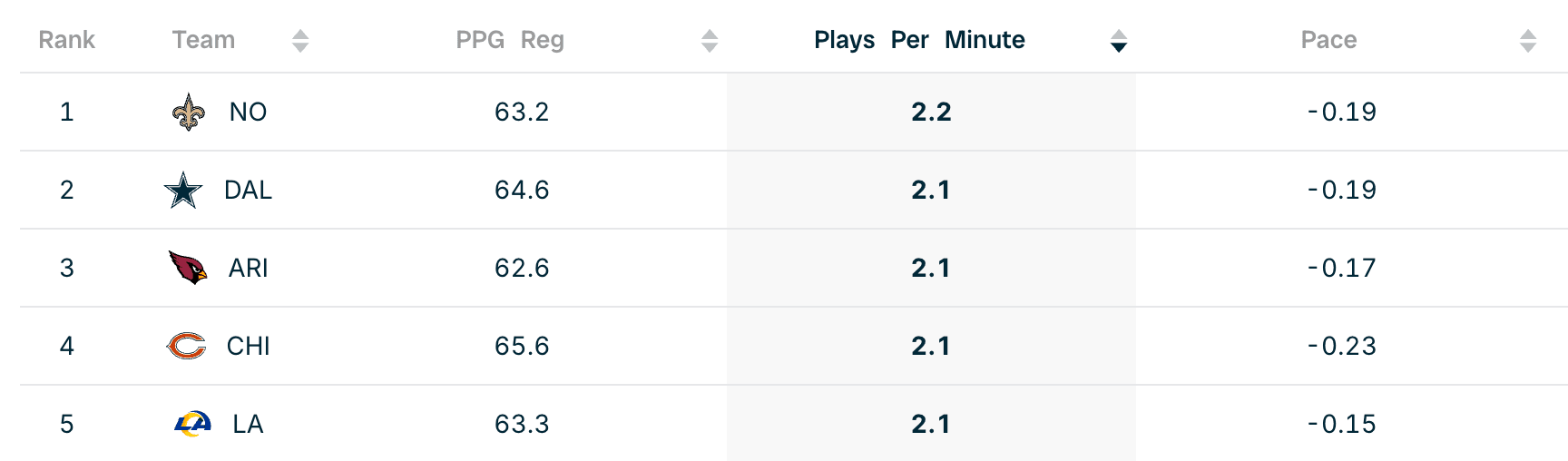
- Stat: The Saints ranked 2nd in no-huddle rate (22.7%)
Only the Commanders played faster last season, as we once again saw Kellen Moore lead a fantasy-friendly offense. The Saints also led the league in plays per minute (2.2), while their 63.2 regulation plays per game ranked ninth.
 New York Giants
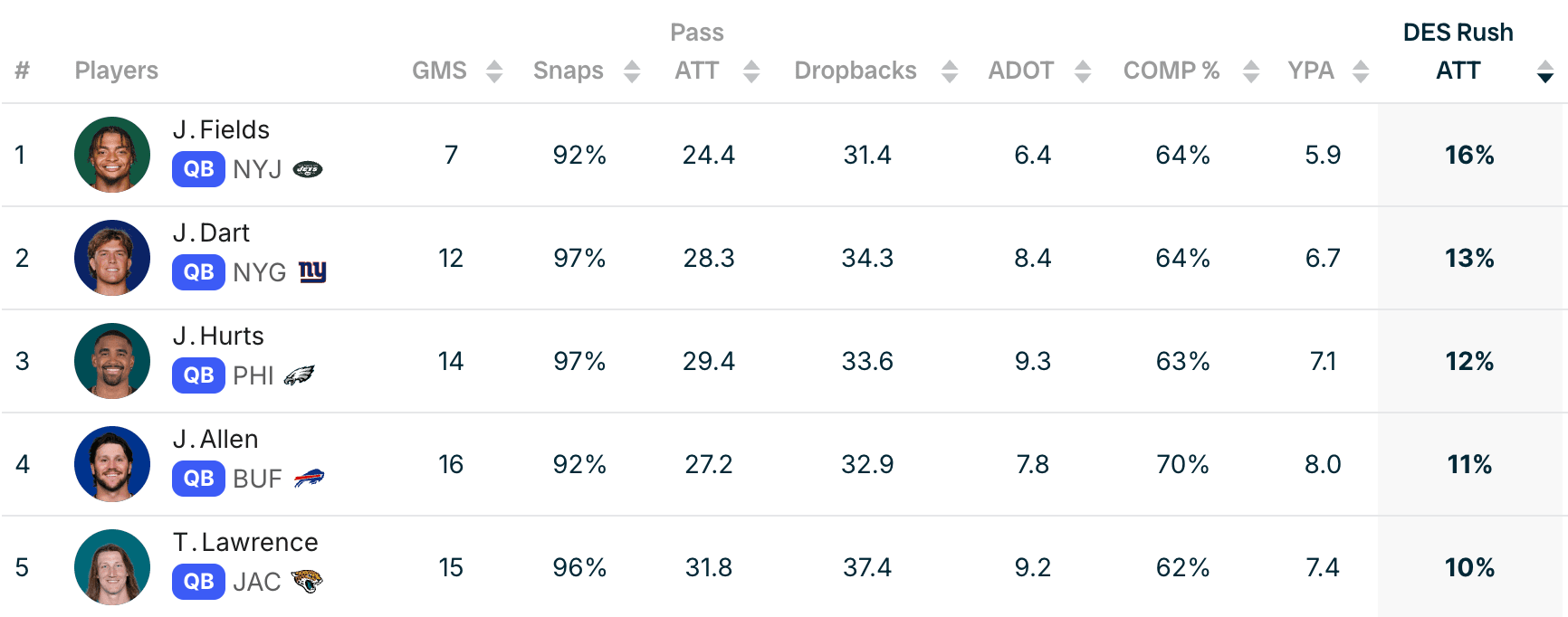
- Stat: Jaxson Dart handled 13% of the Giants designed rush attempts from Week 4 on
The Giants finally gave Dart the keys to the offense in Week 4, and once he took over, he flashed some serious fantasy upside. His 13% designed rush share was second among all signal callers, and during that span, Dart averaged 20.5 points per game (8th). And over the course of the season, Dart averaged the third-most fantasy points per dropback (0.66), proving how valuable rushing is for both floor and ceiling.
Just please start running out of bounds, Jaxson.
 New York Jets
- Stat: Garrett Wilson is averaging 9.1 targets per game since entering the NFL
That’s good for the ninth-most in football during that span. Volume has always been on Wilson’s side, averaging 156 targets over his first three seasons before playing just seven games in 2025. But playing in a putrid Jets offense, that immense volume has only translated to fantasy finishes of WR30, WR32 and WR18.
 Philadelphia Eagles
- Stat: The Eagles had the lowest dropback rate inside the 10-yard line (36%)
The tush push had a lot to do with that, and while the Eagles once again have a new offensive coordinator, it is unlikely that play goes anywhere unless the league has something to say about it. Between the low pass volume and Dallas Goedert accounting for 40.9% of the team’s targets from that area of the field, it’s no wonder why DeVonta Smith scored just four touchdowns in 2025.
 Pittsburgh Steelers
- Stat: Kenneth Gainwell logged 85% of the two-minute snaps last year
Gainwell was Pittsburgh’s best offensive player in 2025, which tells you just about all you need to know about the Steelers’ offense. His presence sapped the fantasy upside of Jaylen Warren, as Gainwell’s 85% two-minute snap share tied for seventh among running backs, while also handling 74% of long down and distances. Rico Dowdle will take plenty of carries away, but perhaps Gainwell’s departure could help Warren return to 2024 usage (78% LDD, 82% 2MIN).

 San Francisco 49ers
- Stat: Jake Tonges ran a route on 75% of dropbacks with George Kittle on IR
San Francisco was without Kittle from Weeks 2-6 last season, thrusting Tonges into a larger role. He filled in admirably, averaging 6.2 targets, 4.4 receptions, 41.8 receiving yards and 11 PPR PPG during that stretch. Tonges had a solid 16% target share and was the TE9 in fantasy in those games. With Kittle likely to miss some time to open the season, Tonges will be on the early streaming radar.
 Seattle Seahawks
- Stat: Zach Charbonnet handled 72% of Seattle’s inside the five rush attempts
Charbonnet’s vulture tendencies frustrated fantasy managers everywhere, as he scored 12 total touchdowns last year. But between Kenneth Walker’s departure and Charbonnet’s ACL recovery, there is some serious touchdown equity up for grabs for Emanuel Wilson, George Holani or whoever Seattle inevitably selects in the draft next month.
 Tampa Bay Buccaneers
- Stat: Bucky Irving had zero carries from inside the five-yard line in 2025
Zero.
His usage once returning from a foot sprain in Week 13 was not fantasy-friendly, as he logged just 13% of the long down and distance snaps after returning from injury, while 41% of the two-minute snaps went to Rachaad White. Meanwhile, Sean Tucker remained Tampa Bay’s goal-line option. The Bucs replaced White with Gainwell, who is essentially a better version, while Tucker could keep a short-yardage role.
 Tennessee Titans
- Stat: Cam Ward had multiple TDs in each of his final four games
Ward left Week 18 after just five snaps, so we won’t count that one. The rookie showed serious flashes during the second half of the season, despite having arguably the worst wide receiver room in the NFL to work with.
 Washington Commanders
- Stat: Terry McLaurin accounted for 38% of Washington’s air yards
Among wideouts with at least 50 targets, he ranked 13th in football. 2025 was a lost season for McLaurin and the Commanders, but we still saw glimpses of the deep ball connection between Jayden Daniels and his star receiver. With Washington’s wide receiver room looking quite barren, 2026 should be a serious bounce-back season for McLaurin.

Join Our Newsletter
Trusted by 400,000+ fantasy football players. Get access to Fantasy Life's free award winning newsletter and tools, all in one step.
By registering or logging in, you agree to our Terms of Use and Privacy Policy.
Players Mentioned in this Article
 MichaelWilsonWRARI
 IsiahPachecoRBDET
- PPG
- 0.0
 JacobyBrissettQBARI
- PPG
- 0.0
- Proj
- 15.4
 TreyMcBrideTEARI
Published Updated