Early Fantasy Football Bold Predictions for 2026: Omarion Hampton Top-5 RB?
Adam Pfeifer breaks down four early bold predictions for the 2026 fantasy football season.
Sure, we’re not even in April yet. But we’re always thinking about fantasy football.
Aren’t we?
I clearly am, anyway, because I’m already getting bold. That’s right. Here are some super early bold predictions for the 2026 fantasy football season.
RELATED: 2026 Fantasy Football Rankings
Fantasy Football Bold Predictions For 2026
 Bucky Irving Finishes Outside The Top-15 RBs
If you selected Irving in the second round of your fantasy draft last year, you more than likely had a bad time.
A foot sprain sidelined him from Weeks 5-12, but once Irving returned, his role wasn’t nearly as fantasy-friendly. Sure, he averaged a strong 18.8 touches per game from Week 13 on, but it didn’t translate to stellar fantasy production. Irving was dominating the carries in between the 20s, but wasn’t seeing the high-value touches we covet for fantasy.
He was suddenly a trap back.
From Weeks 13-18, Irving handled 65% of Tampa Bay’s rushing attempts (good), but averaged 11.1 PPR points per game (not so good). That ranked outside the top-25 running backs during that stretch. Per the Fantasy Life Utilization Report, Irving logged just 13% of the long-down-and-distance snaps after returning from injury, while 41% of the two-minute snaps went to Rachaad White. Irving averaged just 1.8 receptions and 14 receiving yards per game, but perhaps most importantly, he had the exact same number of carries from inside the five-yard line as I did last season. And for those who don’t know me, I, in fact, do not play in the NFL.
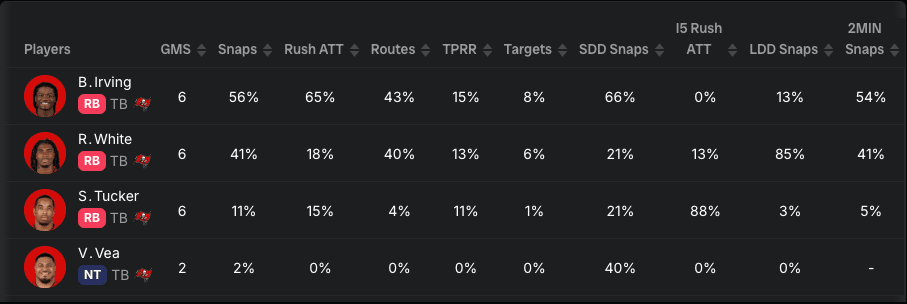
Sean Tucker became this team’s short-yardage option, accounting for 88% of the inside-the-five carries. If he opens the 2026 season in Tampa Bay, it is very possible that role remains his. But we already saw the Bucs replace White with Kenneth Gainwell, one of the league’s best pass-catching and pass-protecting running backs. Irving should still be the starting running back in Tampa Bay. But a lack of high-value touches could lead to some empty stat lines.
 Omarion Hampton Rebounds With A Top-Five Finish
After a slow start to his rookie season, it appeared Hampton was primed to emerge as a fantasy football star. Najee Harris’ Achilles tear led to Hampton becoming the Chargers’ every-down option. From Weeks 3-5, Hampton averaged 14.3 carries, 5.7 catches, 6.0 targets, 20 touches and 21.8 PPR points per game. Unfortunately, an ankle injury derailed his year, sidelining him until Week 13.
But entering his sophomore season, there is a lot to like.
For starters, the Los Angeles offensive line will return to full strength, which is monumental for Hampton. This past season, 24.2% of his carries were stuffed at or behind the line of scrimmage, the fourth-highest rate among qualified running backs. And as a team, 23% of the Chargers' total carries were stuffed at the line of scrimmage, ahead of only the Raiders. Getting both Joe Alt and Rashawn Slater back healthy will be a welcome sight for this entire offense.
Another welcome sight is the addition of Mike McDaniel as offensive coordinator. One of the best run game designers in football, McDaniel has gotten elite fantasy production from the likes of De’Von Achane (17.3 PPG as a rookie), Raheem Mostert (21 touchdowns and 17.9 PPG) in Miami, while the 49ers' run game was extremely efficient during McDaniel’s time as the run game coordinator/offensive coordinator from 2018-2021. And that was with the likes of Matt Breida, Jeff Wilson and Elijah Mitchell. Hampton is set to see more movement, motion, screens and schemed touches in this offense, all of which are conducive to fantasy success.
 Mark Andrews Leads The NFL in TD Receptions
I wrote about Andrews as a late-round ADP target of mine, and I’m doubling down. Predicting touchdowns is usually pretty foolish, but these are bold calls, after all. Andrews only scored five touchdowns last year, but double-digits have to be in play in 2026. The Ravens moved on from Isaiah Likely, potentially unlocking Andrews as more of a full-time player once again. In four games without Likely since 2024, Andrews has run 79.2% of the routes, while sporting a 15% target share and 15.2% TPRR. And perhaps more importantly, Andrews accounted for 27% of the Ravens’ end zone targets with Likely sidelined for the first three weeks of last season.
A healthy Lamar Jackson would also be ideal for Andrews and this Baltimore offense. And over the course of his career, Jackson has targeted tight ends on over 45% of his red zone pass attempts.
 Tyler Shough Finishes as a QB1
Shough took over the starting job in New Orleans in Week 9 and from that point on, the rookie was quietly a top-12 fantasy signal caller, averaging a solid 17.6 points per contest. His rushing production made an impact, as Shough averaged 2.0 designed rush attempts, 1.9 scrambles and nearly 20 rushing yards per game. As a rookie with only one good wide receiver, Shough was more than fantasy relevant. The Saints should add a running mate for Chris Olave during the NFL Draft, while Kellen Moore’s offense remains very fantasy-friendly. This past season, the Saints ran no huddle 22.7% of the time, trailing only the Commanders. They also averaged a league-leading 2.2 plays per minute. Rushing presence, upgraded weapons and play volume have Shough sitting pretty as a fantasy sleeper in 2026.

Join Our Newsletter
Trusted by 400,000+ fantasy football players. Get access to Fantasy Life's free award winning newsletter and tools, all in one step.
By registering or logging in, you agree to our Terms of Use and Privacy Policy.
Players Mentioned in this Article


Published Updated