

Michael Trigg Scouting Report and Rookie Super Model Prospect Profile
Dwain McFarland breaks down the Rookie Super Model's read on Baylor TE Michael Trigg.
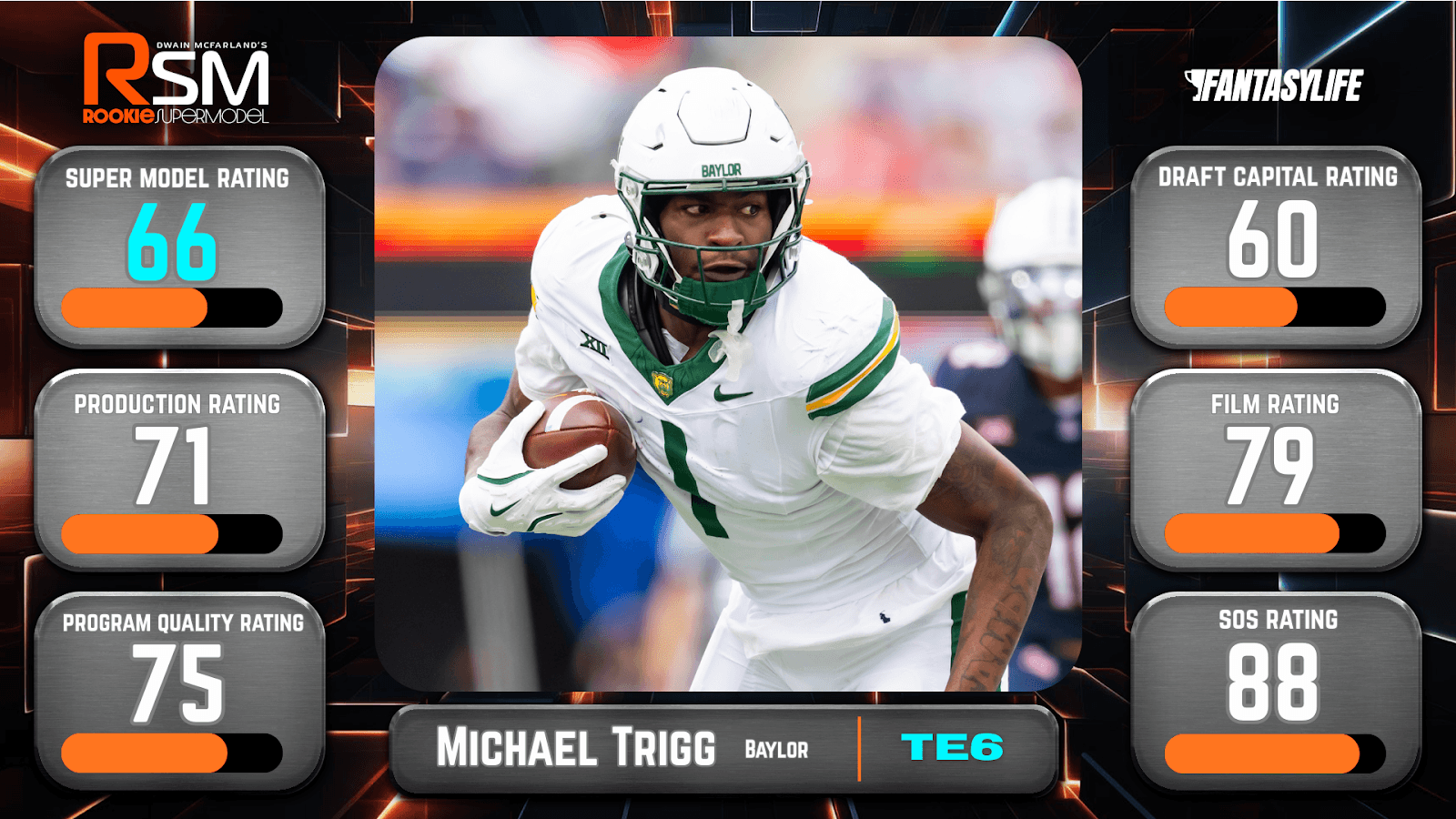
Michael Trigg, the fifth-year TE out of Baylor, checks in as the TE6 in the 2026 Tight End Rookie Super Model. For the full TE class, check out the 2026 TE Rookie Super Model.
If you're new to the model, here is an introductory breakdown of the Rookie Super Model, which rates players on a scale of 50 to 100 based on a composite score across Draft Capital, Production and Film. All of this data is integrated into our free NFL Draft Guide, full of big board rankings, mock drafts and more.
You can find a glossary of terms and stats used in this breakdown at the bottom of the prospect profile.
Scouting Report and Rookie Super Model Prospect Profile For Michael Trigg
- Super Model Rating: 66 (55th since 2018)
- Draft Pick (based on Mock Draft data): 105
- Rookie Age: 24.2
- Height: 76 inches
- Weight: 240 pounds
Trigg was a highly touted recruit, a consensus four-star prospect ranked as a top-four TE by every service. The Tampa, Florida, product was also on the Division I radar as a basketball recruit. He received dual-sport offers from multiple major programs.
He played his first season at USC, where a knee injury limited his role. In Year 2, he transferred to Ole Miss to play with Jaxson Dart, but suffered a broken collarbone, missing six games. Trigg was healthy in Year 3 for the Rebels, but was dismissed from the program.
The big-bodied tight end played Years 4 and 5 for Baylor, where he was the starting TE and one of the top three targets on the team each year. He dealt with an early-season shoulder injury and missed the last game of his Year 5 campaign.
What the Production Says
Trigg's injury and disciplinary issues limit us to 16 total games to work with over his first three seasons, and he didn't register significant age-adjusted numbers until Years 4 and 5, which hurts his RYPTPA. He was, however, a plus player when targeted.
- Adjusted Career RYPTPA: 37th percentile
- Targeted QB Passer Rating: 99.4, 60th percentile
Adjusted Career RYPTPA: Career receiving yards per team pass attempt adjusted for age, strength of schedule, QB play, teammate competition, aDOT and alignment. Doesn't count games missed.
Even in his final seasons, he never reached elite RYPTPA numbers, but they were solid, and he improved almost every year: 0.42 → 0.76 → 0.75 → 1.26 → 1.49. In that final season, he averaged a career-high 63 YPG and notched six TDs for the Bears.
With players like Trigg, who faced early playing-time limitations, it can be helpful to review their career route data to see whether it aligns with their RYPTPA. While these inputs aren't part of the model (they overlap with RYPTPA), they provide context for later years that the model weights less.
There is a potential storyline here. On a per-route basis, Trigg rates far better than his 37th percentile RYPTPA:
- Career YPRR: 1.87 (62nd percentile)
- Career FDPRR: 9% (57th percentile)
- Career TPRR: 24% (68th percentile)
Trigg was a monster against man coverage, posting the fifth-best TPRR (31%) in the model. His TPRR against zone was 21%.
Beyond the Production
The three-program prospect is not your garden-variety target-depth profile. This is a player who can inflict downfield damage, with 52% of his targets coming 10-plus yards beyond the line of scrimmage. His career aDOT of 10.5 yards falls at the 54th percentile.
- Behind the line of scrimmage: 7% (-4 vs avg)
- Short (0-9 yds): 41% (-9 vs avg)
- Medium (10-19 yds): 37% (+10 vs avg)
- Deep (20+ yds): 15% (+3 vs avg)
While Trigg can attack deep, he wasn't prolific after the catch and battled drops. His 4.9 YAC was -0.3 over expected after adjusting for aDOT. His 45% contested catch rate on 42 opportunities was slightly below average (48%) for his aDOT, and his 7.3% drop rate was +1.3 percentage points over expected.
Trigg didn't play in-line often (27%), and his PFF Run Blocking grade of 53.7 (30th percentile) raises concerns about his ability to earn a full-time role at the NFL level.
Lance Zierlein of NFL.com is higher on Trigg than his Production Rating of 71. Zierlein's 6.31 prospect grade (58th percentile) ranks second-highest in the class. The film and data align on his vertical ability, domination vs. man coverage, and limitations as an in-line blocker. But Zierlein calls out "fluid transitions to run after the catch" and his ability to "ricochet off contact to keep run-after-catch going" as positives, which might mean more YAC upside than what our data profile suggests.
Fantasy Football Outlook For TE Michael Trigg
Since 2018, 51 TEs have posted a Super Model rating between 61 and 71, with 10% delivering a top-12 finish by Year 3.
- Top-six finishes: 2%
- Top-nine finishes: 6%
- Top-12 finishes: 10%
Trigg's closest Super Model comps:
- Charlie Kolar
- Hunter Bryant
Bottom line: Trigg profiles as a Day 3 NFL Draft pick in the Rookie Super Model. He was a slow starter with injuries and conduct derailing his first three years, but was solid over his final two seasons at Baylor. The model is docking him for that, but his Film Rating and his underlying per-route data provide some optimism. For NFL teams looking for a vertical TE threat or a big-bodied man-coverage-beater, Trigg fits the bill. He must grow as a blocker and clean up the drops to unlock a full-time role. Trigg is a borderline TE2 with a glimmer of TE1 hope in fantasy football.
Glossary of Terms In The Prospect Profile
- Adjusted Career RYPTPA: Career receiving yards per team pass attempt adjusted for age, strength of schedule, QB play, teammate competition, aDOT, and alignment. Doesn't count games missed.
- aDOT: Average depth of target in yards.
- Career Targeted QB Passer Rating: Passer rating on WR's targets.
- Contested catch rate: Percentage of contested targets caught.
- Contested catch rate over expected: Percentage of contested targets caught after adjusting for aDOT.
- Draft Capital Rating: Based on Chase Stuart's Draft Value Chart, an improved version of what many know as the Jimmy Johnson trade chart. It accounts for the larger drop-off in the first round and a flatter drop-off around the end of the second round.
- FDPRR: First downs per route run. Often shown as a percentage (first downs divided by routes).
- Film Rating: Based on NFL.com prospect grades from Lance Zierlein.
- Production Rating: A combination of adjusted career RYPTPA and career targeted QB passer rating.
- Program Quality Rating: ESPN's College Football Power Index is used to assess program quality. The model accounts for each school a prospect attended.
- RYPTPA: receiving yards per team pass attempt.
- SOS Rating: Based on strength of schedule (SOS) from Sports Reference. The model accounts for each school the prospect attended.
- Target Share: A player's percentage of team targets in games played.
- TPRR: Targets per route run.
- YAC: Average yards after the catch.
- YAC over expected: YAC over expected after adjusting for aDOT.
- YPG: Yards per game.
- YPRR: Yards per route run.

Join Our Newsletter
Trusted by 400,000+ fantasy football players. Get access to Fantasy Life's free award winning newsletter and tools, all in one step.
By registering or logging in, you agree to our Terms of Use and Privacy Policy.
Players Mentioned in this Article



Published Updated