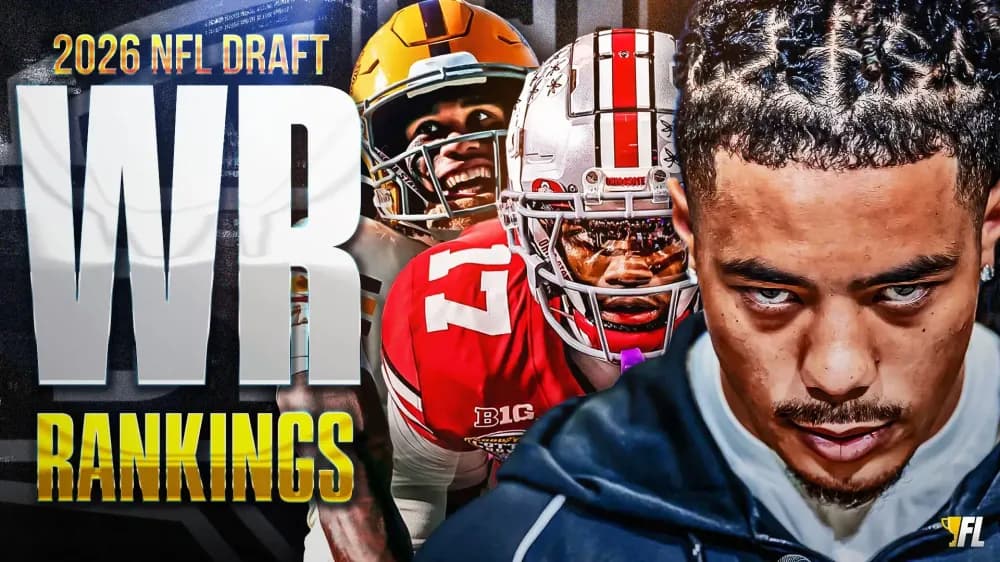
2026 NFL Draft Wide Receiver Rankings: Jordyn Tyson Rises To The Top
Matthew Freedman breaks down his rookie WR rankings ahead of the 2026 NFL Draft.
The draft is a mere six weeks away and NFL free agency is (basically) here. This could shake up which teams plan to target wide receivers come draft day, so I figured it was an appropriate time to update my 2026 NFL Draft wide receiver rankings.
I'm not one to brag, but …
For the 2025 draft, I was No. 1 in big board accuracy and No. 3 in mock accuracy. Since 2020, I'm the No. 1 mocker in the known universe.
For all of our draft coverage, check out our Fantasy Life NFL Draft Hub.
Wide Receiver Rankings For The 2026 NFL Draft
1. Jordyn Tyson | Arizona State | 6-2, 203 lbs. | rJR
Tyson is a three-level alpha who has been his college team's No. 1 WR since his first year on campus. Despite missing three games with a season-ending knee injury, Tyson led a 1-11 pre-Coach Prime 2022 Colorado team with 22-470-4 receiving as an 18-year-old true freshman. The arrival of HC Deion Sanders pushed Tyson to transfer to Arizona State, where he rehabbed and redshirted most of 2023 before breaking out in 2024 with 75-1,101-10 receiving in 12 games.
Tyson opened 2025 in impressive fashion with 57-628-8 receiving and 2-4-1 rushing in the first seven games before hamstring injuries sabotaged the rest of his campaign and limited him to two additional, forgettable games (4-83-0 receiving) … and therein lies Tyson's main drawback: When healthy, he's productive, but he has a notable medical history. His freshman season ended in injury, which sidelined him for most of the following year. His redshirt sophomore campaign ended early because of a broken collarbone, and then the second half of his final season was wiped out by soft-tissue issues.
On the one hand, football's a violent sport, and Tyson's injury history might be the result of random bad luck. On the other hand, there's a real chance Tyson's a dreaded injury-prone player. When he goes through the evaluation process, the medical checkups will be crucial.
But on the field, Tyson looks like the No. 1 WR in the class. He already plays like a pro: He understands space, attacks leverage, varies tempo and snaps routes off with precision to create clean separation against man. He can credibly win as a split end, flanker or slot. He can steadily accumulate production on digs, comebacks and outs and then break loose for explosive gains on posts and fades when DBs jump his intermediate breaks. Even when the defense knows the ball is going his way in high-leverage situations, Tyson can get open with his short-area suddenness and lateral agility.
His catch-point work is borderline cruel. With late hands, outstanding timing and real hangtime, Tyson routinely elevates, twists and plucks through contact to finish downfield “combat catches” while displaying good body control and a plus catch radius. After the catch, he runs with an edge, fights through tackles and plays to the whistle. Although he's a technician, he's not a mere finesse player.
And yet Tyson's also not a bruiser: He's a playmaker. In his freshman year at Colorado, he completed his one pass attempt for 37 yards and turned his four punt returns into 131 yards and a TD. As a football player, he has big-play DNA.
Tyson isn't a burner. He plays with good speed and on-field burst, but he's not a “make the defense change to a coverage shell” athlete, so in the NFL he'll need to win more with craft, toughness and timing than pure foot-race dominance. Even so, he should win isolated matchups with CBs more often than he loses.
Given his production and tape, Tyson profiles as a high-end NFL-ready WR with the potential to be an elite professional. He looks like a first-round lock and could go in the top 10 if he tests reasonably well and his medicals check out.
2. Carnell Tate | Ohio State | 6-2, 192 lbs. | JR
Tate, in some ways, is "just another Buckeye WR": He's a big, young athlete who earned 4-5 stars as a recruit from the major scouting services and then flashed enough at Ohio State to suggest he'll be a capable NFL player at worst. At the same time, he's more than just the name of the college on his jersey: A long, savvy separator, Tate is a classic X receiver with a polished, efficient game and the ability both to move the chains and explode for big gains in a pro-style pass attack.
With his size, Tate has the kind of wiry, above‑the‑rim frame that immediately expands a QBs strike zone, and he possesses the length and body control to win even when he’s not cleanly separated, which isn't often, because his main asset is his craftsmanship and savviness as a route runner. More smooth than twitchy, Tate consistently creates space with pacing, tempo and leverage. With his stems, he sells vertical routes, gets CBs to turn their hips and then makes sharp cuts for easy-completion curls, comebacks and deep digs.
Against off and zone, he shows a veteran feel for sitting in windows and working back to the ball. Against press, he uses his length and timing to clear contact and restack CBs. With the ability to line up across the formation, Tate is difficult to cover in isolation for perimeter and slot CBs alike because of his size and route IQ.
And his ball skills complete the profile. Tate is the kind of “if it’s in the zip code, it’s in play” receiver who extends fully away from his frame, tracks the ball late and over his shoulder, and finishes through contact. As a leaper, he climbs the ladder on fades and posts and has the body control to make tough mid-air adjustments and win contested back‑shoulder and high-point throws. As a blocker, Tate's functionally competitive.
But he isn't perfect. There's no shame in playing behind Marvin Harrison, Emeka Egbuka and Jeremiah Smith … but Tate has never been the No. 1 WR in his offense. A depth player as a freshman (18-264-1), he started 15 games as the No. 3 WR for the championship-winning Buckeyes as a sophomore (52-733-4 receiving) and then he ascended to the No. 2 role last year (51-875-9 receiving in 11 games). While those numbers are acceptable, it must be noted that Tate is the least productive of the first-round pass-catching candidates (Garrett Wilson, Chris Olave, Jaxon Smith-Njigba, Harrison, Egbuka) to emerge from HC Ryan Day's program.
And physically, Tate is more of a glider than a rocket. His long-striding speed is probably sufficient but definitely unexceptional (4.53-second 40-yard dash, 1.61-second 10-yard split), and his breaks can be choppy. After the catch, he’s more “efficient finisher” than "tackle eraser" and "joystick operator," which could limit his manufactured-touch upside. And Tate should be able to add more functional muscle in the NFL, but right now, he's almost too lean and can be pushed off his spot by physical press defenders.
But those are nitpicks. Tate has a strong combination of size, polish, ball skills and production in an NFL-style system. He profiles as a first-rounder and could be the No. 1 WR off the board.
3. Makai Lemon | USC | 5-11, 192 lbs. | JR
Lemon is a high-volume slot man who moves like an RB once he has the ball. Despite entering USC with 4-5 recruitment stars, he served as a reserve pass catcher (6-88-0 receiving) and occasional special teamer (5-94-0 kick returning) as a freshman, but then topped the depth charts at WR (52-764-3) and kick returner (19-514-0) as a sophomore and broke out as a junior (79-1,156-11). Each year of college, he has added to the well-roundedness of his game. As a sophomore, he completed his lone pass attempt for 39 yards. As a junior, he once again contributed as a passer (24-yard TD) and also added endzone production as a runner (9-4-2) and punt returner (6-71-0) while still chipping in as a kick returner (8-144-0). With his all-around ability, Lemon truly turned himself into the centerpiece of HC Lincoln Riley's offense in his final season, winning the 2025 Biletnikoff Award.
With his compact size, Lemon is a springy mover with loose hips and real short‑area juice. In the slot, he specializes in leverage: He sets the nickel up with option routes, choice concepts, whips and crossers, and then he breaks in the opposite direction to give his QB a quick and clean window. As a route runner, he varies tempo through the stem, layers in head fakes and rocker steps and makes breaks with such suddenness that man defenders struggle to sit on any one move.
And after the catch, Lemon's a true problem for defenses. As a YAC producer, he sports contact balance and competitive toughness that belie his frame. He routinely bounces off arm tackles, sets up blocks in space and jump cuts away from pursuit. With his lateral agility, he has the ability to turn modest underneath targets into breathtaking, explosive plays. Even with defenses tilting coverage toward him on key downs, the USC offense regularly fed Lemon via the screen and quick game and jet motion.
What Lemon offers will not be what all play callers want. He's not a prototypical X receiver. His smaller size and wingspan will likely prohibit him from the perimeter, where he's unlikely to win consistently on contested balls. Longer NFL DBs will be able to squeeze him at the catch point without pristine ball location. His long speed is good but not great, so he wins vertically (seams, deep overs, double moves) mainly on craft and scheme. As a slot-centric player, he could struggle with a coordinator who doesn't work to keep him clean with motion, bunch, stacks and option routes.
Despite these caveats, Lemon looks like a first-round lock. In the NFL, he should be an immediate contributor if not starter.
4. Denzel Boston | Washington | 6-4, 212 lbs. | rJR
Boston is a textbook boundary X receiver with playmaking skills. He opened his Huskies career as a depth option behind 1,000-yard WRs Rome Odunze, Jalen McMillan and Ja'Lynn Polk (7-66-0 receiving, 1-2-1 rushing in two seasons), but after their mass exodus to the NFL, he ascended to the No. 1 perimeter role as a redshirt sophomore (63-834-9, 12 games) and then was the No. 1 WR overall in his final season (62-881-11, 12 games). Throughout his career, he has also been a serviceable punt returner (25-212-1), and he added a 12-yard TD pass this past year.
With his prototypical size, Boston has a tape-popping high‑cut frame, and he uses his length to play above the rim and tilt 50‑50 balls in his favor. His body control is notable, and his tracking is strong: He finds the ball early, extends his hands late and makes clean catches. On fades, back shoulders and red‑zone crossers, he gives QBs a big strike zone and boxes out DBs like a power forward.
For a tall wideout, he’s also fluid. Boston sinks his hips, sells double moves and runs routes with intent, forcing CBs into conflict when left on an island. He’s not a twitch trafficker, but once he gets into his stem he can separate on curls, outs and digs. When in the slot, he becomes a mismatch bully on undersized nickels. And he also does the necessary dirty work in the run game as a perimeter blocker who seals CBs and cracks LBs.
As an athlete, he has average juice. He lacks explosion off the line and is a build-up runner, not a sprinter. He can cruise if untouched, but he won’t instantly erase cushions, and physical press CBs can stall him early. If he's to beat NFL bump-and-run coverage consistently, he'll need to develop a more varied release package. After the catch, he’s more functional than frightening: He's strong enough to fall forward, but he's not dynamic enough to break multiple tackles.
Boston seems likely to secure first-round draft capital. And even if he doesn't, Boston will get a shot to start immediately in the NFL.
5. Kevin "KC" Concepcion | Texas A&M | 6-0, 196 lbs. | JR
Concepcion is a rollicking motion piece and space creator who leveraged early-career success and a shrewd portal move into centerpiece usage with the Aggies. As a true freshman, he broke out as the featured playmaker at NC State (71-839-10 receiving, 41-320-0 rushing, 17-yard TD passing, 13 games). His sophomore season was less impressive (53-460-5 receiving, 19-36-2 rushing, 28 yards passing, 12 games), but after Concepcion jumped to Texas A&M as a four-star transfer, he reemerged as the team's top all-around producer this past season (61-919-9 receiving, 10-75-1 rushing, 25-456-2 punt returning, 13 games).
While he doesn't wow with his size, Concepcion is compact and elastic with above‑average long speed, real first‑step pop and outstanding short‑area agility, which make him an ideal fit as a motion slot in modern offenses. His strength is separation: Concepcion owns an advanced release and route package that uses stutters, tempo changes and lateral footfire to win early against man corners and to manipulate zone defenders.
For the Wolfpack and Aggies alike, Concepcion was the “gotta have it” guy on choice routes, options and RPO slants. After the catch, he looks like a return man: He shifts into second gear suddenly, snaps off one‑cut moves and stacks angles. And his steady usage as a runner speaks to his unquestioned ability with the ball in his hands.
But his size will be an issue for some evaluators. He lacks ideal play strength, which enables longer press corners to re-route him. Additionally, some teams will see him as a slot‑only player, and his tape bears evidence of concentration drops and insufficient blocks.
Concepcion could go in Round 1 if his testing confirms the juice seen on film, but his limitations might destine him for Day 2.
6. Omar Cooper | Indiana | 6-0, 199 lbs. | rJR
Cooper is a rocked‑up space tycoon who runs like a slot but bodies people like a splash-play Z. While he did little in his first two seasons (18-266-2 receiving, 4-63-0 kick returning), he flashed as a big-play producer for the Hoosiers as a redshirt sophomore (28-594-7 receiving, 2-23-1 rushing, 13 games), and then this past season he functioned as a co-No. 1 WR alongside Elijah Sarratt (69-937-13 receiving, 3-74-1 rushing, 16 games).
Cooper wins with tempo and explosion. He has fast-and-loose releases, real vertical burst and enough route craft to beat CBs at all three levels. After the catch, he displays RB-like contact balance and vision and the kind of power that encourages DBs to make business decisions.
As an athlete, Cooper is good (not great), and some of his production is schemed (not earned), but whether he goes on Day 1 or Day 2, he could have a decade-long career as a low-end No. 1 WR or solid scheme-independent No. 2 WR.

Unlock Our Tools!
Stop hitting the paywall. FL+ gives you access to our premium in-depth content, expert rankings & projections, mock draft simulator, and all the tools you need – all personalized to your league.
7. Chris Bell | Louisville | 6-2, 221 lbs. | SR
Bell is a rocked‑up YAC bully who has steadily developed across his four-year career. A deep reserve as a freshman (7-105-0 receiving), Bell served as the No. 2 WR for the Cardinals over the next two years (72-1,144-6, 27 games) and then broke out as the No. 1 WR in his senior season (72-917-6, 11 games).
With a frame that jumps off the screen, Bell is built closer to a power back than a string‑bean boundary X, and his undeniably dense lower body translates to true play strength. But he's not just big: He's also fast. A high-school sprinter (22.5-second 200-meter dash), Bell plays with legit burst. He's not a possession lumberer. He's a big-and-fast juice squeezer.
Where he really stands out is after the catch. Bell is a YAC runner who welcomes contact: He pinballs through arm tackles, lowers his pads into would‑be thuds and turns routine in‑breakers into chunk gains. Once he secures the ball, he hits second gear quickly, erases pursuit angles and shows RB spatial awareness as he motors down the field. With his post-catch ability, Bell enables play callers to lean into slants, glance routes, RPOs, screens and crossers, since they know he will do damage after the ball arrives.
As a route runner, Bell is best with his between‑the‑hashes work on slants, digs and crossers, where he can find soft spots, decelerate on time and offer the QB a safety blanket against single‑high and pressure looks. As a pass catcher, he plays big: He initiates contact, tracks the ball cleanly and adjusts to imperfect throws with impressive body control.
The main questions with Bell have to do with economy of movement. He's not stiff, but he's also not loose. His straight-line explosiveness is more notable than his lateral agility. His top-of-route fluidity is more molasses than syrup, and his 90‑degree cuts can look labored. Against top man CBs, he wins more with frame and leverage than separation and quickness, and he’s not yet a full three‑level technician on the perimeter. Plus, he has just one season of strong production as a late-career breakout … and he suffered a season-ending ACL tear in November, which could put his rookie year in jeopardy.
Bell has Round 1 talent and athleticism, but his knee injury will likely push him into Day 2.
8. Zachariah Branch | Georgia | 5-9, 177 lbs. | JR
The No. 1 WR in the 2023 recruitment class, Branch enrolled at USC as a unanimous five-star recruit with a world of hype. A sprinter like his great uncle and NFL Hall of Famer Cliff Branch, he won the Jet Award as a freshman as the nation's best returner (16-332-1 on punts, 24-442-1 on kicks), and he chipped in as a runner (9-70-1), but he did little as the No. 3 WR for the Trojans (31-320-2, 11 games). After a sophomore season in which he failed to progress beyond the No. 2 WR role (47-503-1, 12 games), Branch transferred to Georgia, where he immediately served as the No. 1 WR (81-811-6, 14 games) for the Bulldogs.
A jitterbug slot and return elitist, Branch is a certified fireworks technician. His blazing speed is legit: The summer before his freshman year, he scorched 26 mph on a treadmill, and at the combine he demonstrated his ability on the fast track (4.35-second 40-yard dash, 1.50-second 10-yard dash). With his twitch, burst and vision, he detonates out of breaks, explodes with violent start-stops and annihilates angles with his cuts. Once the ball is in his hands, he looks more like a back or returner than receiver. Bubbles, jets and orbit screens are his bag of explosives.
Branch has steady hands, body control and alignment versatility, and he plays bigger than his size … but he's still small, so many NFL evaluators will likely see him as a slot/return contributor, not an offensive centerpiece. Plus, he has never had a season of truly dominant production.
With Branch setting the Indianapolis turf on fire, he could sneak into Round 1. If not, he should go on Day 2.
9. Chris Brazzell II | Tennessee | 6-4, 198 lbs. | rJR
Brazzell, the son of former NFL & CFL player of the same name, is a stringbean Brobdingnagian boundary wideout who redshirted at Tulane (1-11-0 receiving) and then flashed as the No. 1 WR for the Green Wave in his first year of extended action (44-711-5, 13 games) before entering the portal as a four-star transfer and enrolling at Tennessee. There, he toiled as the No. 4 WR for the Vols as a redshirt sophomore (29-333-2, 13 games) and then broke out as the No. 1 WR this past season (62-1,017-9, 12 games).
Despite his production in HC Josh Heupel's stat-inflating offense, Brazzell is more of a traits-based project than a finished product. With long arms and smooth, gliding strides, he drives off the line, eats cushion and stacks CBs on verticals, posts and deep overs. With his size and catch radius, Brazzell is best working outside the numbers and against zone, where his downfield presence creates space underneath for teammates.
But he exhibits questionable hands and struggles in tight man coverage and true 50/50 situations, which is problematic for a dude who looks like a jump-ball operator. And as a route runner, Brazell displays average change of direction and below‑average body control and spatial awareness. After the catch, he's more of a linear build‑up athlete than agile tackle breaker.
Still, Brazzell flashed low-grade Randy Moss speed at the combine (4.37-second 40-yard dash), which means he could sneak into the back half of Round 1. If he doesn't, Day 2 is assured. Either way, he'll likely be a boom/bust role player in the NFL, not a true perimeter alpha.
10. Germie Bernard | Alabama | 6-1, 206 lbs. | SR
Bernard is a rocked‑up, shape‑shifting offensive weapon who quietly became the centerpiece of the Crimson Tide offense last year. A four-star recruit, he committed to Washington, flipped to Michigan State, and then—after one uneventful season as a reserve receiver (7-128-2) and kick returner (6-119-0)—transferred to Washington, where as a sophomore he backed up Rome Odunze, Jalen McMillan and Ja'Lynn Polk as the No. 4 WR (34-419-2) and pitched in as a gadget player (13-43-2 rushing, 14 yards passing) and returner (10-233-0 kick returning, 3-43-0 punt returning) on the way to the national championship game.
Shortly after Huskies HC Kalen DeBoer joined the Tide, Bernard opted to follow him to Alabama, where he had a solid campaign as a junior (50-794-2 receiving, 4-37-1 rushing, 13 games) and then put his best plays on tape as a senior (64-862-7 receiving, 18-101-2 rushing, 15 yards passing, 14 games).
With his size and build, Bernard offers great alignment versatility as a boundary wideout, featured slot and auxiliary tailback. He explodes out of motion into space, accelerates quickly to top speed and carries real pop on contact. At Alabama, the offense regularly gave him the ball on jets, orbits, RPO glance routes, and crossers between the hashes, where his balance and leg drive turned glancing blows into plus yards.
Bernard is a route-running craftsman. He understands leverage, varies tempo and exhibits a veteran feel for finding voids on digs, sits and crossers. He's also a steady hands catcher: He plucks the ball outside his frame, finishes through contact, and flashes back‑shoulder and slot‑fade acumen in tighter red‑zone windows.
His flaws are athletic. Bernard lacks elite straight‑line juice and pure twitch. He doesn’t have defense-stretching speed or ankle-breaking separation, which will cause some evaluators to view him as only a big slot or movable utilitarian receiver. Even so, Bernard is likely good enough as an athlete (4.48-second 40-yard dash, 6.71-second three-cone). He's definitely not physically deficient.
Bernard's multidimensional positionality, YAC ability, and return-game functionality should appeal to enough HCs and GMs to draw Day 2 draft capital.
11. Skyler Bell | UConn | 6-0, 192 lbs. | rSR
After a redshirt season (1-15-0 receiving), Bell served as the No. 2 WR at Wisconsin for two years (68-740-6, 13-160-0 rushing, 25 games) and then transferred to Connecticut, where he immediately stepped up as the No. 1 WR in 2024 (50-860-5) and finished as a Biletnikoff Finalist in 2025 (101-1,278-13, 13 games).
A chains-moving craftsman, Bell wins with pacing, leverage and short‑area twitch more than size and deep‑speed juice, but he was markedly faster (4.40-second 40-yard dash, 1.53-second 10-yard split) and explosive (41-inch vertical jump, 11-1 broad jump) than expected at the combine. He might have hidden upside in the league, but even if he doesn't, his polished professionalism gives him a shot to go on Day 2 and stick as a plug‑and‑play slot/Z contributor.
12. Elijah Sarratt | Indiana | 6-3, 210 lbs. | SR
Sarratt is an old‑man‑at‑the‑rec center spirit in a Big Ten WR body: In the best of ways, a chain mover. A zero-star recruit, Sarratt earned first-team all-NEC recognition as a red-zone dominant freshman in the FCS at Saint Francis (42-700-13 receiving, 7-47-0 rushing, 5-84-0 kick returning, 12 games) and then leveled up as a sophomore to James Madison, where he had similar success as the No. 1 WR (82-1,191-8, 1-1-1 rushing, 13 games). As a junior, he followed HC Curt Cignetti to Indiana and served as the No. 1 WR for the Hoosiers for his final two seasons (118-1,787-23, 27 games).
Sarratt's positives are size, feel and reliability. He lives on digs, outs, crossers and back shoulders. He finds soft spots, boxes out and vacuums anything in range. He comes through in crunch time. He'll probably place last in a track meet, but he's a professional route runner and contested‑catch winner with three‑level production and a long tape-based history of helping QBs.
He didn't test at the combine, but if he posts reasonable numbers at his pro day, he could go in Round 2. If not, Round 4 feels like his floor.
13. Malachi Fields | Notre Dame | 6-5, 218 lbs. | rSR
A high school QB, Fields did little for his first two seasons as he converted to receiver (16-230-1), but in his sophomore and junior campaigns he produced as the top perimeter receiver for the Cavaliers (113-1,619-10, 24 games) before entering the portal as a four-star transfer and finishing his college career at Notre Dame this past year (36-630-5, 12 games).
A classic boundary bully, Fields overwhelms CBs with a massive catch radius, which enables him to win more than his fair share of contested targets. His game is built more on technique and effort than athleticism (4.61-yard 40-yard dash), but play callers who value ball skills and grown-man physicality might see him as a Day 2 asset.
14. Ja’Kobi Lane | USC | 6-4, 200 lbs. | JR
Lane is a skyscraping boundary X who has quietly evolved from buzzy red‑zone specialist to respected downfield player. As a deep reserve, Lane flashed TD bonafides in his freshman season (7-93-2 receiving), and then he exploded with endzone effulgence as a sophomore (43-525-12). His junior year saw a marked decline in scoring, but it also witnessed all-around development of his game as he earned a larger role in the Trojans offense (49-745-4).
Lane checks the boxes as a classic X. He's tall with long arms, a big catch radius and enough build‑up speed to stress corners vertically once he gets going. His strength is his ability to win in the air in high-leverage situations: He has focused body control, muscular high‑point dexterity, vigorous concentration through contact and vicelike grip strength to pluck the ball and maintain possession in tight quarters and high-leverage situations. In the red zone, he plays like a power forward, boxing out smaller DBs and treating fades and back-shoulder throws like alley-oops.
For his size, Lane is a smooth route runner. He accelerates quickly when untouched, uses long strides to eat cushion and maneuvers with mid‑route physicality to work across CBs on posts, digs and deep outs. In getting off the line, he has resilience and livable hand-fighting technique.
But like many X archetype prospects, Lane has middling separation skills: He's more linear than sudden, which limits his effectiveness on sharp‑breaking underneath routes, reduces his YAC potential and causes too many contested targets. He's not a straight-up plodder, but his lack of lateral agility inhibits his ability to make leverage‑changing adjustments. Plus, he has never been the No. 1 WR for the Trojans. He hasn't been useless in college, but at this point, he's still more of a project than a proven producer.
With his ball skills and size/speed profile (4.47-second 40-yard dash), evaluators will likely see Lane as a solid Day 2 selection, but in the NFL he probably won't be more than a supplementary and situational perimeter playmaker.
15. Antonio Williams | Clemson | 6-0, 187 lbs. | rJR
Williams entered Clemson in 2022 as a four-star recruit, and immediately as an 18-year-old freshman, he flashed as the No. 1 WR for the Tigers (56-604-4, 14 games). An injury-induced redshirt season stalled his development (22-224-2, five games), but he bounced back in a big way as a sophomore in 2024 (75-904-11 receiving, 7-101-1 rushing, 62 yards and a TD passing, 14 games) before battling through a hamstring injury in his final season (55-604-4 receiving, 13-78-1 rushing, 75 yards and a TD passing, 10 games).
A jitterbug schemed-touch slot savant with space-creating nuance, Williams excels on third‑and‑medium and in the red area thanks to his pacing: He attacks leverage, throttles up and down and snaps off option routes with precision. While he plays more quick than fast, Williams still has plenty of speed (4.41-second 40-yard dash), but he doesn't have the size to erase press coverage or outmuscle CBs on contested catches.
Even so, in a modern spread or RPO‑heavy attack, he could be a plug‑and‑play NFL contributor, and evaluators will like his punt return functionality (39-351-0). Williams has legitimate Day 2 potential.
16. Bryce Lance | North Dakota State | 6-3, 204 lbs. | rSR
Lance started college slowly (seven yards in three years), but like his brother (NFL QB Trey), he contributed to multiple FCS championship-winning squads, and in his final two seasons, he dominated (126-2,150-25 receiving, 9-121-2 rushing, 29 games).
Like Bison predecessor Christian Watson, Lance is a burner on the perimeter (4.34-second 40-yard dash), and he partners his athleticism with physicality and route polish. Despite his small-school pedigree, Lance could have a successful NFL transition as a Day 2 possession receiver and ace special-teams grinder if he's unable to crack the receiver rotation.
Unlock Our Tools!
Stop hitting the paywall. FL+ gives you access to our premium in-depth content, expert rankings & projections, mock draft simulator, and all the tools you need – all personalized to your league.
17. Deion Burks | Oklahoma | 5-10, 180 lbs. | rSR
Burks opened with two forgettable seasons at Purdue (16-175-0 receiving), but as a redshirt sophomore, he flashed as the No. 1 WR for the Boilermakers (47-629-7, 12 games) before jumping to Oklahoma as a four-star transfer and playing his final two years as the No. 2 WR for the Sooners (88-865-7, 18 games).
A jet‑fueled jitterbug (4.30-second 40-yard dash, 1.49-second 10-yard split), Burks separates with burst and angles, destroys cushions on seams and slot fades and becomes a returner after the catch. His diminutive size, scattershot impact and limited special‑teams work are concerns, but he intrigues as a mid-round field-stretching RPO/motion turbocharger.
18. Aaron Anderson | LSU | 5-8, 191 lbs. | rJR
A four-star recruit who redshirted at Alabama, Anderson broke out at LSU as a sophomore (61-884-5 receiving, 13 games) before regressing this past season (33-398-0, nine games).
A pint-sized stick of dynamite, Anderson turns manufactured touches into explosives. He doesn’t play above the rim, and he doesn't offer an expanded catch radius, but Anderson wins on leverage, pacing and ankle-snapping cuts on option routes, crossers and jet motion. Additionally, he has flashed as a kick returner on limited action (6-191-1).
Even with Day 3 draft capital, Anderson could stick in the NFL as a slot-dominant souped-up YAC specialist and return ace.
19. C.J. Daniels | Miami (FL) | 6-2, 202 lbs. | rrSR
Daniels is a well-seasoned (six-seasoned, as it were) scheme-versatile veteran. He had a decent four-year career at Liberty (106-1,959-21 receiving, 42 games), especially as a breakout redshirt junior (55-1,067-10, 14 games) … and then he added two supplementary campaigns at LSU and Miami as a four-star transfer (92-1,037-7, 24 games).
A savvy intermediate/deep technician with trustworthy hands and alignment flexibility, Daniels wins on size, pacing and polish, but his older age and ordinary athleticism place a hard cap on his ceiling.
20. Ted Hurst | Georgia State | 6-4, 206 lbs. | SR
Hurst was the No. 3 WR for two years at Division II Valdosta State (60-1,027-10), but he stepped up in his final two seasons as the No. 1 WR when he leveled up to Georgia State (127-1,965-15, 24 games).
A long, wiry vertical vendor (4.42-second 40-yard dash), Hurts can outrun and stack CBs, but he's still more of a linear burner than a polished separator, and his play strength and underneath route tree are limited. He's a likely Day 3 dude.
21. Josh Cameron | Baylor | 6-2, 220 lbs. | rSR
Cameron is a walk-on warhammer who hits like a DB and moves like a TE at 2x speed. The No. 1 WR for the Bears in his final two seasons (121-1,626-19, 25 games), he bullied Big 12 defenses with volume and violence and chipped in as a near-elite punt returner across his career (14.0 yards per return).
To his credit, Cameron sports a fully tricked‑out release package, grown‑man play strength, and vacuum hands. To his detriment, he lacks real speed, hip fluidity, and separation subtlety. Even so, he feels like the kind of guy who could have a decade-long NFL career as a rotational receiver and special-teams demon.
22. Eric Rivers | Georgia Tech | 5-10, 176 lbs. | rSR
Recruited as a multipositional "athlete," Rivers played special teams and defense and then redshirted for his first two years at Memphis before he jumped to Florida International, where he was a rotational receiver in his first season and then the No. 1 WR in 2024 (62-1,172-12, 12 games).
With this success, he enrolled at Georgia Tech as a four-star transfer for his final season, which was something of a letdown (46-658-2 receiving, 7-56-0 rushing, 13 games), although he was once again his team's No. 1 WR, and he added punt returner to his résumé (9-99-0).
A light-in-the-pants silk merchant, Rivers won't win many bar fights against NFL press corners, but he's fast (4.35-second 40-yard dash), and he likely has enough ball skills, inside/outside versatility, and special-teams functionality to drink a few cups of the NFL's coffee.
23. Brenen Thompson | Mississippi State | 5-9, 164 lbs. | SR
Thompson is a Lilliputian track star (10.40-second 100-meter dash in high school, class-best 4.26-second 40-yard dash at combine) and three‑school nomad who did little in three years at Texas and Oklahoma (27-503-4 receiving, 27 games) but enjoyed a Bulldog breakout as a senior (57-1,054-6 receiving, 4-14-1 rushing, 13 games).
A four-star two-sport college athlete, Thompson is a vertical Z/slot lid-lifting space weapon who wins with blur speed, gear changes, and after-catch juice more than play strength. His strong combine could push him into Day 2, but he's more of a Day 3 talent.
24. Kevin Coleman | Missouri | 5-10, 179 lbs. | SR
Coleman is the archetypal NIL journeyman. A four-star recruit, he signed with Jackson State as a freshman … and then every season since has played at a new school (Louisville, Mississippi State, Missouri).
Though a No. 1 WR in his final two seasons (140-1,664-7, 25 games), Coleman has never dominated. His career-long versatility as a runner (19-112-0) and returner (62-511-1 on punts, 20-461-0 on kicks) is a plus, but his diminutive size and unrefined skills could limit him to an NFL gadget/special-teams role.
25. Barion Brown | LSU | 5-11, 177 lbs. | SR
Brown looks like Tavon Austin with half the production … but he might have a shot to stick in the NFL as a real receiver. As a true freshman, he was the No. 1 WR for Kentucky (50-628-4), and this past season he was the No. 1 WR for LSU (53-532-1). Throughout his career he has steadily contributed as a runner (32-228-2) and shredded as a kick returner (65-1,910-6).
Brown has a slender frame, inconsistent hands, and raw route tree. So what? He won't be a No. 1 WR in the NFL. But he has the track speed (4.40-second 40-yard dash) and YAC vision to threaten defenses vertically on posts and go balls and horizontally on jets and bubbles. Plus, he has All-Pro potential in the return game. He's a swing-for-the-fences Day 3 option.
26. Caullin Lacy | Louisville | 5-9, 183 lbs. | GR
Lacy had modest numbers in 2024 (18-196-1 receiving, redshirt) and 2025 (60-635-2 receiving, 13 games), but before transferring to Louisville, he was the No. 1 WR at South Alabama in 2023 (91-1,316-7). With regular production as a rusher (51-214-1) and returner (86-936-3 on punts, 34-831-1 on kicks) across his six-year career, Lacy is a legitimate situational "offensive weapon."
As a receiver, Lacy is a slot separator who wins on option routes with sudden feet and nuanced pacing, and once he has the ball, he can break away with his vision and balance. But his size is an issue: His catch radius is small, he's suspect on the perimeter, and DBs can push him off his routes and outmuscle him on contested targets. And his long speed is subpar for his size (4.55-second 40-yard dash).
Lacy might stick in the league as a return ace and rotational receiver, but he's unlikely ever to be a reliable starter.

Join Our Newsletter
Trusted by 400,000+ fantasy football players. Get access to Fantasy Life's free award winning newsletter and tools, all in one step.
By registering or logging in, you agree to our Terms of Use and Privacy Policy.
Players Mentioned in this Article







Published Updated