
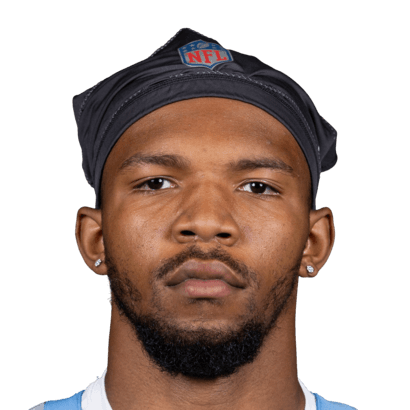
Jonah Coleman Prospect Profile From The 2026 Rookie Super Model
Dwain McFarland breaks down how the 2026 RB Rookie Super Model views Jonah Coleman and what his fantasy football outlook looks like ahead of the 2026 NFL Draft.
Checking in as the RB2 in the RB Super Model, could Jonah Coleman out of Washington bring three-down potential? For the full RB class, check out the 2026 RB Rookie Super Model.
If you're new to the model, here is an introductory breakdown of the Rookie Super Model, which rates players on a scale of 50 to 100 based on a composite score across Draft Capital, Production and Film. All of this data is integrated into our free NFL Draft Guide, full of big board rankings, mock drafts and more.
You can find a glossary of terms and stats used in this breakdown at the bottom of the prospect profile.
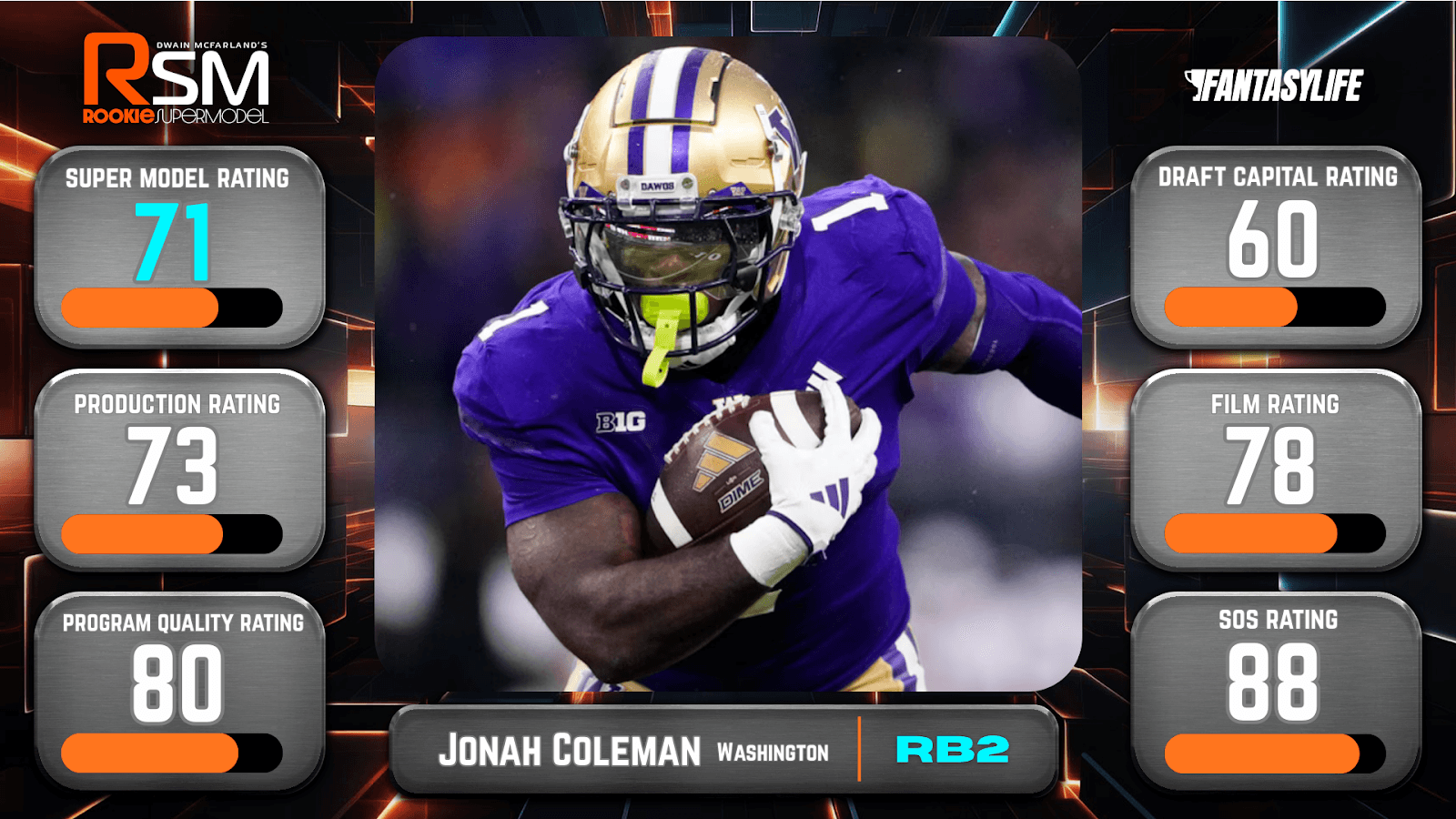
Rookie Super Model Prospect Profile For Jonah Coleman
- Super Model Rating: 71 (49th since 2017)
- Draft Pick (based on Mock Draft data): 90
- Rookie Age: 23
- Height: 68 inches
- Weight: 220 pounds
Coleman was a consensus three-star recruit in the 2022 class out of Stockton, California. He was a four-year starter in high school, compiling 3,319 rushing yards and 58 TDs. He tacked on 799 yards and 10 scores on 55 receptions.
He immediately earned playing time as a freshman at Arizona with a 26% snap share and went on to lead the team in rushing with 66 yards per game in Year 2. Following that year, he entered the transfer portal as a four-star recruit, following head coach Jedd Fisch to the Huskies.
Coleman finished his career as the leading back for Washington over his final two seasons, compiling 25 rushing TDs and 2 receiving scores. He was a finalist for the Paul Hornung Award as the nation's most versatile player in Year 4.
What the Production Says
Average slightly-below-average marks across input categories drive Coleman's 73 Production Rating in the Rookie Super Model.
- Year-Weighted YPTA: 1.47 (52nd percentile)
- Best YPTA: 1.80 (47th percentile)
- Best RYPTPA: 0.99 (49th percentile)
 Nerd note: What do these numbers mean?
- YPTA: Adjusted yards per team attempt (pass + rush), with receiving yards double-weighted. Normalizes production across teams with different play volumes.
- Year-Weighted YPTA: Weights Years 1-3 more heavily, where college production best predicts NFL success. Year 4 carries a negative correlation. Good players show up early.
- Best YPTA: Career-high yards per team attempt season.
- Best RYPTPA: Peak-season receiving yards per team pass attempt, normalizing production across run-heavy vs. pass-heavy offenses.
Coleman improved his YPTA from Year 1 to Year 2 and then plateaued before improving again in Year 4: 0.54 → 1.69 → 1.68 → 1.80.
However, the Rookie Super Model doesn't know that Coleman suffered a PCL injury in Week 11 of Year 4. His average snap share over the first eight games was 73%. That fell to 39% over the final four games he was active (the model doesn't count the missed game against him).
Here is a breakdown of Coleman's Year 4 campaign before injury:
- YPTA: 2.53 (68th-percentile best-season)
- RYPTPA: 1.37 (67th-percentile best-season)
- Target Share: 14% (68th-percentile best-season)
Those marks would improve Coleman's Production Rating from 73 to 79 and his Rookie Super Model rating from 70.6 to 72.4. While that isn't huge because Year 4 marks receive less weight, it is meaningful. His Production Rating would rank second in the class if we excluded games after the PCL injury.
The bigger point is that we should consider the numbers above when comparing his best seasons to players like Emmett Johnson (2.88 best YPTA and 1.05 best RYPTPA). Coleman was a better player earlier in his career, and his best-season marks are closer than many think in the final year, before injury.
- Career YPRR: 1.21 (43rd percentile)
- Career TPRR: 16% (37th percentile)
Beyond the Production
Coleman's Film Rating of 78 ranks fifth in the class.
- NFL.com Prospect Grade: 5.91 (34th percentile)
- Career PFF Rushing & Receiving Grade: 78.5 (83rd percentile)
He was a plus player on the ground and via the air, according to PFF career grades:
- Career PFF Rush Grade: 87.6 (92nd percentile)
- Career PFF Rec Grade: 69.4 (61st percentile)
However, Lance Zierlein of NFL.com isn't as bullish. He views the Huskies' RB1 as a potential "three-down" back, but only as a backup. He notes Coleman's ability to process and set up blocks, as well as pass blocking, as positives. Zierlein's concerns: ability to get to the edge, "below-average burst" and limitations as a tackle breaker.
During his college career, Coleman was elusive and above average after contact. He was also above average in the big play department.
- Rushing Missed Tackles Forced: 32% (73rd percentile)
- Rushing Average Yards After Contact: 4.12 (59th percentile)
- 10-Plus Yard Attempts: 17% (53rd percentile)
While the film and data don't align 100%, that is okay. When projecting players to the next level, film evaluators aim to determine whether the college numbers will hold up against stiffer competition. By including both in the model, we get the most well-rounded view of a prospect.
Plus, while it isn't often, we have seen prospects with lower NFL.com prospect grades find success in the NFL:
- Kyren Williams: 6.00 (38th percentile)
- Bucky Irving: 5.87 (33rd percentile)
- Tony Pollard: 5.80 (30th percentile)
- Aaron Jones: 5.42 (14th percentile)
Zierlein's assessment of Coleman as a pass blocker 100% aligns with his collegiate data. Coleman's 68.9 career PFF Pass Block Grade (76th percentile) and low-pressure rate allowed of 5.5% (below the 7% historical prospect average) could help Coleman's chances of taking over a full-time workload, whether via injury to a starter or a weak RB room.
Coleman also rarely lets the football touch the ground. His 0.5% career fumble rate is below the 0.9% average for prospects. His career drop rate of 0.9% is far below the average of 6.8% and ranks second in the 2026 RB class.
Fantasy Football Outlook For Jonah Coleman
With Coleman, I am going to give him a slightly higher range for this analysis, given how his PCL injury clearly impacted his final season.
There have been 55 RBs who have garnered a Super Model rating between 68 and 78 since 2017, with 36% delivering a top-24 finish by Year 3.
- Top-six finishes: 7%
- Top-12 finishes: 13%
- Top-24 finishes: 36%
- Top-36 finishes: 53%
Skill set: Potential Every-Down RB.
Coleman's closest Super Model comps:
- Rhamondre Stevenson
- Kyren Williams
- Royce Freeman
Bottom line: Coleman rates as a Round 3 NFL Draft pick in the Rookie Super Model. He delivered solid but not great production over his first three seasons and had a strong Year 4 before his PCL injury. He has a three-down skill set, but could struggle to produce at the same level in the NFL. His low drop and fumble rates, combined with strong pass-pro skills, could quickly make him a coach's pet. This profile is the type that can surprise in a weak RB room or step into a full-time role if injury knocks the starter out. Coleman is a low-end RB3 with RB2 upside in fantasy football.
Glossary of Terms In The Prospect Profile
- Adjusted Career RYPTPA: Career receiving yards per team pass attempt adjusted for age, strength of schedule, QB play, teammate competition, aDOT, and alignment. Doesn't count games missed.
- aDOT: Average depth of target in yards.
- Career Targeted QB Passer Rating: Passer rating on WR's targets.
- Contested catch rate: Percentage of contested targets caught.
- Contested catch rate over expected: Percentage of contested targets caught after adjusting for aDOT.
- Draft Capital Rating: Based on Chase Stuart's Draft Value Chart, an improved version of what many know as the Jimmy Johnson trade chart. It accounts for the larger drop-off in the first round and a flatter drop-off around the end of the second round.
- FDPRR: First downs per route run. Often shown as a percentage (first downs divided by routes).
- Film Rating: Based on NFL.com prospect grades from Lance Zierlein.
- Production Rating: A combination of adjusted career RYPTPA and career targeted QB passer rating.
- Program Quality Rating: ESPN's College Football Power Index is used to assess program quality. The model accounts for each school a prospect attended.
- RYPTPA: receiving yards per team pass attempt.
- SOS Rating: Based on strength of schedule (SOS) from Sports Reference. The model accounts for each school the prospect attended.
- Target Share: A player's percentage of team targets in games played.
- TPRR: Targets per route run.
- YAC: Average yards after the catch.
- YAC over expected: YAC over expected after adjusting for aDOT.
- YPG: Yards per game.
- YPRR: Yards per route run.

Join Our Newsletter
Trusted by 400,000+ fantasy football players. Get access to Fantasy Life's free award winning newsletter and tools, all in one step.
By registering or logging in, you agree to our Terms of Use and Privacy Policy.
Players Mentioned in this Article





Published Updated