
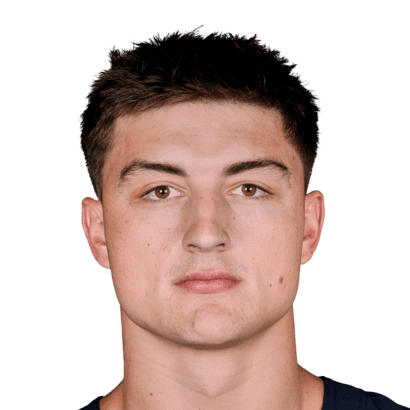
Kenyon Sadiq Prospect Profile From The 2026 Rookie Super Model
Dwain McFarland breaks down what the 2026 Tight End Rookie Super Model has to say about Oregon TE Kenyon Sadiq.
Kenyon Sadiq lands in a tier of his own among tight ends in the 2026 NFL Draft class and runs away with the TE1 designation in the 2026 TE Super Model. For the full TE class, check out the 2026 TE Rookie Super Model.
If you're new to the model, here is an introductory breakdown of the Rookie Super Model, which rates players on a scale of 50 to 100 based on a composite score across Draft Capital, Production and Film. All of this data is integrated into our free NFL Draft Guide, full of big board rankings, mock drafts and more.
You can find a glossary of terms and stats used in this breakdown at the bottom of the prospect profile.
Rookie Super Model Prospect Profile For TE Kenyon Sadiq
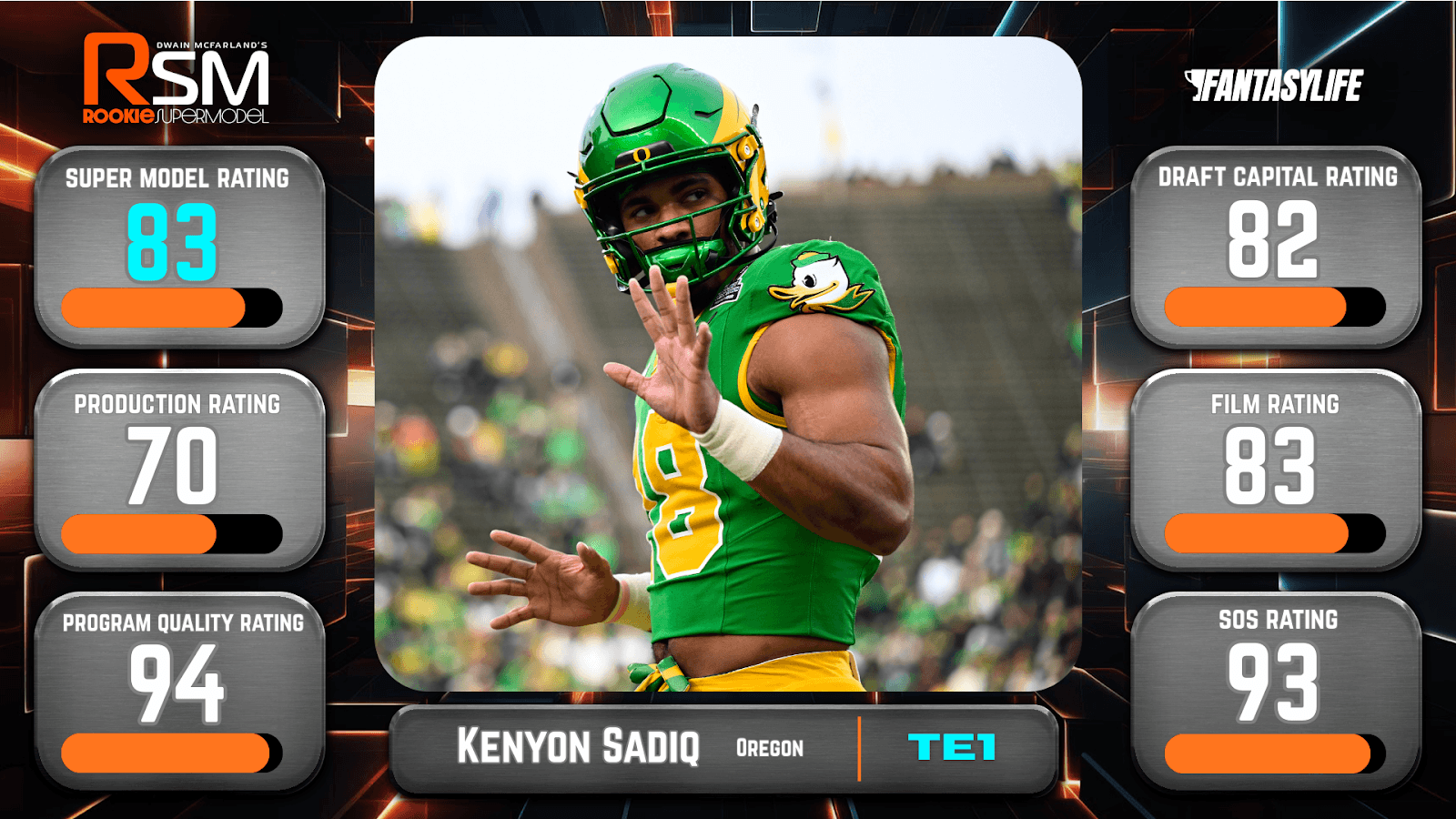
- Super Model Rating: 85 (6th since 2018)
- Draft Pick (Based on Mock Draft data): 17
- Rookie Age: 21.5
- Height: 75 inches
- Weight: 241 pounds
Sadiq was a consensus four-star recruit out of Idaho in the 2023 class. He was ranked as the No. 4 athlete in the country by 247Sports and was recruited by multiple top-notch programs across the nation.
The 21-year-old started slowly over his first two seasons in Eugene, playing behind the Rams' 2025 second-rounder, Terrance Ferguson, and 2025 UDFA Traeshon Holden. He also crossed paths with other future NFL players: Troy Franklin, Tez Johnson, Noah Whittington and Bucky Irving.
He notched his best season in Year 3, with less target competition, totaling 560 yards and eight TDs. Sadiq lived up to his "athlete" recruiting tag, obliterating the NFL Scouting Combine.
What the Production Says
The Rookie Super Model weighs two components for Production Rating (74), and Sadiq's results are polar opposites. When we normalize his career receiving yards by team pass attempts (RPYTPA), he drastically underperformed. However, when he was targeted, his signal callers were highly rewarded.
- Adjusted Career RYPTPA: 32nd percentile
- Targeted QB Passer Rating: 137.9, 89th percentile
Adjusted Career RYPTPA: Career receiving yards per team pass attempt adjusted for age, strength of schedule, QB play, teammate competition, aDOT and alignment. Doesn't count games missed.
Over his first two seasons, Sadiq delivered RYPTPAs of 0.08 and 0.66. On the one hand, most of that was driven by a lack of playing time, and Terrance Ferguson was a factor (which the model adjusts for).
On the other hand, Ferguson was also never a force at Oregon—he didn't notch a meaningful RYPTPA until Year 4 (1.45). We shouldn't view Ferguson as an immovable force, especially for a Round 1 TE like Sadiq. Maybe the bigger red flag is that Sadiq couldn't beat out an UDFA, Traeshon Holden, for playing time.
In Year 3, Sadiq set career-high marks with a 1.35 RYPTPA (34th percentile) and 40 YPG. He led the team with a 17% target share. While those numbers are all signs of progress, they aren't star-level data points.
Simply stated: Sadiq was never the focal point of the Ducks' offense. That is a red flag.
When we have players who played a limited number of routes, zooming out to look at their per-route data can give a different perspective. While these data points aren't in the Rookie Super Model due to overlap with RYPTPA, they help us answer the question: How good were they when on the field?
- Career yards per route run (YPRR): 1.73 (58th percentile)
- Career first downs per route run (FDPRR): 9% (62nd percentile)
- Career targets per route run (TPRR): 20% (53rd percentile)
This data is more positive on Sadiq than his RYPTPA, which counts lack of playing time against him. It also aligns more closely with his targeted passer rating, though they fall in the above-average range rather than the elite.
Beyond the Production
Like most TE prospects, Sadiq earned the majority of his targets underneath. However, his profile is a little different: 37% came behind the line of scrimmage, which is 26 percentage points above the average.
- Behind the line of scrimmage: 37% (+26 vs avg)
- Short (0-9 yds): 31% (-19 vs avg)
- Medium (10-19 yds): 20% (-7 vs avg)
- Deep (20+ yds): 13% (+1 vs avg)
Targets behind the line aren't necessarily a bad thing. Brock Bowers was at 31%, and Dallas Goedert was at 28%. While Sadiq wasn't as active in the short- and medium-range, his deep-target rate was in line with historical prospects.
His 6.2-yard career aDOT (28th percentile) is on the low end. However, he notched a significantly higher mark in his third year at 8.3. That final number aligns more closely with recent top TE draft selections.
After the catch, Sadiq added value. His 6.6 YAC was +1.1 yards over expected after adjusting for aDOT. However, he struggled to hold onto the football, with a 7.9% drop rate. That is the third-worst mark for a Round 1 or Round 2 TE since 2018.
- Luke Musgrave: 11.3%
- Noah Fant: 7.9%
- Mike Gesicki: 7.3%
- Irv Smith Jr.: 6.8%
In his final season, with more playing time and his highest aDOT, the Ducks' star TE dropped 9% of his catchable targets.
Sadiq rarely aligned in-line (31%). Did Oregon view him as a liability as a run blocker? Possibly, but he was a solid with a 68.7 career PFF Run Block Grade (65th percentile)—the best mark in the class.
If we isolate players with similar in-line snap rates and weights, we get mixed results regarding early playing time.
- Brock Bowers: 36% in-line, 243 lbs, 71.4 PFF Run Block Grade → immediate takeover
- Colston Loveland: 40% in-line, 248 lbs, 52.1 PFF Run Block → mid-season takeover Y1
- Dalton Kincaid: 40% in-line, 243 lbs, 60.5 PFF Run Block → part-time role
- Michael Mayer: 38% in-line, 249 lbs, 73.6 PFF Run Block Grade → backup (arrival of Bowers was a factor)
- Harold Fannin Jr.: 43% in-line, 241 lbs, 69.6 PFF Run Block → mid-season takeover Y1
Lance Zierlein of NFL.com has a 6.46 prospect grade (65th percentile) on Sadiq. One of the cool things about adding film analysis to the model: part of finding future stars is about what they could become.
And Zierlein is effusive in his praise of Sadiq. He sees him as a potential high-volume target who can attack every level with route-running versatility. Of course, this doesn't align with the data on Sadiq—he was never a high-end target earner, and his target-depth distribution was unbalanced. So those are question marks.
Zierlein also calls out his ability in contested catch situations, which the data aligns with. Sadiq hauled in 53%, but the sample of 15 contested targets is small. Zierlein also notes that the freaky athletic tight end "allows balls to hit the ground on lower-difficulty plays", which tracks with the data.
While Zierlein was positive overall in his film notes on Sadiq, his final grade was significantly lower than Kyle Pitts (100th percentile), Brock Bowers (77th percentile), T.J. Hockenson (81st percentile), Colston Loveland (77th percentile) and Tyler Warren (80th percentile).
Sadiq's NFL Scouting Combine was one for the ages:
- 40-yard dash: 4.39 seconds (99th percentile)
- Vertical: 43.5 inches (89th percentile)
- Broad: 133 inches (93rd percentile)
Those are amazing numbers for a 241-pound human being. His 129.8 Speed Score, which is the main thing we care about for TEs, ranks first in our database back to the 2018 class.
Fantasy Outlook For TE Kenyon Sadiq
Since 2018, four TEs have posted a Super Model rating between 80 and 90, with 75% delivering a top-12 finish by Year 3.
- Top-six finishes: 0%
- Top-nine finishes: 50%
- Top-12 finishes: 75%
Sadiq's closest Super Model comps:
Bottom line: The Rookie Super Model views Sadiq as a mid-to-late Round 1 NFL Draft pick. He is a traits-based prospect who didn't get going until his final season in Year 3. Sadiq was never the alpha at Oregon, which is a significant red flag. He offers YAC upside, but could face playing-time restrictions, and the high drop rate is a concern. However, he is an elite athlete, and his Film Rating suggests untapped potential. Ideally, he lands with a creative offensive mind that views playmaking upside as the primary criteria for snaps. Sadiq profiles as a low-end TE1 with mid-range TE1 upside.
Glossary of Terms In The Prospect Profile
- Adjusted Career RYPTPA: Career receiving yards per team pass attempt adjusted for age, strength of schedule, QB play, teammate competition, aDOT, and alignment. Doesn't count games missed.
- aDOT: Average depth of target in yards.
- Career Targeted QB Passer Rating: Passer rating on WR's targets.
- Contested catch rate: Percentage of contested targets caught.
- Contested catch rate over expected: Percentage of contested targets caught after adjusting for aDOT.
- Draft Capital Rating: Based on Chase Stuart's Draft Value Chart, an improved version of what many know as the Jimmy Johnson trade chart. It accounts for the larger drop-off in the first round and a flatter drop-off around the end of the second round.
- FDPRR: First downs per route run. Often shown as a percentage (first downs divided by routes).
- Film Rating: Based on NFL.com prospect grades from Lance Zierlein.
- Production Rating: A combination of adjusted career RYPTPA and career targeted QB passer rating.
- Program Quality Rating: ESPN's College Football Power Index is used to assess program quality. The model accounts for each school a prospect attended.
- RYPTPA: receiving yards per team pass attempt.
- SOS Rating: Based on strength of schedule (SOS) from Sports Reference. The model accounts for each school the prospect attended.
- Target Share: A player's percentage of team targets in games played.
- TPRR: Targets per route run.
- YAC: Average yards after the catch.
- YAC over expected: YAC over expected after adjusting for aDOT.
- YPG: Yards per game.
- YPRR: Yards per route run.

Join Our Newsletter
Trusted by 400,000+ fantasy football players. Get access to Fantasy Life's free award winning newsletter and tools, all in one step.
By registering or logging in, you agree to our Terms of Use and Privacy Policy.
Players Mentioned in this Article





Published Updated