
Mike Washington Jr. Scouting Report and Rookie Super Model Prospect Profile
Dwain McFarland breaks down the Rookie Super Model's analysis of Mike Washington Jr. and what it means for his fantasy football outlook.
After catching every eye in Indianapolis at the NFL Combine, Mike Washington Jr. checks in as the RB6 in the Rookie Super Model. For the full RB class, check out the 2026 RB Rookie Super Model.
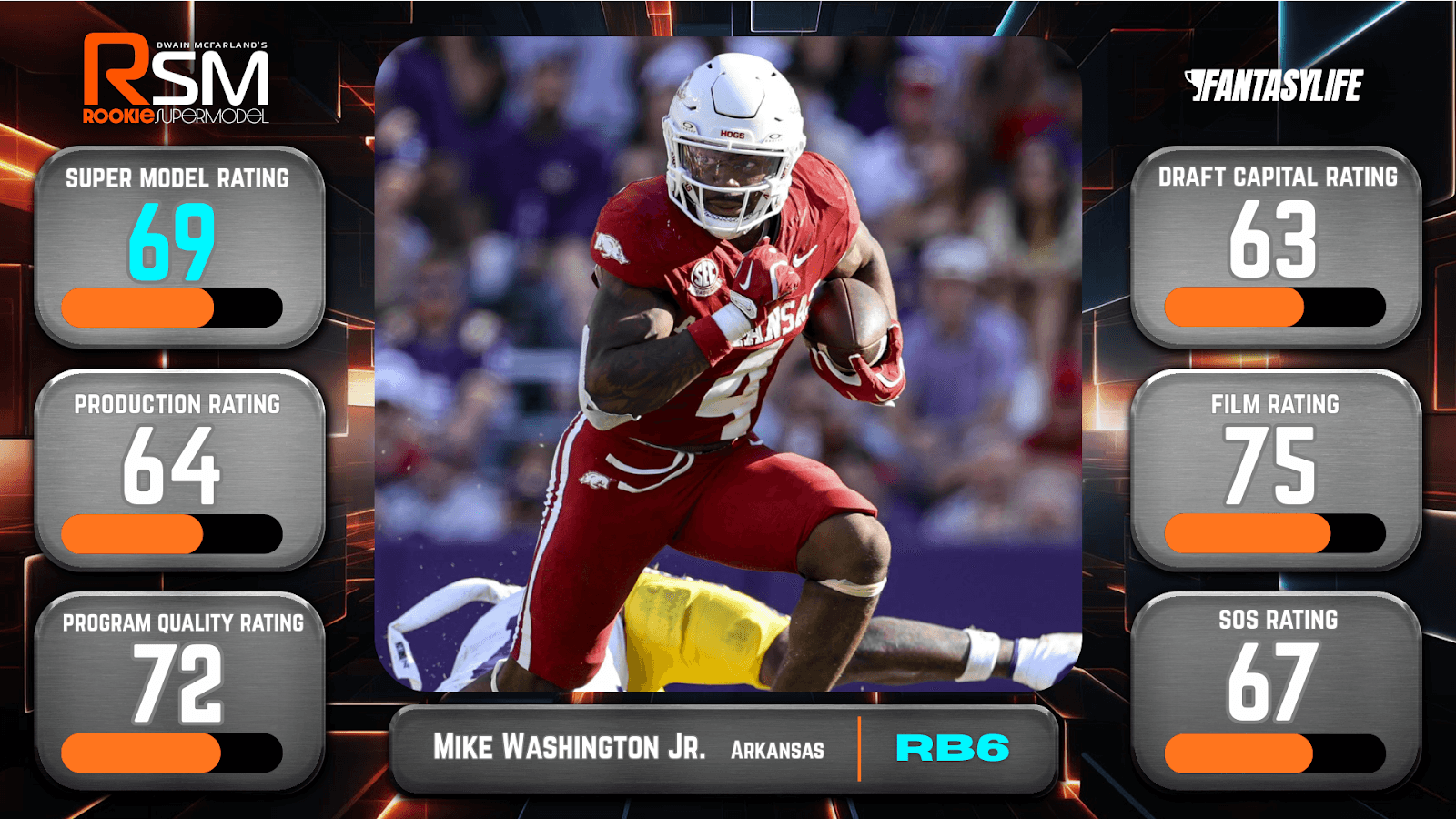
If you're new to the model, here is an introductory breakdown of the Rookie Super Model, which rates players on a scale of 50 to 100 based on a composite score across Draft Capital, Production and Film. All of this data is integrated into our free NFL Draft Guide, full of big board rankings, mock drafts and more.
You can find a glossary of terms and stats used in this breakdown at the bottom of the prospect profile.
Scouting Report and Rookie Super Model Prospect Profile for Mike Washington Jr.
- Super Model Rating: 69 (69th since 2017)
- Draft Pick (Based on mock draft data): 65
- Rookie Age: 23.2
- Height: 73 inches
- Weight: 223 pounds
Washington was a two-star recruit per 247Sports and a three-star prospect per ESPN and Rivals in the 2021 class. He earned All-State honors in New York as a high school junior, but COVID-19 canceled his senior season.
He stayed local, playing with Buffalo (redshirt Year 1) for his first three years before transferring to New Mexico State in Year 4. He entered the transfer portal again ahead of Year 5 as a three-star recruit, signing with Arkansas, where he delivered his best season.
Since going scorched earth at the NFL Scouting Combine, Washington has dramatically climbed consensus big boards. He was a slow starter in college, but he dramatically improved his NFL Draft outlook over the last 12 months.
What the Production Says
Washington was a late-bloomer and never became a strong receiving threat, which significantly dampens his Production Rating (64) in the model. Additionally, he played at lower-quality programs where a path to volume is theoretically easier, and we would expect greater efficiency against lesser competition. However, in Year 5 at Arkansas, he produced 89 rushing yards per game and notched his best YPTA.
- Year-Weighted YPTA: 0.84 (32nd percentile)
- Best YPTA: 1.90 (50th percentile)
- Best RYPTPA: 0.59 (29th percentile)
 Nerd note: What do these numbers mean?
- YPTA: Adjusted yards per team attempt (pass + rush), with receiving yards double-weighted. Normalizes production across teams with different play volumes.
- Year-Weighted YPTA: Weights Years 1-3 more heavily, where college production best predicts NFL success. Year 4 carries a negative correlation. Good players show up early.
- Best YPTA: Career-high yards per team attempt season.
- Best RYPTPA: Peak-season receiving yards per team pass attempt, normalizing production across run-heavy vs. pass-heavy offenses.
The model accounts for his best season, but in the year-weighted calculation, Year 5 receives the least weight. Washington simply never flashed significant production potential in the most critical years, but if you are looking for a silver lining, he did improve in each of his last two campaigns.
- Year 1 at Buffalo: Redshirt
- Year 2 at Buffalo: 0.92 YPTA, 0.29 RYPTPA → 48 ru YPG, 7 TDs; 10 rec YPG, 1 TD
- Year 3 at Buffalo: 0.57 YPTA, 0.10 RYPTPA → 32 ru YPG, 2 TDs; 3 rec YPG, 0 TDs
- Year 4 at New Mexico State: 1.07 YPTA, 0.28 RYPTPA → 58 ru YPG, 8 TDs; 8 rec YPG, 1 TD
- Year 5 at Arkansas: 1.90 YPTA, 0.49 RYPTPA → 89 ru YPG, 8 TDs; 19 rec YPG, 1 TD
Still, I think it is reasonable to ask: if Washington is a good RB prospect, how was he limited to designed rush shares of 31%, 24%, 33% and 45% in backfields without superstars? At New Mexico State, he did play with mid-round NFL Draft pick hopeful Seth McGowan; if you want to give him a pass there, fine.
When we zoom out and look at Washington's career receiving data on a per-route basis, it echoes his low RYPTPA numbers.
- Career YPRR: 0.78 (28th percentile)
- Career TPRR: 17% (41st percentile)
His best target share season of 10% (38th percentile) says maybe he can get by if forced into a full-time role, but his production profile suggests limited receiving upside.
Beyond the Production
Lance Zierlein sees Washington as a back who can eventually become an average NFL starter, rating him the No. 3 prospect in the class. Even though his PFF Rushing and Receiving grades are in higher percentiles, they rank last in the class.
- NFL.com Prospect Grade: 6.24 (49th percentile)
- Career PFF Rushing & Receiving Grade: 63.3 (58th percentile)
Zierlein sees Washington as a strong runner once he is on the move, but not a very sudden player who can be "step slow" in processing holes at the line of scrimmage. However, calls out Washington's agility as "adequate" for changing directions smoothly.
However, Washington's underlying career advanced rushing profile contrasts with the film scouting:
- Rushing Missed Tackles Forced: 17% (25th percentile)
- Rushing Average Yards After Contact: 3.09 (27th percentile)
- 10-Plus Yard Attempts: 13% (35th percentile)
But Zierlein may be primarily weighing Washington's final season, where he notched career-highs in each category:
- Rushing Missed Tackles Forced: 20%
- Rushing Average Yards After Contact: 3.86
- 10-Plus Yard Attempts: 18%
Accounting for a player's progress and using that to forecast how they will perform at the next level can be tricky. Sometimes, variance can be the biggest driver. Other times, a player has actually improved. Either way, the data does align with Zierlein's prognosis: Washington was better in his final season.
When you factor that improvement into an equation that includes a weak RB class plus an outlier NFL Scouting Combine performance, you get a riser in the predraft process.
Washington blew scouts away in Indianapolis, running a 4.33-second 40-yard dash (92nd percentile). That is amazing for a 223-pound human being. Washington's 126.9 Speed Score is the best on record since 2017 in my database.
Nerd Note: Bill Barnwell invented Speed Score. It helps us understand how fast a player is relative to their weight. A 180-pound RB running a 4.40-second 40-yard dash isn't the same thing as a 215-pound back with the same time. Of all the testing data points from the NFL Scouting Combine, Speed Score carries the most signal for NFL RB production. Formula: Weight*200/(40-yard dash)4.
While the scouting reports on Washington's ability as a runner are encouraging, his receiving ability remains a potential massive hole in his game—especially for fantasy football. His 51.5 career PFF Receiving Grade falls in the 25th percentile. He also struggled in pass pro with a 41.9 career PFF Pass Block Grade (35th percentile), allowing pressure on 6.5% of his reps (slightly better than the average prospect at 7%). His 7.5% drop rate was slightly higher than the average of 6.8%.
Zierlein also notes troubles holding onto the football, which aligns with Washington's high career fumble rate of 1.8%. That is double the 0.9% average for prospects back to 2017.
Fantasy Football Outlook For Mike Washington
There have been 94 RBs who have garnered a Super Model rating between 64 and 74 since 2017, with 22% delivering a top-24 finish by Year 3.
- Top-six finishes: 4%
- Top-12 finishes: 10%
- Top-24 finishes: 22%
- Top-36 finishes: 33%
Skill set: Early-Down RB.
Washington's closest Super Model comps:
- Isaac Guerendo
- Israel Abanikanda
- Isiah Pacheco
Bottom line: The Rookie Super Model views Washington as a Day 3 NFL Draft selection. His 64 Production Rating is low due to his extremely slow start. However, he did flash in Year 5 at Arkansas, which might have some NFL teams giddy about taking a stab on Day 2 in a weak RB class—especially after testing extremely well at the NFL Combine. His production profile and film point toward limited upside in the passing game, so Washington needs a soft landing spot with a path to early-down work or as the primary early-down backup. To stay out of the doghouse, he must improve his ball security and pass blocking. Washington is an RB4 who could offer RB2 upside on the right team that can maximize his straight-line speed.
Glossary of Terms In The Prospect Profile
- Adjusted Career RYPTPA: Career receiving yards per team pass attempt adjusted for age, strength of schedule, QB play, teammate competition, aDOT, and alignment. Doesn't count games missed.
- aDOT: Average depth of target in yards.
- Career Targeted QB Passer Rating: Passer rating on WR's targets.
- Contested catch rate: Percentage of contested targets caught.
- Contested catch rate over expected: Percentage of contested targets caught after adjusting for aDOT.
- Draft Capital Rating: Based on Chase Stuart's Draft Value Chart, an improved version of what many know as the Jimmy Johnson trade chart. It accounts for the larger drop-off in the first round and a flatter drop-off around the end of the second round.
- FDPRR: First downs per route run. Often shown as a percentage (first downs divided by routes).
- Film Rating: Based on NFL.com prospect grades from Lance Zierlein.
- Production Rating: A combination of adjusted career RYPTPA and career targeted QB passer rating.
- Program Quality Rating: ESPN's College Football Power Index is used to assess program quality. The model accounts for each school a prospect attended.
- RYPTPA: receiving yards per team pass attempt.
- SOS Rating: Based on strength of schedule (SOS) from Sports Reference. The model accounts for each school the prospect attended.
- Target Share: A player's percentage of team targets in games played.
- TPRR: Targets per route run.
- YAC: Average yards after the catch.
- YAC over expected: YAC over expected after adjusting for aDOT.
- YPG: Yards per game.
- YPRR: Yards per route run.

Join Our Newsletter
Trusted by 400,000+ fantasy football players. Get access to Fantasy Life's free award winning newsletter and tools, all in one step.
By registering or logging in, you agree to our Terms of Use and Privacy Policy.
Published Updated