Zachariah Branch Rookie Super Model Prospect Profile For The 2026 NFL Draft
Dwain McFarland breaks down what the Rookie Super Model has to say about incoming WR Zachariah Branch out of Georgia.
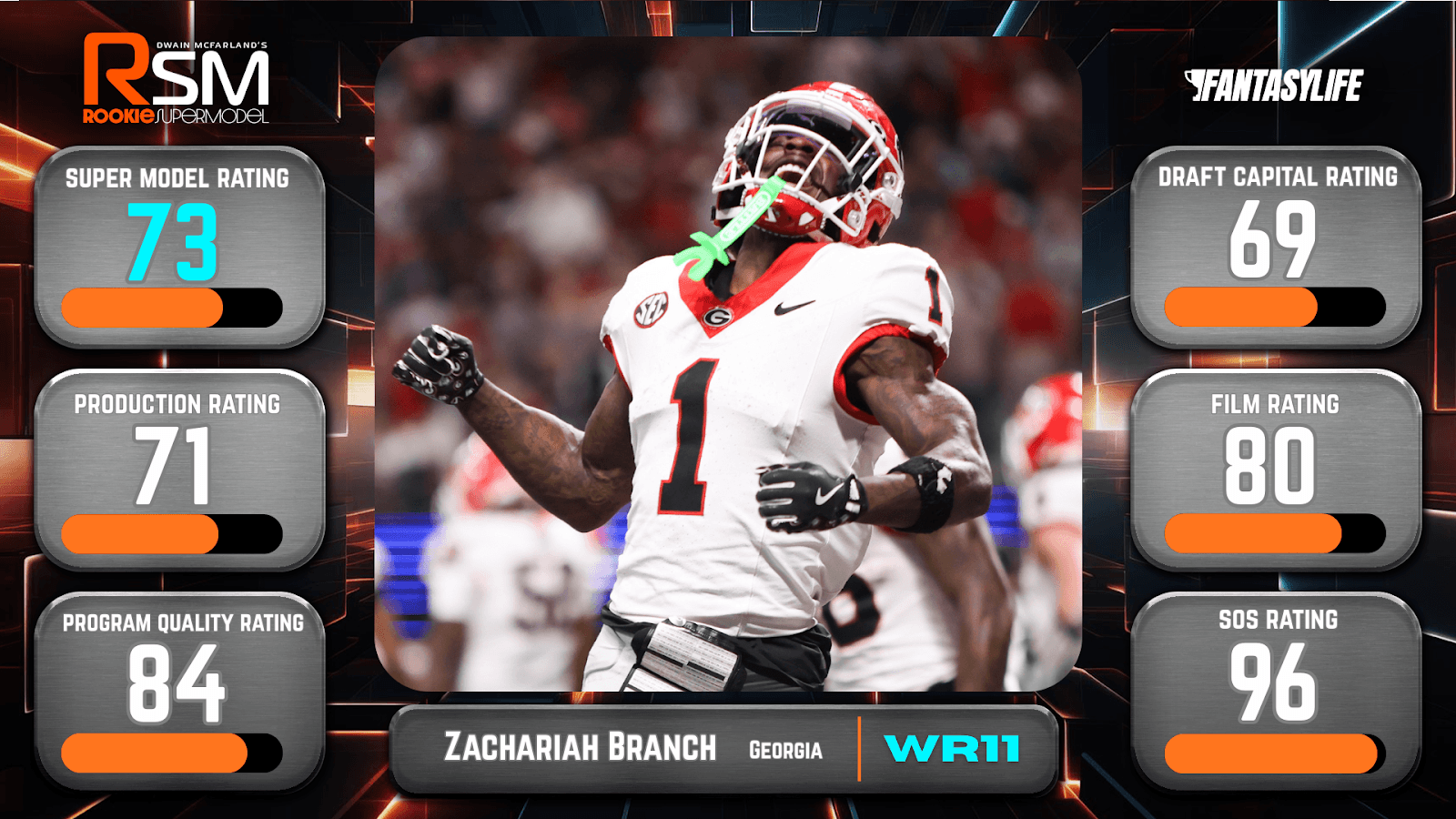
NFL Draft prospect Zachariah Branch out of Georgia checks in as the WR11 in the release of the 2026 Rookie Super Model.
I've profiled 25 of the top wide receivers in the class with individual Prospect Profiles from their Super Model data. For the full WR class, check out the 2026 WR Rookie Super Model.
If you're new to the model, here is an introductory breakdown of the Rookie Super Model, which rates players on a scale of 50 to 100 based on a composite score across Draft Capital, Production and Film. All of this data is integrated into our free NFL Draft Guide, full of big board rankings, mock drafts and more.
You can find a glossary of terms and stats used in this breakdown at the bottom of the prospect profile.
Rookie Super Model Prospect Profile For Zachariah Branch
- Super Model Rating: 73 (94th since 2018)
- Draft Pick: 50
- Rookie Age: 22.4
- Height: 69 inches
- Weight: 177 pounds
Branch was the No. 1 receiver in the 2023 recruiting class out of Las Vegas, Nevada. He was the MaxPreps Nevada Player of the Year as a junior and helped lead Bishop Gorman High School to the 5A state title. He has NFL bloodlines. He is the nephew of NFL Hall of Famer Cliff Branch of the Oakland/LA Raiders.
Branch signed with USC under Lincoln Riley and joined forces with Caleb Williams. He played two seasons with USC as a part-time player in an offense with fellow 2023 recruit Makai Lemon, plus other future NFL players: Tahj Washington, Brenden Rice, Ja'Kobi Lane, Woody Marks and Lake McRee.
He transferred to Georgia for his final season, where he again played a part-time role with a 64% route participation rate, but led the team in receiving with 81 receptions for 811 yards and 6 TDs. He added 3 TDs on special teams.
What the Production Says
Despite being the No. 1 WR recruit in the 2023 class, Branch never topped a 65% route participation rate, which capped his production. While he is a playmaker with the ball in his hands, his low aDOT subdued his targeted QB passer rating.
- Adjusted Career RYPTPA: 53rd percentile
- Targeted QB Passer Rating: 102.3, 48th percentile
Branch's production improved every year, but he didn't have a meaningful RYPTPA until his third year. He did contribute in other ways each season.
- 2023 at USC: 0.80 RYPTPA, 29 YPG, 2 TDs
- Special teams: 180 punt return yards; 210 kick return yards; 1 rushing TD
- 2024 at USC: 1.01 RYPTPA, 42 YPG, 1 TD
- Special teams: 86 punt return yards, 1 TD; 108 kick return yards
- 2025 at Georgia: 1.94 RYPTPA, 58 YPG, 6 TDs
- Special teams: 327 punt return yards, 2 TDs; 449 kick return yards, 1 TD
Branch had a career target share of 18%, which isn't great. However, he was highly utilized when on the field, notching a career TPRR of 26% (29% vs. man, 27% vs. zone). While this is a positive, the question remains: can he grow into a larger role at the next level? His size and aDOT, which we will discuss in the next section, could be limiting factors based on historical comparisons.
For players in limited roles, it can be helpful to look at per-route data to gauge the upside, should they grow into a larger role in the NFL. The data points below aren't inputs to the model, but they provide additional information.
- Career YPRR: 2.02 (40th percentile)
- Career FDPRR: 10% (47th percentile)
To make a stand against the model, these numbers need to be higher. They are good enough, but not elite.
Beyond the Production
Branch's role in college was extremely narrow. He was massively dependent on targets behind the line of scrimmage and was well below the average in every other bucket.
- Behind the Line of Scrimmage Targets: 45% (+31 vs. avg)
- Short Targets (0-9 yards): 26% (-10 vs. avg)
- Medium Targets (10-19 yards): 17% (-9 vs. avg)
- Deep Targets (20+ yards): 12% (-10 vs. avg)
His 5.3 career aDOT (17th percentile) and 18% wide alignment are red flags. Historically, players in this range have not fared well in the NFL.
- Kadarius Toney: 6.6 aDOT, 30% wide, Round 1 pick
- Rondale Moore: 5.4 aDOT, 10% wide, Round 2 pick
- Parris Campbell: 6.2 aDOT, 35% wide, Round 2 pick
- Malachi Corley: 6.3 aDOT, 8% wide, Round 3 pick
To be fair, none of the players above had the same recruiting pedigree as Branch. But they played similar roles in college. They also all contributed on special teams and/or chipped in on the ground.
Like all of the players above, Branch was a plus-player in the YAC department. His career average of 8.0 yards was +2.0 over expected after adjusting for aDOT.
While he was electric with the ball in his hands, Branch was subpar as a contested-catch player, hauling in only 38% of those targets. That is well below the 46% average for prospects since 2018.
When you put all of this data together with his low route participation rates, it points toward a limited profile. We can't know for sure, but it makes sense that a player of this archetype can only be on the field so often.
I have seen comparisons to Zay Flowers and Tank Dell floating around, which don't align with the data. While they are similar in size, both of those players demonstrated a much broader skill set and played more. Flowers had a 13.0 aDOT (60th percentile) and aligned wide 27% of the time. Dell had an 11.8 aDOT (53rd percentile) and aligned wide on 52% of snaps. Their Production Ratings were also superior to Branch, with Dell at 94 and Flowers at 80.
Having said all of this, while past production is important, projecting traits into the future matters as well. That is a major reason the Rookie Super Model includes a Film Rating. Lance Zierlein of NFL.com has Branch's prospect grade at 6.32 (60th percentile).
Zierlein sees Branch as a player who could "see more choice routes and deep crossers rolled into his workload as a pro." But also balances this with "he could be pigeon-holed into a 'manufactured' touch role, but is capable of more." Ultimately, he sees him as eventually becoming a starting slot WR who adds value in the return game.
It is worth noting that Zierlein had similar grades on Kadarius Toney (6.37), Rondale Moore (6.22) and Malachi Corley (6.35).
Branch ran a 4.35-second 40-yard dash (82nd-percentile) at the NFL Scouting Combine, which could create vertical upside in the minds of some NFL executives. But all the guys above were also fast outside of Corley. Toney: 4.39. Moore: 4.28. Campbell: 4.31.
Fantasy Outlook
Since 2018, 68 WRs have posted a Super Model rating between 68 and 78, with 28% delivering a top-36 finish by Year 3.
- Top-six finishes: 3%
- Top-12 finishes: 7%
- Top-24 finishes: 19%
- Top-36 finishes: 28%
Branch's closest Super Model comps:
- Rondale Moore
- Parris Campbell
- Wan'Dale Robinson (stretch comp, slightly higher aDot of 7.8, but close enough)
Bottom line: The Super Model views Branch as a Round 3 pick. He is a player who can add value around the line of scrimmage after the catch and provide punch on special teams. But he must prove he can be more than a gadget player. His snaps could be capped. Historically, his archetype has not lived up to fantasy expectations. He is a WR4 prospect in fantasy football.
Glossary of Terms In The Prospect Profile
- Adjusted Career RYPTPA: Career receiving yards per team pass attempt adjusted for age, strength of schedule, QB play, teammate competition, aDOT, and alignment. Doesn't count games missed.
- aDOT: Average depth of target in yards.
- Career Targeted QB Passer Rating: Passer rating on WR's targets.
- Contested catch rate: Percentage of contested targets caught.
- Contested catch rate over expected: Percentage of contested targets caught after adjusting for aDOT.
- Draft Capital Rating: Based on Chase Stuart's Draft Value Chart, an improved version of what many know as the Jimmy Johnson trade chart. It accounts for the larger drop-off in the first round and a flatter drop-off around the end of the second round.
- FDPRR: First downs per route run. Often shown as a percentage (first downs divided by routes).
- Film Rating: Based on NFL.com prospect grades from Lance Zierlein.
- Production Rating: A combination of adjusted career RYPTPA and career targeted QB passer rating.
- Program Quality Rating: ESPN's College Football Power Index is used to assess program quality. The model accounts for each school a prospect attended.
- RYPTPA: receiving yards per team pass attempt.
- SOS Rating: Based on strength of schedule (SOS) from Sports Reference. The model accounts for each school the prospect attended.
- Target Share: A player's percentage of team targets in games played.
- TPRR: Targets per route run.
- YAC: Average yards after the catch.
- YAC over expected: YAC over expected after adjusting for aDOT.
- YPG: Yards per game.
- YPRR: Yards per route run.

Join Our Newsletter
Trusted by 400,000+ fantasy football players. Get access to Fantasy Life's free award winning newsletter and tools, all in one step.
By registering or logging in, you agree to our Terms of Use and Privacy Policy.
Players Mentioned in this Article




Published Updated