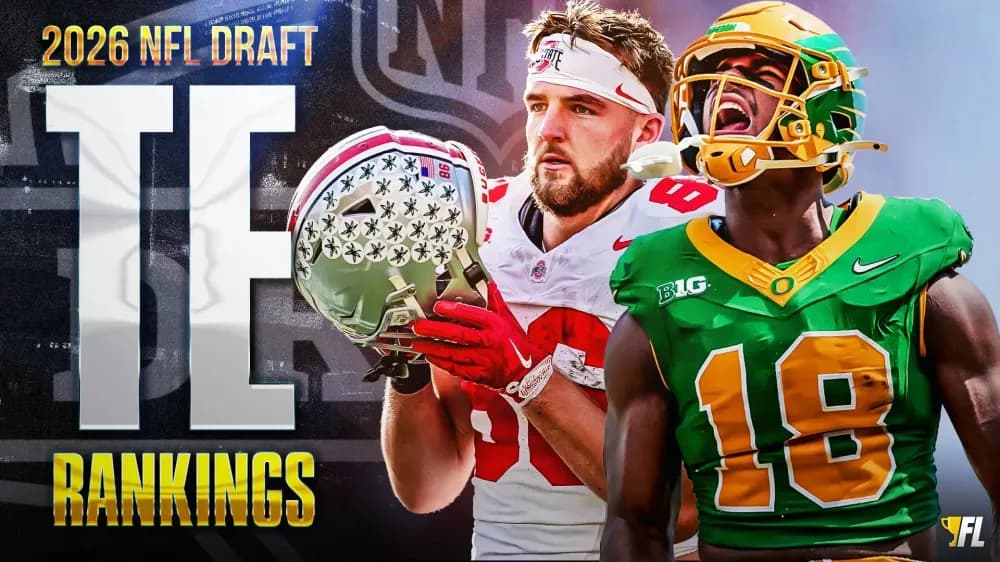
2026 NFL Draft Tight End Rankings: Kenyon Sadiq Stands Alone
Matthew Freedman breaks down his TE rankings for the 2026 NFL Draft.
As we continue to forge along through our NFL Draft positional rankings, we're brought to my 2026 NFL Draft tight end rankings below.
If you missed our positional rankings that have been released to date, see below:
- 2026 NFL Draft Quarterback Rankings
- 2026 NFL Draft Running Back Rankings
- 2026 NFL Draft Wide Receiver Rankings
We'll continue to move through the trenches and defensive side of the ball over the next handful of weeks ahead of the draft.
Also, I'm not one to brag, but …
For the 2025 draft, I was No. 1 in big board accuracy and No. 3 in mock accuracy. Since 2020, I'm the No. 1 mocker in the known universe.
For all of our draft coverage, check out our NFL Draft Guide.
Tight End Rankings For The 2026 NFL Draft
Kenyon Sadiq | Oregon | 6-3, 241 lbs. | Rookie Age: 21 | JR
Sadiq is a modern space TE with WR-esque movement skills and ascending usage in Oregon’s offense. Despite his position and young age, Sadiq led the Ducks this past season with 51 receptions, which he leveraged into 560 yards (No. 2 on team), and he was especially reliable in the red zone (8 TDs).
His 2025 tape shows a player transitioning from a gadgety move piece to a featured mismatch. In his sophomore season (24-308-2 receiving), Sadiq was more of a complementary contributor who garnered schemed touches as the No. 2 TE behind 2025 second-rounder Terrance Ferguson. This past season, though, he became a truly integral and vital part of the passing game and earned a large share of true progression targets.
While he's a tad undersized, Sadiq wins with a sudden first step, sufficient long speed and fluid change of direction that consistently exposes LBs and DBs in man coverage. With his skill set, Sadiq lined up all over the formation this past year (in the slot, out wide and as an H-back), and he has the ability to serve as an above-average vertical seam stretcher, crosser merchant and catch-and-run specialist on overs, drags and screens.
On top of that, Sadiq had 9-42-0 rushing in his college career. While I doubt he will see regular work as a runner in the NFL, his undergrad usage on the ground speaks to his playmaking capacity. As a receiver, he flashes strong hands, a sizable catch radius for his frame, and enough contact balance to finish through tackles after the catch.
Sadiq is by no means a complete TE. He's a "move" F, not a traditional in-line Y. If he's to contribute as a blocker in the NFL, he must continue to add play strength, and as a pass catcher he needs to tighten his route breaks and eliminate the focus drops.
But his athleticism is just too great to ignore: His speed (4.39-second 40-yard dash, 1.54-second 10-yard split) and explosiveness (43.5-inch vertical jump, 11-1 broad jump) are elite. Sadiq's the clear No. 1 TE in this class as a scheme-diverse matchup piece, and the former four-star recruit could go as high as the top 10.
Eli Stowers | Vanderbilt | 6-4, 239 lbs. | Rookie Age: 23 | GR
Stowers is a dual-threat QB convert who looks like a lab-built move TE. After enrolling at Texas A&M as a four-star passing recruit, transferring to New Mexico State two years later, and switching to TE as a redshirt sophomore (35-366-2 receiving, 28-108-2 rushing), Stowers in 2024 jumped to Vanderbilt, where he functioned as the No. 1 pass catcher for the Commodores for two seasons (111-1,407-9).
With slot-ready burst and real YAC juice, Stowers is a matchup piece who can create explosives, finish through contact and even run the wildcat. He offers little as a blocker, which could push him into Day 2, but his elite athleticism (4.51-second 40-yard dash, combine-record 45.5-inch vertical jump) could catapult him into Round 1, especially if an innovative play caller sees him as a potential chess piece mismatch.
Max Klare | Ohio State | 6-4, 246 lbs. | Rookie Age: 23 | rJR
Klare is a smooth, pro-ready receiving TE whose game is built on separation, reliability and all-around utility more than freak traits. A 2025 transfer, he was a consistent chain-mover this past season in a loaded Buckeyes offense (43-448-2 receiving), and the year prior he was the No. 1 pass catcher at Purdue in a breakout campaign (51-685-4). With multi-year production in Big Ten systems that require TEs to run a full route tree and block in the run game, Klare is a well-rounded prospect.
At his size, Klare isn’t a traditional mauler, but he’s a fluid mover with enough speed to threaten the seam and enough agility to separate on digs, outs and curls. As a route runner, he displays enough tempo, leverage and nuance to beat LBs with his breaks, and against zone coverage he settles quickly into windows and presents a clean target.
Klare’s blocking is competitive but still a work in progress. Power EDGEs can confound him on contact. Like most TE prospects, he needs to improve his functional strength and refine his hand use to hold up as a true in-line Y. He also lacks eye-popping athleticism, so he must win with polish, toughness and steadiness.
Even so, with his route craft, ball skills and multi-alignment experience, Klare looks like a strong Day 2 candidate with NFL starter potential.
Michael Trigg | Baylor | 6-4, 240 lbs. | Rookie Age: 24 | rSR
Trigg is the prototypical "basketball forward turned TE." A long-armed vertical playmaker with four-star recruitment pedigree, he flashed intermittently early at USC and Mississippi, but it wasn't until his first season with the Bears in 2024 that Trigg translated his athletic profile into sustained Power 5 production (30-395-3 receiving), and then this past season he progressed further and served as the No. 2 pass catcher in Waco (50-694-6) while putting together the cleanest, most complete tape of his career.
No longer a pure "traits bet" prospect, Trigg is now a legitimate seam and red-zone mismatch. With his size, he moves like an oversized X receiver. He accelerates through the stem, eats cushion and can stack LBs and some DBs on seams, posts and deep overs. His basketball background shows up in how he elevates with plus length, body control and strong hands to finish through contact and win in the air. He’s also dangerous after the catch, with enough burst to hit creases and the toughness to run through arm tackles. His tape is littered with explosive plays in high-leverage moments.
But Trigg needs to develop more as a hands catcher and route runner. He's far more of an athlete than a technician, and while you can't teach speed, five years of college haven't purged Trigg yet of concentration drops and occasional freelanced patterns. Also, Trigg is raw as a blocker. He seems willing to do the dirty work, but his effort is unrefined: His pad level drifts, his hand placement wanders, and his strength fails against powerful EDGEs. His potential as an in-line Y player is questionable.
Finally, there's the matter of Trigg's delayed development. It's better to have broken out late than not at all … but it's also way better to break out early than late and to have multiple years of consistent production than just one campaign. Evaluators will likely have more than a couple of questions when considering Trigg.
But his ability to win vertically and in the red zone gives Trigg a shot to secure Day 2 draft capital and an eventual starting gig.
Oscar Delp | Georgia | 6-5, 245 lbs. | Rookie Age: 23 | SR
Delp is a classic SEC in-line TE with enough athletic juice to matter in the pass game and enough sand in his pants to hold up as a true Y, even if he lacks eye-popping traits. After apprenticing behind Brock Bowers and Darnell Washington as a four-star freshman, Delp stepped into a starting role in 2023 and gave the Bulldogs steady, assignment-sound play in his final three seasons (24-284-3 receiving as a sophomore, 21-248-4 receiving as a junior, 20-261-1 as a senior).
While Delp's production has never been splashy, Georgia's offense has intentionally spread the ball around in recent seasons, and his receiving numbers undersell his snap-to-snap impact in the run game and pass protection.
With his size, Delp checks the box with a long, well-proportioned frame and functional strength, and as an athlete, he's a sufficient mover with solid short-area agility. He's not a matchup nightmare for DBs, but he's good enough to separate from most LBs on seams, outs and crossers. As a route runner, Delp sports a pro-ready tree, finds soft spots in zone, and works back to his QB.
The main selling point with Delp is his pro-ready well-roundedness. He is more of a steer-and-sustain blocker than a people-mover, and he hasn't consistently dominated at the catch point or piled up the production, but in the run game he plays with leverage, hand placement and strain, and in the pass game he holds his own.
In a prospect class light on polished Y players, Delp has a shot to go in the top 100 and open his rookie year as a steady No. 2 TE.
Jack Endries | Texas | 6-5, 245 lbs. | rJR
Endries is a clean TE whose game is built on separation, reliability and versatility. A walk-on redshirt at Cal, Endries opened his playing career with back-to-back productive campaigns (91-1,031-4 receiving) and served as the No. 1 pass catcher for the Golden Bears as a sophomore before joining Texas in 2025 as a four-star transfer. With the Longhorns, Endries functioned as a steady chain-mover and safety valve in a deep skill-group rotation (33-346-3 receiving).
With his size and athleticism (4.62-second 40-yard dash), Endries moves like a big slot who can situationally play in-line. As a route runner, he demonstrates the tempo, leverage and suddenness to uncover against LBs and some DBs. As a receiver, he flashes strong hands and quick tuck-and-turn ability after the catch. Overall, he displays high football IQ, toughness and comfort in multiple alignments and motion looks.
The downside with Endries is his potential lack of upside: He's a "jack of all trades, master of none" prospect who might already be near his peak. Plus, his blocking is based more on effort than technique.
While he has a shot to go in the top 100 and develop into an NFL starter, Endries could ultimately slide to Day 3 and top out as a reliable backup.
Joe Royer | Cincinnati | 6-5, 247 lbs. | rSR
Royer is a late-emerging, three-down TE who finally broke out with the Bearcats after languishing at Ohio State for years. A four-star 2020 recruit, Royer redshirted as a freshman and then caught just four passes as a deep Buckeyes reserve over the next three seasons before transferring to Cincinnati, where he immediately established himself as a consistent contributor (50-522-3 receiving in 2024, 29-416-4 in 2025).
Royer has prototypical TE size and enough athletic juice to threaten zones, seams and intermediate territory without being a burner. He’s a savvy route runner who settles into windows on time and finishes through contact with strong hands and a wide catch radius. After the catch, he transitions quickly upfield and runs through glancing blows for extra yardage.
Royer’s ceiling is more “very good starter” than star. He's a good but unexceptional athlete, and he still loses against powerful EDGEs in the run game. But with his production, polish and three-down utility, he profiles as the kind of Day 3 candidate who could become a starter.
Eli Raridon | Notre Dame | 6-6, 245 lbs. | Rookie Age: 22 | rJR
Raridon is a skyscraper TE with field-stretching speed (4.62-second 40-yard dash), and in 2025 he finally converted his four-star pedigree into sustained production (32-482-0 receiving) after two ACL tears and upperclassmen Michael Mayer and Mitchell Evans slowed him down for three seasons.
A smooth strider, Raridon is more of a downfield playmaker than a dumpoff merchant, and he's especially active against zone, where his expanded catch radius gives him an edge. With good hands, Raridon has enough ball skills to finish through contact and win in the air.
But as a route runner, Raridon is more linear than twitchy, and as a run blocker, he displays inconsistent pad level and technique. With his pass-catching ability, he looks like a potential Day 2 selection, but Raridon's injury history, delayed breakout and underdeveloped skill set will probably push into Day 3.
Lake McRee | USC | 6-4, 243 lbs. | Rookie Age: 24 | rSR
McRee is a fifth-year TE with two starting campaigns and a final-season breakout as a vertical assassin (30-450-4 receiving). A smooth route savant for a big man, McRee runs real seams and overs, tracks the ball naturally, and makes tough circus catches in traffic.
He is more positional than punishing as a blocker, and he lacks true mismatch ability as an athlete, but in a spread or play-action NFL offense, McRee could be a solid all-purpose No. 2 TE with the potential to pop for explosives when defenses overplay WRs. He's the definition of a Day 3 prospect.
Chamon Metayer | Arizona State | 6-4, 255 lbs. | rSR
Metayer is a rocked‑up specimen who spent three years at Cincinnati (23-258-5 in 2023) and a spring at Colorado before transferring to Arizona State, where he quickly became a key contributor and eventually served as the No. 2 pass catcher for the Sun Devils (70-681-9 receiving in two seasons).
More of a no-nonsense sledgehammer than seam‑splitting sprinter, Metayer thrives in the intermediate area, and he earns snaps across all personnel groupings thanks to strong hands and reliable blocks. Even though he wasn't invited to the combine, Metayer could still carve out a career as a physical do-it-all "coach's favorite."

Join Our Newsletter
Trusted by 400,000+ fantasy football players. Get access to Fantasy Life's free award winning newsletter and tools, all in one step.
By registering or logging in, you agree to our Terms of Use and Privacy Policy.
Published Updated