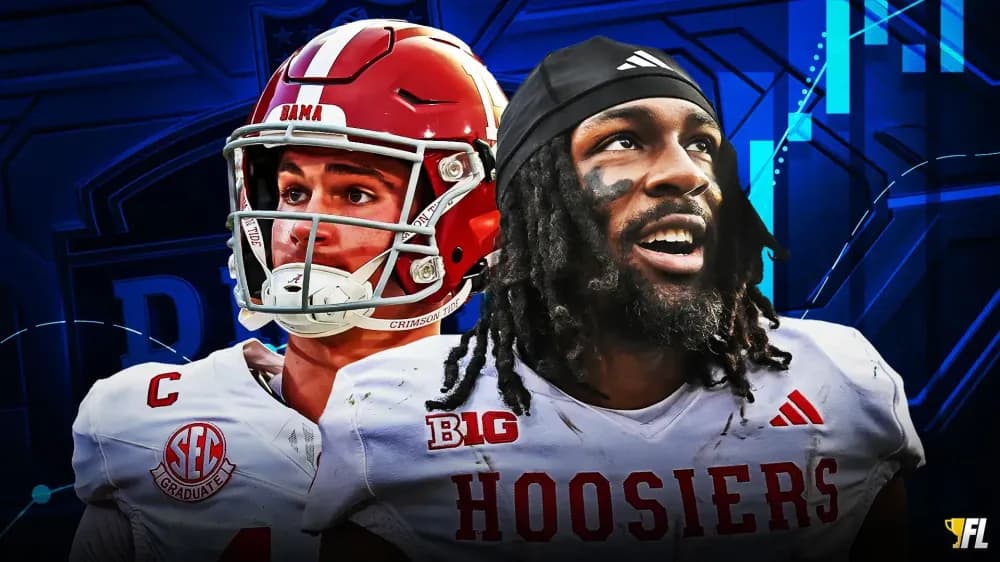
NFL Draft Risers and Fallers: Omar Cooper Up, Jordyn Tyson Falls
Matthew Freedman highlights the biggest risers and fallers through his pre-2026 NFL Draft prospect evaluation process.
The NFL draft is now just weeks away, so now feels like an ideal time to take a holistic look at the market and highlight a few prospects whose stocks have notably risen and fallen throughout the evaluation process.
For the 2025 draft, I was No. 1 in big board accuracy and No. 3 in mock accuracy. Since 2020, I'm the No. 1 mocker in the known universe.
For all of our draft coverage, check out our NFL Draft Guide.
2026 NFL Draft: Risers
WR Omar Cooper (Indiana)
Omar Cooper is the No. 4 WR in the 2026 Rookie Super Model and No. 6 WR in our 2026 NFL draft prospect big board.
But when I started the evaluation process months ago, he was outside of the top 10 at the position in consensus big boards. He wasn't at all thought of as a potential first-rounder.
He honestly might've been on the borderline of Days 2-3.
But Cooper was a big winner at the NFL combine with his numbers.
- Size: 6-0, 199 lbs.
- Speed: 4.42 40-yard dash | 1.55-second 10-yard split
- Explosiveness: 37-inch vertical jump
In my most recent mock draft, I have him going No. 16 to the Jets, and he's now locked into Round 1.
Although Cooper never had a big breakout at Indiana (69-937-13 receiving, 3-74-1 rushing in 16 games last year), he was the co-No. 1 WR in his final season for the championship-winning Hoosiers, and his inside/outside versatility will make him attractive for teams who want players capable of lining up all across the formation.
See my fuller write-up of Cooper in my 2026 rookie WR ranks.
OT Monroe Freeling (Georgia)
When I started digging into prospects in November, Monroe Freeling was barely on my radar. He was a Day 2 guy.
Now, he's commonly mocked at No. 6 to the Browns, and he has overtaken OT Spencer Fano on the NFL Mock Draft Database Consensus Big Board (11 vs. 12).
He has limited experience (18 games at LT), but he's probably the top LT in the class, and has outstanding size (6-foot-7, 315 pounds), arm length (34.75 inches) and athleticism (4.93, 40-yard dash).
I don't agree with it, but I understand why he has jumped up the board.
S Dillon Thieneman (Oregon)
During the season, Dillon Thieneman was thought of as a solid player. A Round 2 guy.
But after his great combine …
- Size: 6-foot, 201 pounds
- Speed: 4.35, 40-yard dash
- Explosion: 41-inch vertical jump, 10-5 broad jump
… I now have him as the No. 2 S in this class. Incredibly rare (and also probably stupidly contrarian) is the mock that doesn't have him in Round 1.
Thieneman can play FS, SS and slot CB, and that versatility will make him an attractive matchup chess piece for almost any team.
Outside of QB Fernando Mendoza-to-Raiders at No. 1 and EDGE/LB Arvell Reese-to-Jets at No. 2, Thieneman-to-Vikings at No. 18 is the most chiseled-in-stone pick made by mockers over the past six weeks.
2026 NFL Draft: Fallers
QB Ty Simpson (Alabama)
I talk about Ty Simpson a LOT in my recent best bets draft piece.
ESPN's Dan Orlovosky believes that Simpson is the No. 1 QB in the class. Per Orlovsky, there's a meaningful number of NFL decision makers who agree with him.
But I'm not buying it.
In one of my early mocks, I had Simpson going No. 16 to the Jets, and before the College Football Playoff, he was often mocked in the top 10.
But Simpson is No. 30 in the NFL Mock Draft Database consensus big board and No. 38 on my big board. He's present in only 52% of the recent sharp mocks I've surveyed.
With apologies to Orlovsky: Simpson's probably not better than Mendoza, and he's definitely going ahead of him.
And if I had to bet—and it turns out I am a betting man—I'd bet he doesn't go in Round 1 at all.
To me, Simpson looks like a classic Round 2 QB. There are legitimate reasons to like him. He was a five-star recruit entering college, and in his final season—his first as a starter—he was a good passer (3,567 yards, 28 TDs, five INTs on a 64.5% completion rate).
But he has significant issues as a prospect. He's not big (6-1, 211 lbs.). He had just 15 starts in college. He did little as a runner this past season (93 yards). And his play fell off in the second half of 2025 (6.5 AY/A in Games 8-15 vs. 10.3 in Games 1-7).
Given the hype he had at the midway point of the college season, Simpson has endured a catastrophic collapse in draft stock.
WR Jordyn Tyson (Arizona State)
I love Jordyn Tyson. He was the No. 1 WR at Colorado as an 18-year-old true freshman. As a redshirt sophomore at Arizona State, he looked like one of the best WRs in the country (75-1,101-10 receiving, 12 games).
And then last year he dominated (57-628-8 receiving, 2-4-1 rushing) for the first seven games before hamstring injuries sabotaged the rest of his campaign.
But his medical history is significant: His freshman season ended with an ACL tear, which sidelined him for most of the following year. His redshirt sophomore campaign culminated in a broken collarbone, and then the second half of his final season was wiped out by soft-tissue issues.
To make matters worse, Tyson didn't work out at the combine because of his lingering hamstring injury. He could revive his stock if he shows well in his April 17 workout—but the damage has probably already been done.
At the beginning of evaluation season, Tyson was neck-and-neck with Carnell Tate (Ohio State) to be the No. 1 WR in the class.
Now, Tyson is at risk of falling outside the top 20.
DT Peter Woods (Clemson)
Peter Woods never lived up to his potential in college (5 sacks, 14.5 tackles for loss), but he's still only 21 years old and was the No. 1 DT in the 2023 recruitment class
His youth and pedigree made him look like a potential top-10 pick early in the process—but then he didn't participate at the combine, and he didn't measure in with imposing size (6-foot-3, 298 lbs.).
At some point, a team will bet on his traits, but Woods now seems likelier to fall out of Round 1 than go in the top 10.

Join Our Newsletter
Trusted by 400,000+ fantasy football players. Get access to Fantasy Life's free award winning newsletter and tools, all in one step.
By registering or logging in, you agree to our Terms of Use and Privacy Policy.
Published Updated