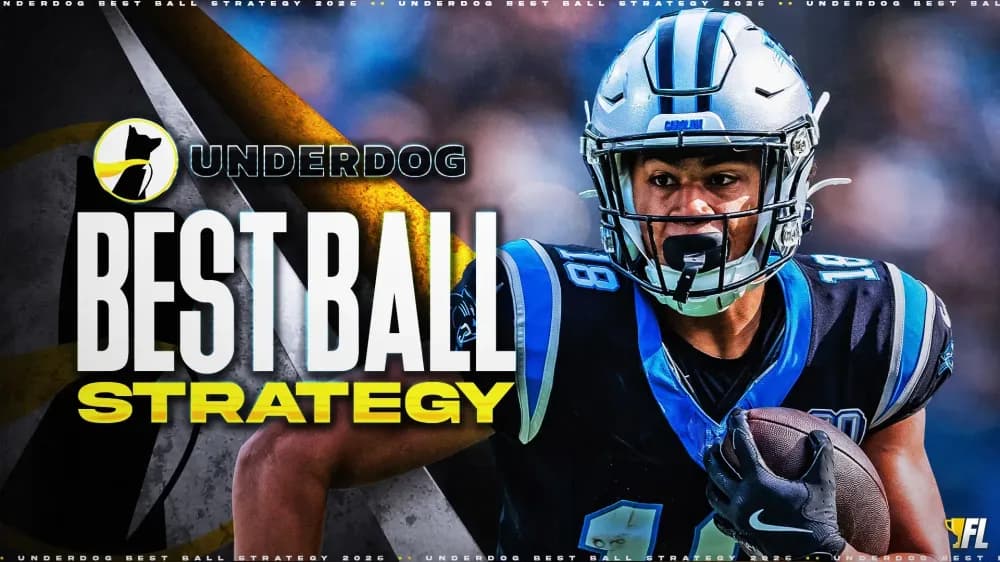
10 Late-Round ADPs To Target In Underdog Best Ball Drafts: Jalen Coker and More
Adam Pfeifer breaks down 10 players with late-round ADPs on Underdog who could vastly outperform expectations in 2026.
You can have a ton of success drafting best ball teams.
But when you draft could make all the difference.
ADP will continue to fluctuate, presenting value opportunities if you are grinding early in the offseason. Looking at some Underdog ADP, let’s highlight 10 players with immense upside in the later rounds of drafts.
Late-Round Best Ball Targets On Underdog
 Kyler Murray | QB | MIN
- Underdog ADP: 144.5, QB22
It may seem crazy, but there was a reason there was fantasy appeal with J.J. McCarthy once upon a time. Whether it was Kirk Cousins, Sam Darnold or even Joshua Dobbs, Kevin O’Connell’s offenses have boosted fantasy production from signal callers in the past.
Vikings QBs under Kevin O’Connell | ||
|---|---|---|
| Year | Player | FPPG |
| Kirk Cousins | 18.0 | |
| Kirk Cousins | 19.3 | |
| Nick Mullens | 17.8 | |
| Joshua Dobbs | 19.1 | |
| Sam Darnold | 18.8 | |
2023 was a wild year for the Vikings. Three different quarterbacks helped us out in fantasy, including Mullens and Dobbs to end the season. After Kirk Cousins tore his Achilles in Week 8, Dobbs took over as the starter, ranking as the QB11 in PPG in four full starts from Weeks 9-12. And once Mullens took over from Weeks 15-18, he averaged nearly 18 fantasy points per game, operating as QB13 during that stretch. Now go ahead and tell me what Mullens or Dobbs did in their NFL careers outside of a stretch with O’Connell in Minnesota.
I’ll wait.
Murray is a much, much better quarterback and still provides that rushing floor we love for fantasy. Last season in Arizona, Murray handled 11% of the designed rush attempts, to go along with a 9% scramble rate. His 34.6 rushing yards per contest ranked fifth among quarterbacks last season, while rushing for at least 25 yards in all five starts.
Assuming Murray opens the year as the starter, the only question I have is how well he’ll transition from more under center. Murray has been at his best out of the shotgun/pistol, though his under-center rate has climbed in two seasons with Drew Petzing in Arizona. Regardless, given his fantasy track record and the skill position players around him, a return to QB1 status is very possible.
 Jalen Coker | WR | CAR
- Underdog ADP: 118.5, WR46
I highlighted Coker in my 32 stats article as an underrated sleeper wideout entering 2026. For starters, we tend to see receivers really hit their stride in year three of their careers (Michael Wilson, anyone?), and once Coker was healthy last season, he made an impact. Following Carolina’s Week 14 bye, Coker saw a healthy 22% target share. And during that stretch, Coker averaged 6.0 targets, 4.8 receptions, 61 receiving yards and 14.5 PPR PPG, which included an impressive 9-134-1 stat line in a playoff loss against the Rams. A healthy start to the season and an uptick in passing could lead to a breakout year three from Coker.

 Jalen McMillan | WR | TB
- Underdog ADP: 158.7, WR57
McMillan is the definition of high upside. We didn't see much of him in 2025, but as a rookie in 2024, McMillan scored 8 touchdowns on 37 catches, while averaging 10.4 fantasy points per game, despite seeing just 4.5 targets per game. Entering 2026, McMillan is fully healthy and is set to play a larger role following the departure of Mike Evans. It’s also worth pointing out that once he returned from injury last year, the Bucs thrust him into a notable role, logging 56% of the routes.
 Josh Downs | WR | IND
- Underdog ADP: 155.3, WR56
I still firmly believe Downs is a good wide receiver. Among wideouts with at least 100 routes last season, Downs ranked 11th in TPRR vs man coverage (29%). Despite being just 5-foot-9 and 171 pounds, Downs has the footwork, release and route-running ability to play on the perimeter, even though he’s primarily played in the slot.
The absence of Michael Pittman Jr. should open up more opportunities for Downs, who didn’t play when the Colts were in two-wide sets last season. And Downs can soak up plenty of targets in the area of the field that Pittman operated. Pittman’s 14 RPO targets were good for the third-most in football last season. Those are often designed, quick-hitting passes that are only made for one pass catcher. It wouldn’t surprise me to see a handful of those looks go towards the direction of Downs in 2026.
 Malik Willis | QB | MIA
- Underdog ADP: 146.2, QB23
Yes, I understand he has no one to throw the ball to (for now). But Willis still offers so much fantasy upside, especially at a current ADP of QB23. There’s no doubt in my mind that by the time we hit May, Willis is going to be drafted as a borderline top-15 fantasy signal caller. So if you really want him on your fantasy teams, now is the time to pounce. After shining in spot starts during his tenure in Green Bay, Willis will now start for the Dolphins. On 89 pass attempts over the last two years, Willis is averaging 11.1 yards per attempt. And across three starts during that span, Willis is averaging 23.3 fantasy points, seven rush attempts and 58 rushing yards per game.
 Chris Rodriguez | RB | JAX
- Underdog ADP: 235.7, RB60
All of the hype is surrounding Bhayshul Tuten. And for good reason. But Rodriguez at RB60 is still intriguing, even if you ignore the college narrative with head coach Liam Coen. In a smaller sample size throughout his career, Rodriguez has been an efficient rusher, averaging 4.6 YPC on 198 career totes. And among running backs with at least 100 carries last year, Rodriguez impressed:
- 28.5% first down rate (5th)
- 46.4% success rate (7th)
- 0.06 EPA/rush (4th)
Tuten should lead this backfield, but I’m not convinced it’s a runaway. In fact, the Fantasy Life projections currently have Tuten at 185 carries and Rodriguez at 136.
 Mark Andrews | TE | BAL
- Underdog ADP: 152.9, TE15
Look, I’ve written about Andrews more than any other player this offseason. I think this ADP is just wrong, and if you want more thoughts on why I’m high on Andrews this season, you can check it out here. Oh, by the way. The Fantasy Life projections have Andrews scoring the most touchdowns among tight ends in 2026.
 Romeo Doubs | WR | NE
- Underdog ADP: 140.6, WR51
Admittedly, a lot of Doubs’ ADP is likely due to the ongoing A.J. Brown rumors. But if he isn’t a member of the Patriots in 2026, this is going to be a screaming value.
Doubs would enter the season as Drake Maye’s top target, which is extremely enticing. In 2025, Maye ranked third in deep ball completion rate (52.4%) and seventh in catchable deep ball rate (54.3%). Doubs can make plays at the second level, while also presenting touchdown upside. Last season in Green Bay, Doubs was responsible for 32% of the team’s targets from inside the 10-yard line, the eighth-highest rate in football.
 Chig Okonkwo | TE | WAS
- Underdog ADP: 232.7, TE31
Washington will surely add to the pass-catching room, but as of right now, Okonkwo projects as the second option in this passing game. He replaces Zach Ertz, who wasn’t the most exciting player, but his role was more than fantasy-relevant. Last year, Ertz ranked fifth among tight ends in target share (21%), sixth in end zone target share (24%) and 10th in expected fantasy points per game (10.1). And over the past two seasons, Ertz has run 78.5% of the routes, while Okonkwo hasn’t even reached 65% of the routes in Tennessee during that span.
Still just 26 years old with plenty of talent, Okonkwo is a sneaky breakout candidate in Washington.
 Emanuel Wilson | RB | SEA
- Underdog ADP: 226.8, RB56
The uncertainty in Seattle’s backfield may lead others to avoid, but that very murkiness makes me want to attack. Sure, we don’t know who will get the opening carry for the Seahawks in Week 1.
But that creates opportunity.
The Seahawks added Wilson this offseason, who will compete with George Holani and whoever the team drafts in April while Zach Charbonnet recovers from his ACL tear. Holani has been with Seattle since 2024, but he has 25 career carries to Wilson’s 258, where he’s averaged a solid 4.4 YPC. And when given opportunity, he’s produced, averaging 13.6 fantasy points per game in eight outings with at least 12 touches since 2024.

Join Our Newsletter
Trusted by 400,000+ fantasy football players. Get access to Fantasy Life's free award winning newsletter and tools, all in one step.
By registering or logging in, you agree to our Terms of Use and Privacy Policy.
Players Mentioned in this Article


Published Updated