
Eli Stowers Prospect Profile From The 2026 Rookie Super Model
Dwain McFarland breaks down the 2026 Rookie Super Model's read on QB-turned-TE Eli Stowers.
How does a QB-turned-TE stack up in the 2026 Tight End Rookie Super Model? We can start to answer those pressing questions thanks to the TE2 in the 2026 class, Eli Stowers. For the full TE class, check out the 2026 TE Rookie Super Model.
If you're new to the model, here is an introductory breakdown of the Rookie Super Model, which rates players on a scale of 50 to 100 based on a composite score across Draft Capital, Production and Film. All of this data is integrated into our free NFL Draft Guide, full of big board rankings, mock drafts and more.
You can find a glossary of terms and stats used in this breakdown at the bottom of the prospect profile.
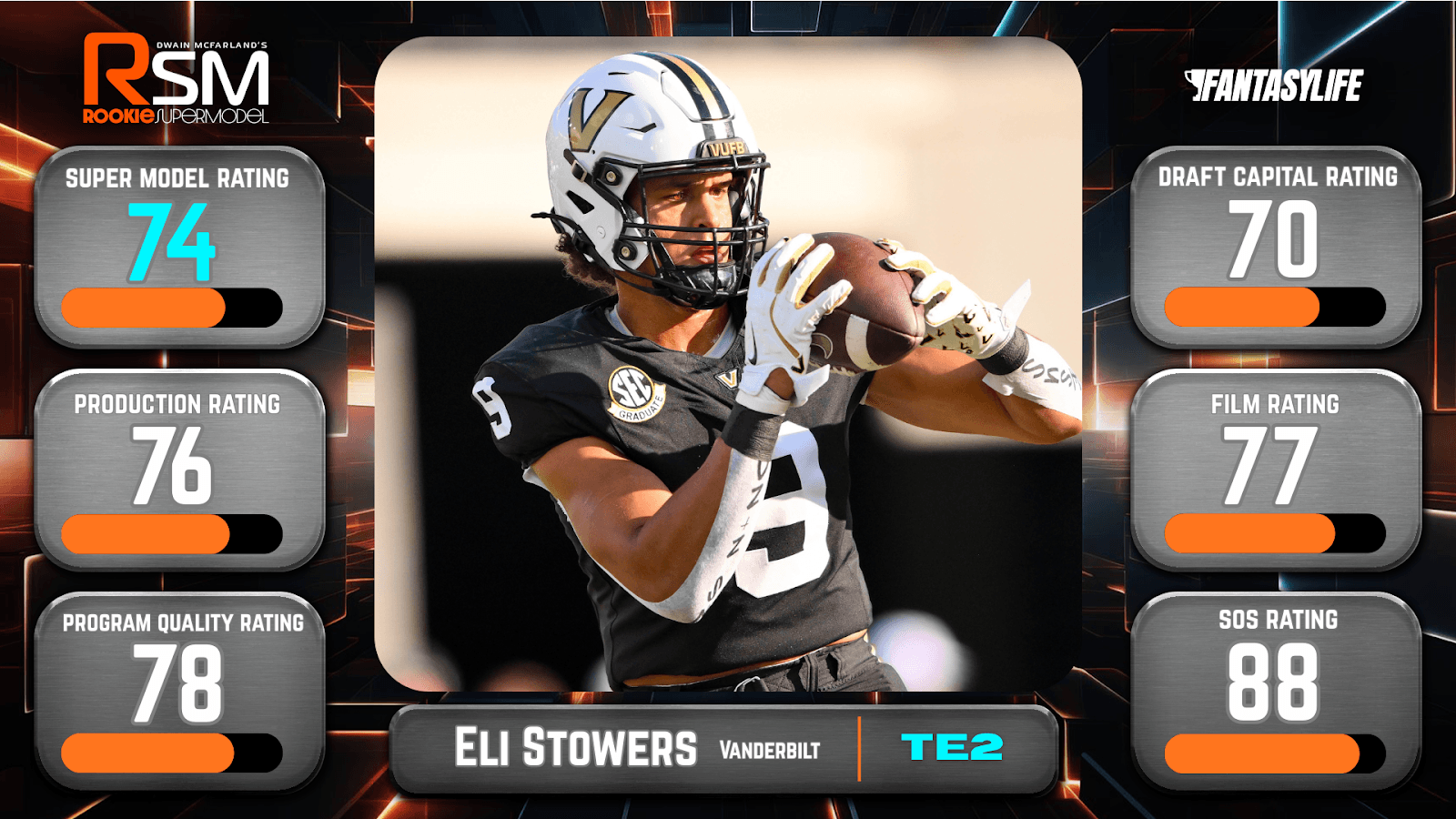
Rookie Super Model Prospect Profile For TE Eli Stowers
- Super Model Rating: 74 (19th)
- Draft Pick (Based on Mock Draft data): 47
- Rookie Age: 23.4
- Height: 76 inches
- Weight: 239 pounds
Stowers was a consensus four-star quarterback recruit in the 2021 class out of Denton, Texas. According to 247Sports, he was the No. 12 QB in the nation, and Rivals ranked him as the No. 5 dual-threat QB.
He dealt with injuries during his first two seasons at Texas A&M. In his third season, he transferred to New Mexico State and switched to TE. He played a part-time role, but did enough to open the door to the transfer portal again, where he was a three-star TE prospect.
Stowers played Years 4 and 5 at Vanderbilt, where he became the centerpiece of their passing offense. In his final year, he won the John Mackey Award as the best tight end in the nation.
This put him on the radar of NFL teams, earning an invite to the NFL Scouting Combine, where he nailed the biggest job fair of his life. Stowers tested through the roof, pushing his draft stock even higher.
The five-year collegiate player isn't your typical late-bloomer because he swapped positions—he is an ascending TE prospect who was far more productive than Kenyon Sadiq.
What the Production Says
Not switching to TE until his third season ultimately holds down Stowers' Production Rating (76) due to a mediocre adjusted career RYPTPA.
- Adjusted Career RYPTPA: 45th percentile
- Targeted QB Passer Rating: 109.6, 68th percentile
Adjusted Career RYPTPA: Career receiving yards per team pass attempt adjusted for age, strength of schedule, QB play, teammate competition, aDOT and alignment. Doesn't count games missed.
Stowers is a tricky player because the model doesn't know he swapped positions, and early-career RYPTPAs get more weight during the age/class adjustment. But for experimental purposes, if we wanted to say Year 3 was his first year to play TE and evaluate production from there, his class-adjusted RYPTPA would jump to the 80th percentile.
- First year playing TE (Year 3): 0.92 RYPTPA, 24 YPG, 2 TDs
- Second year playing TE (Year 4): TE: 2.11 RYPTPA, 50 YPG, 5 TDs
- Third year playing TE (Year 5): TE: 2.12 RYPTPA, 64 YPG, 4 TDs
Let this sink in: That would push Stowers' adjusted career RYPTPA to the 75th percentile. His Production Rating would climb from 76 to 88. That would be the sixth-highest in the model's history. His overall Rookie Super Model Rating would climb to 78 (11th all-time).
This raises a fundamental question about prospects. How much do we care about their age or years in college in a case like this? We know those factors matter for most prospects, but there are unique circumstances. It is a question I will be pondering for the 2027 Rookie Super Model. Well, at least I will be discussing it with Matthew Freedman over some BBQ and hopefully a beer or three!!!
 Nerd Note: RYPTPAs in Years 1-3 have a much stronger correlation with future production in the NFL. In fact, Year 5 has a negative correlation with TE fantasy success. Because of this, RYPTPA data from the first three years carries more weight, with a small weight to Year 4. Many of the best prospects break out early in college because they can ball, y'all!
Since Stowers didn't get TE snaps until year three, let's take a look at a few other data points:
- Career YPRR: 2.34 (78th percentile)
- Career FDPRR: 12% (82nd percentile)
- Career TPRR: 27% (80th percentile)
- Career TPRR Man/Zone Splits: 29% (7th all-time), 25% (6th all-time)
Those are excellent numbers that support the idea that the model could be undervaluing Stowers as a prospect.
Beyond the Production
Stowers attacked all levels of the field, but was primarily a shallow target.
- Behind the line of scrimmage: 15% (+4 vs avg)
- Short (0-9 yds): 51% (+1 vs avg)
- Medium (10-19 yds): 24% (-3 vs avg)
- Deep (20+ yds): 9% (-3 vs avg)
His 7.6-yard career aDOT (36th percentile) also paints him as an underneath target maven. However, his dual-threat QB skills came into play after the catch. His 6.5 YAC was +1.1 over expected after adjusting for aDOT.
Stowers also demonstrated good hands with a 3% drop rate, but struggled in contested-target situations with a 41% catch rate. That is below the 50% catch rate for players with a similar aDOT.
Perhaps the biggest question for Stowers: can he play a full-time role in the NFL? He aligned in-line only 20% of snaps and struggled as a run blocker with a PFF Run Block Grade of 53.3 (29th percentile). He might need to put on more weight (239 pounds) and improve as a blocker to unlock an 80% route participation rate. If he can't do that, he could get Juwan Johnson-like treatment in the NFL.
It is worth noting that we have seen some poor PFF Run Grade players find full-time roles, such as Colston Loveland (26th percentile) and Sam LaPorta (36th percentile). They weighed 248 and 245 pounds, respectively.
Lance Zierlein of NFL.com sees Stowers as a "natural pass catcher with an outstanding catch radius and massive run-after-catch talent." However, he has concerns that Stowers' run-blocking ceiling is low and could get typecast as more of an "F" tight end or TE2. He also notes a need to improve in contested-catch situations. This is one of the cases where the film mostly aligns with the data. Zierlein's prospect grade on Stowers: 6.24 (55th percentile).
Stowers knocked the athletic testing at the NFL Scouting Combine out of the park.
- 40-yard dash: 4.51 seconds (83rd percentile)
- Speed Score: 115.5 (70th percentile)
- Vertical: 45.5 inches (99th percentile)
- Broad: 135 inches (99th percentile)
While Speed Score is the only component the Rookie Super Model factors for TEs, the NFL cares about these tests, and that is good news for Stowers' draft stock.
Fantasy Outlook For TE Eli Stowers
Disclaimer: While I haven't changed Stowers' rating in the model, I will use a slightly higher rating to capture his range of outcomes. He is an outlier scenario because he played QB his first two years.
Since 2018, 14 TEs have posted a Super Model rating between 73 and 83, with 50% delivering a top-12 finish by Year 3.
- Top-six finishes: 21%
- Top-nine finishes: 43%
- Top-12 finishes: 50%
Stowers' closest Super Model comps:
Bottom line: The Rookie Super Model sees Stowers as a mid- to late-Round 2 NFL Draft pick. However, the model doesn't know he played QB for two seasons before switching to TE. Stowers is the best receiving TE prospect in this class. He has demonstrated target-hog upside and is a plus athlete with the ball in his mitts. Ultimately, the landing spot could be critical early due to blocking concerns. To unlock an early full-time role, we need a creative offensive coordinator who sees his receiving skillset as a reason to figure out how to keep him on the field. If he adds weight and improves as a blocker, the sky is the limit. Stowers is a borderline TE1 with mid-range TE1 upside.
Glossary of Terms In The Prospect Profile
- Adjusted Career RYPTPA: Career receiving yards per team pass attempt adjusted for age, strength of schedule, QB play, teammate competition, aDOT, and alignment. Doesn't count games missed.
- aDOT: Average depth of target in yards.
- Career Targeted QB Passer Rating: Passer rating on WR's targets.
- Contested catch rate: Percentage of contested targets caught.
- Contested catch rate over expected: Percentage of contested targets caught after adjusting for aDOT.
- Draft Capital Rating: Based on Chase Stuart's Draft Value Chart, an improved version of what many know as the Jimmy Johnson trade chart. It accounts for the larger drop-off in the first round and a flatter drop-off around the end of the second round.
- FDPRR: First downs per route run. Often shown as a percentage (first downs divided by routes).
- Film Rating: Based on NFL.com prospect grades from Lance Zierlein.
- Production Rating: A combination of adjusted career RYPTPA and career targeted QB passer rating.
- Program Quality Rating: ESPN's College Football Power Index is used to assess program quality. The model accounts for each school a prospect attended.
- RYPTPA: receiving yards per team pass attempt.
- SOS Rating: Based on strength of schedule (SOS) from Sports Reference. The model accounts for each school the prospect attended.
- Target Share: A player's percentage of team targets in games played.
- TPRR: Targets per route run.
- YAC: Average yards after the catch.
- YAC over expected: YAC over expected after adjusting for aDOT.
- YPG: Yards per game.
- YPRR: Yards per route run.

Join Our Newsletter
Trusted by 400,000+ fantasy football players. Get access to Fantasy Life's free award winning newsletter and tools, all in one step.
By registering or logging in, you agree to our Terms of Use and Privacy Policy.
Players Mentioned in this Article








Published Updated