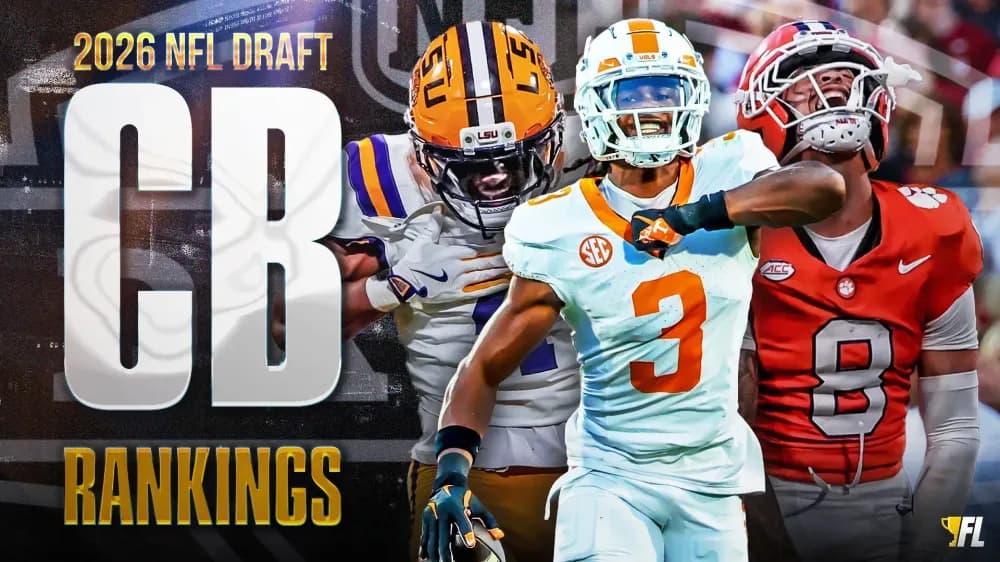
2026 NFL Draft Cornerback Rankings: Jermod McCoy, Mansoor Delane and More
Gene Clemons breaks down how he ranks the cornerbacks in the 2026 NFL Draft class after the Combine and as we approach draft day.
The opening week of NFL free agency is coming to a close as we inch one week closer to the draft, continuing to go position by position through our rankings. Up next? My 2026 NFL Draft cornerback rankings.
See below for more of our positional ranking analysis from Matthew Freedman and me. You can find big boards, mock drafts and more analysis for free in our NFL Draft Guide.
- 2026 NFL Draft QB Rankings
- 2026 NFL Draft RB Rankings
- 2026 NFL Draft WR Rankings
- 2026 NFL Draft TE Rankings
- 2026 NFL Draft OL Rankings
Let's dive into my CB rankings.
Cornerback Rankings For The 2026 NFL Draft
Jermod McCoy | Tennessee | 6-0, 193 lbs. | JR
Amazingly, McCoy is the top-rated cornerback in the 2026 NFL Draft class despite not playing a down of football in the 2025 season and recovering from a knee injury. That’s how phenomenal he was in 2023 and 2024. He has 22 passes defended and six interceptions in his two seasons of play. His first came at Oregon State, and in 2024, he became a first-team All-SEC and second-team All-American at cornerback for the Volunteers.
There’s a reason that he has so many passes defended—his elite ball skills. The post-season evaluation circuit will go a long way in proving that his athleticism is back where it was pre-injury, but clearly, McCoy is not worried about that. He could have easily returned to Tennessee if there were any concerns that he would not be ready for the rigors of an NFL season.
The highlight of his collegiate career came in his matchup against superstar Alabama WR Ryan Williams. With Alabama on the goal line threatening to score, they were looking to throw a fade route for a touchdown to Williams, who was lined up out wide with McCoy pressed up on him. On the snap, McCoy was able to stab Williams with his inside hand and control his feel for the receiver’s movement. He was then able to look back for the pass from Bama quarterback Jalen Milroe. When the ball went up, McCoy kept enough distance between himself and Williams that it prevented the receiver from using his body as leverage. Then, McCoy threw his hand out for the pass while jumping and snatched it into his body. He then took off the other way and returned the interception 54 yards. It was not the only time he made a team play for testing him with a fade pass, but it was the most high-leverage situation and cemented the young prodigy as a college football star.
Mansoor Delane | LSU | 6-0, 191 lbs. | SR
Delane is one of the more versatile defensive backs in this draft. He can play cornerback as well as safety. He has the flexibility to play on the inside as well as the perimeter, which is why his highest ceiling is on the outside at cornerback. At cornerback, all of his tools can be utilized; his physicality, which makes him one of the best tacklers at the position, veteran experience with his four seasons of college play and elite athleticism that includes great speed can make him a system-proof asset for any organization looking to upgrade in the secondary.
One of the parts of his game that does not get discussed enough is his football IQ. His route recognition is second to none in college football. It allows him to seem as if he is running the route for the receiver. In zone coverage, it feels like he can stay a step ahead of the receiver and attack the football. That is made possible because of his elite change of direction. It feels like his toes are pointed in all directions at the same time. He can shift and cut on a dime while moving full speed. It’s also one of the reasons why he has 153 tackles over the past three seasons; he can change direction and get to the ball carrier immediately. That is what has led to his six interceptions and 18 passes defended over the past two seasons.
He was a Bednarik Award semifinalist, a Thorpe Award finalist, an All-SEC First Team selection and a unanimous selection as a first team All-American, garnering the honor from all five major outlets that release awards. He is the definition of production over promise, and that should help him hit the ground running on day one in the NFL.
Avieon Terrell | Clemson | 5-11, 180 lbs. | JR
Terrell is ready to go into the family business as a cornerback in the NFL. His older brother, A.J. Terrell, just played his sixth season as a cornerback for the Atlanta Falcons, so you know the bloodline is elite. Both brothers starred at Clemson, and now both will be in the league. Seeing that level of excellence most of his life is likely where his elite competitive nature comes from. A feeling that he needs to live up to what his brother has done, and so far, he is succeeding. Terrell can stay connected with any receiver in pass coverage, like he’s being worn as a coat.
Terrell was a second-team All-ACC performer in 2024 and improved that to a first-team selection in 2025, showing his continued improvement throughout his career. That is why so many recognize him as a top prospect, not simply because of the familiarity with his last name.
The skills that Terrell possesses are the biggest reason that he is considered one of the best prospects in the draft. There are not many who have the fluidity in their movements and possess the change-of-direction ability to constantly harass receivers while they run their routes. Being able to mirror receivers without losing his position gives him the ability to make a play on the pass when the quarterback throws it, not just try to tackle the receiver when the ball is caught. He has great ball tracking skills, which is why he has 21 passes defensed over the last two seasons, and there is still more refinement to be made in his game. He has everything athletically you want, and there is no doubt that he has been training like a pro since arriving at Clemson. This is the natural step for him, where he can garner that refinement at the level he plans to be at for the next 10-12 years if he is fortunate enough.

Unlock Our Tools!
Stop hitting the paywall. FL+ gives you access to our premium in-depth content, expert rankings & projections, mock draft simulator, and all the tools you need – all personalized to your league.
Colton Hood | Tennessee | 6-0, 195 lbs. | rSO
The advantage of playing cornerback for three different programs in three seasons is that you get a chance to learn multiple defensive schemes, techniques and responsibilities. Hood, the nephew of former eight-year NFL cornerback Roderick Hood, has the advantage of this experience during his time in college. Over the past two seasons for Colorado and Tennessee, he had three interceptions and 14 passes defensed. He is aggressive in man coverage thanks to his time with Coach Prime in Boulder, and he is a surprisingly good tackler in open space, which is handy when you play a lot of man coverage and have to close on receivers who catch passes around him.
This season with the Volunteers, he finished with 50 tackles—over double the amount amassed in 2024. That speaks to an increase in his physicality as well as a change in defensive philosophy. He was able to work on mixing and disguising coverages more often at Tennessee, where that defense utilized a more diverse coverage package, and he clearly adapted well to it. He spent more time at the line of scrimmage, illustrated by his 4.5 tackles for loss after recording only one in his previous two seasons of play. He earned All-SEC Second-Team cornerback honors and he was a semifinalist for the Thorpe Award.
Year three in college established that Hood is equally adept at playing man coverage as he is performing in zone coverage. You can tell he’s a student of the game based on his route recognition and understanding of passing concepts. Even though his tackling needs a good bit of refining, he has shown this past season that he is a willing tackler, not afraid to get his jersey dirty when necessary. He has good footwork while working through press coverage, and that assists with being in position to use his good ball skills to disrupt passes or intercept the football. He has experience as a returner as well, which should also bolster his stock as someone who can come in and make an impact on special teams as well as defense.
Chris Johnson | San Diego State | 6-0, 195 lbs. | SR
Johnson is one of the most intelligent and disciplined cornerbacks in college football, and he has played his best football this season. He has scheme versatility as a cornerback, operating well in zone coverage and man schemes. He had a career-high in interceptions with four, and passes defended with nine. He also returned two interceptions for touchdowns. He’s not afraid to stick his nose in the mix and get his uniform dirty. He has 116 tackles over the past two seasons and three tackles for loss this season, another career high. His physicality can't be ignored.
What has been impressive about his ascent, besides his loyalty to San Diego State, has been his consistent improvement throughout the years. He went from the team's special teams player of the year to All-Mountain West Honorable Mention, to First Team All-Mountain West. In his junior season, he really showed his improved physicality and aggressiveness as a tackler. 49 of his 67 tackles were solo, and he also forced three fumbles. It silenced any questions evaluators would have about his tackling ability or his physicality against the run. He doubled back for his senior season and put together his best year as a coverage specialist. That is why there were career highs in every coverage area. He showed elite anticipation and the ability to react quickly when the pass was released.
All of his hard work and attention to refining the elements of his game, necessary to be a serious prospect, earned him the Mountain West Conference Defensive Player of the Year. He also earned second-team AP All-American honors and other All-American accolades from various publications. It also allows him to go into this evaluation period as a player who has the versatility to play anywhere that a defense would need a cornerback to play. Whichever team grabs him will have an immediate upgrade on special teams and a proven leader by example, not afraid to get in the lab and improve on the design.
D’Angelo Ponds | Indiana | 5-9, 170 lbs. | JR
Ponds is the definition of a gnat that you can't get rid of or away from. No, he’s not the mold of many of the bigger cornerbacks in this draft, but many of them do not have feet like Ponds. His fast feet allow him to change direction quickly and stay attached to receivers. He knows how to shadow a receiver, and that makes him difficult to shake without being too grabby. His closing speed allows him to get beat off the line of scrimmage and still make up the difference when the ball goes in the air. The best part is his physicality. Don't be fooled by his size; he plays big against the best.

Join Our Newsletter
Trusted by 400,000+ fantasy football players. Get access to Fantasy Life's free award winning newsletter and tools, all in one step.
By registering or logging in, you agree to our Terms of Use and Privacy Policy.
Davison Igbinosun | Ohio State | 6-2, 195 lbs. | SR
Igbinosun has elite length and the physicality to be a great cornerback in the NFL. He is a physical specimen who has a frame that can still hold more weight. He is intimately involved as a run defender since joining the Buckeyes in his sophomore season, having averaged more than 50 tackles each of the last three seasons. He is physical at the line of scrimmage and uses his length to disrupt the timing of routes before they have the chance to find their rhythm. He can grab on to receivers a little too much when trying to pattern match, but that physicality can be cleaned up with slightly better technique.
Brandon Cisse | South Carolina | 6-0, 190 lbs. | JR
South Carolina has become known for their zone coverage, and understanding how to play it can make or break a cornerback in their system. So when Cisse transferred from North Carolina State, where he was an All-American as a freshman, to the Gamecocks, he brought with him a great understanding of zone coverage and showed a tremendous amount of eye discipline. He also plays well in press to disrupt routes. He is long and athletic and can use his length to get hands on receivers while also using the ability to identify and close on passes with super twitchy movements that keep him around the football.
Devin Moore | Florida | 6-3, 198 lbs. | SR
Moore is a long, athletic cornerback with a ton of upside as a big field defender who can neutralize the tall, big X-receivers. What he lacks is the most important ability: availability. He's dealt with numerous injuries that have kept him out of the game while at Florida. He is good in press coverage and knows how to get his hands on receivers and work them towards out of bounds on vertical routes. He is great at tracking the ball in the air and tends to win those jump-ball opportunities against receivers; either he gets his hands on the ball, or he does a great job of knocking it away from the receiver. If he can show that he can be healthy, he could be a steal in this draft.
Jadon Canady | Oregon | 5-10, 175 lbs. | rSR
Canady has been well-traveled over his five seasons in college. He began his career at Tulane before heading to Ole Miss and then to Oregon. He has played cornerback and safety and has a ton of upside as a slot corner or a nickel back. He may be shorter and slimmer than some of the other elite talents in the draft, but don't let that fool you. He’s physical against bigger tight ends, and he is a vocal leader who has the respect of his teammates because he plays the game from the neck up. He has fewer route recognitions and wins a lot of matchups before the ball is snapped.
Chandler Rivers | Duke | 5-10, 180 lbs. | SR
Rivers has been a quality producer at cornerback since his first season with the Blue Devils. He has played in 52 games over four seasons at Duke, which speaks to his durability, his loyalty and his desire to answer the call on gameday. He is not afraid to set an edge, tackle in the open field or run down on a special team and hit someone. He has exceptional closing speed and plays well in zone coverage. His skills and size could make him an immediate asset at nickel and on special teams. He has decent ball skills and has amassed seven interceptions to go with his 29 passes defensed.
Will Lee III | Texas A&M | 6-3, 189 lbs. | SR
Lee is another example of perseverance in college football. He went from Missouri high school football to Junior College, then to the Big 12 and the SEC. Now, he’s one of the best in college football. He is not the fastest corner, but he uses his extreme size for the position to disrupt receivers. He has a massive wingspan thanks to his pterodactyl-like arm length. Not only do they allow him to have success in press coverage, but they also allow him to get his hands on or around a lot of footballs in coverage opportunities. His 18 passes defensed over the last two seasons are a testament to him showing up against high-quality SEC talent. He is a willing tackler and even does a good job of defeating blocks.
Julian Neal | Arkansas | 6-2, 203 lbs. | SR
Neal is another one of those fifth-year guys who really came into his own late in his collegiate career. He is a big and physical cornerback who has an intimidating presence when lined up over receivers. He has prototypical measurements for a press corner, although he still needs to refine his technique. What he does well is make the receiver wear him while they're running their routes. He's very sticky and keeps his body on the receiver, making it much more difficult for them to create separation. He should have an immediate impact on special teams and, with a little seasoning and correction, could blossom into a great rotational piece for a defense.
Keionte Scott | Miami (FL) | 6-0 195 lbs. | rrSR
Scott is a physical and highly aggressive defensive back who is always ready to mix it up. He is a triple threat as a slot defender. He’s good in coverage, a great tackler and he has added value as a blitzer. In his first season with the Hurricanes, he has accumulated career highs in interceptions (two), tackles (58) and sacks (five). His aggression can sometimes get him in trouble, falling for pump fakes or double moves, but more patience can be developed as he matures as a pro. Scott could be a special teams ace and a nickel or dime specialist thanks to his physicality/coverage combination.
Malik Muhammad | Texas | 6-0, 188 lbs. | JR
Muhammad is a versatile defensive back who has skills that could see him line up as a boundary cornerback, slot corner or safety. He’s been playing in high-stakes games his entire life. He was an instant contributor from the moment he set foot on the campus at the University of Texas. He has excellent hands and uses them to help control receivers by redirecting them from their routes. He has fluid hips and can turn in and out of his breaks well. He is a twitchy athlete and has no issues with closing on the receiver when the ball is thrown.
Devon Marshall | NC State | 5-11, 200 lbs. | SR
Marshall is a corner not afraid to be matched up one-on-one with elite receivers. He has the bravado and skill to back it up, despite not being as long or having the deep-ball speed that most need to be elite. His build actually helps him in press coverage to put a jolt into receivers when he gets his hands on them at the line of scrimmage. He also gets his hands on a lot of passes. He led the ACC in passes defensed this season with 16, and against future pros like Florida State receiver Duce Robinson, he showed that he wanted all the smoke as he was able to pick off the Seminoles twice.
Keith Abney II | Arizona State| 5-10, 187 | Junior
Abney is a fiery corner who has elite-level processing and recognition that allows him to win on a consistent basis. He will not wow you with his size or his physical presence, but he understands how to play the game of football at its highest level. He would be an ideal boundary corner and could slide inside and be an elite-level nickelback. He is physical in press coverage and especially effective at the first and second levels. At the third level, he can get a little lost, but by that time, he has disrupted the flow of the route from the receiver, making it more difficult for the quarterback to trust throwing the pass. Don't be surprised if he finds his way on the field for some team sooner rather than later.
Cam Miller | Rutgers | 6-0, 192 lbs. | SR
Miller is a slot corner with length who can bring immediate value to a team as a nickel corner and on special teams. He’s played in a lot of Big Ten action as a starter for Penn State and then Rutgers. While he isn’t the most physically aggressive on the inside, he’s not afraid to get dirty. He also has a knack for getting his body on a ball carrier's legs and getting him to the ground. He plays well, shadowing defenders in man, but really shows off his ability to sink his hips and burst out while playing zone.
Al’zillion Hamilton | Fresno State | 5-11, 185 lbs. | SR
Hamilton is a rare breed in today's college football landscape. He has spent five seasons at Fresno State, not looking to chase the money or prestige of playing in a Power Four conference. He has good speed that he uses to stay step-for-step with receivers on deep passes. He also has good hands, which allow him to bat down passes and intercept balls. His four interceptions this season were a career-high for him after coming off a season where he recorded 13 passes defended. Even though he needs to improve his strength and aggressiveness in press coverage, his quickness allows him to still find success.
Join Our Newsletter
Trusted by 400,000+ fantasy football players. Get access to Fantasy Life's free award winning newsletter and tools, all in one step.
By registering or logging in, you agree to our Terms of Use and Privacy Policy.
Players Mentioned in this Article
 JalenMilroeQBSEA
- PPG
- 0.0
Published Updated