
Rating the 2026 NFL Draft Tight End Prospects: The Rookie Super Model
Dwain McFarland breaks down the 2026 Rookie Super Model's view of the tight end draft class.
Have you ever wondered how NFL Draft prospects stack up across multiple factors—draft pick, collegiate production and film? Yeah, me too.
That's why I built the Rookie Super Model. And it has a strong track record compared to NFL Draft pick alone. Using well-researched inputs that matter for TE prospects, we rate and tier the top 2026 TEs, with player comps and historical fantasy hit rates included.
Analysis here focuses on the bottom line, but full write-ups are linked throughout and accessible via the 2026 NFL Draft Guide under the Analysis tab. As we get updated mock draft and actual draft pick data, we will update the Rookie Super Model.
WHAT IS THE TIGHT END ROOKIE SUPER MODEL?
New to the Rookie Super Model? The introductory guide covers all the inputs by position and includes a glossary for any unfamiliar terms. We also have a quick-reference glossary at the end of this article. Returning Super Model lovers, welcome to Year 4!
In short, the model calculates a rating between 50 and 100 based on what has historically mattered most for NFL production. It accounts for age, strength of schedule, program quality, and teammates to normalize comparisons.
Don't fixate on exact grades—focus on tiers and range of outcomes. That's how you find over- and underpriced assets.
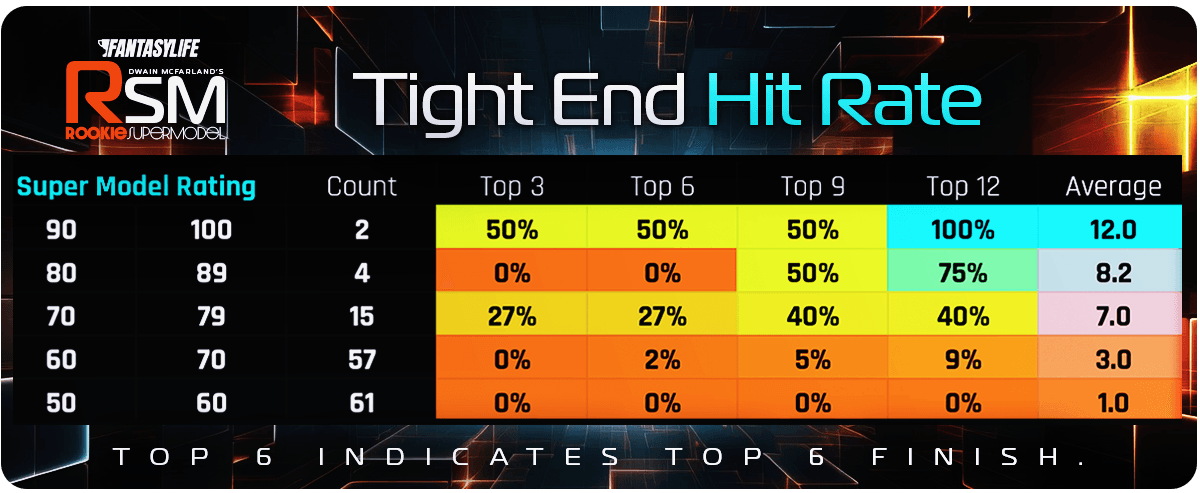
Below is a review of how TE prospects fared based on Rookie Super Model rating. For example, 100% of the TEs rated between 90 and 100 achieved a top-12 PPR finish by Year 3 versus 75% for TEs rated 80 to 89.
HOW DO THE 2026 TE DRAFT PROSPECTS COMPARE TO PRIOR YEARS?
Before we dive into the prospects, let's zoom out and assess the overall strength of this TE class. To do this, I have broken the prospects into three buckets:
- Super Model Rating: 90 to 100 (elite prospects)
- Super Model Rating: 80 to 89 (great prospects)
- Super Model Rating: 70 to 79 (good prospects)
The data below shows the number of elite, great and good prospects from each class since 2018:
- 2018: 0, 2, 7 (9)
- 2019: 1, 2, 7 (10)
- 2020: 0, 1, 10 (11)
- 2021: 1, 0, 4 (5)
- 2022: 0, 0, 11 (11)
- 2023: 0, 5, 6 (11)
- 2024: 0, 2, 9 (11)
- 2025: 1, 2, 13 (16)
- 2026: 0, 1, 20 (21)
For 2026, we are using mock draft data, so things will change when we get actual draft picks. But as of now, this TE class only offers one elite/great prospect, which is below average. However, we have a record-setting 21 options with a rating of 70 to 79.
Part of that is driven by the 27 invites to the NFL Scouting Combine, which is the modern record. But those invites also depend on the quality of the class, so they go hand in hand. Although a small portion of this spike might be attributed to the NFL's copycat nature, with multiple TE personnel groupings on the rise.
2026 TE ROOKIE SUPER MODEL RATINGS & TIERS
It's time to dive into the prospects, y'all! See below for how the Rookie Super Model views each 2026 TE prospect, ordered by tiers.
Tier 1: Low-End to Mid-Range TE1 Prospects
Kenyon Sadiq | Oregon
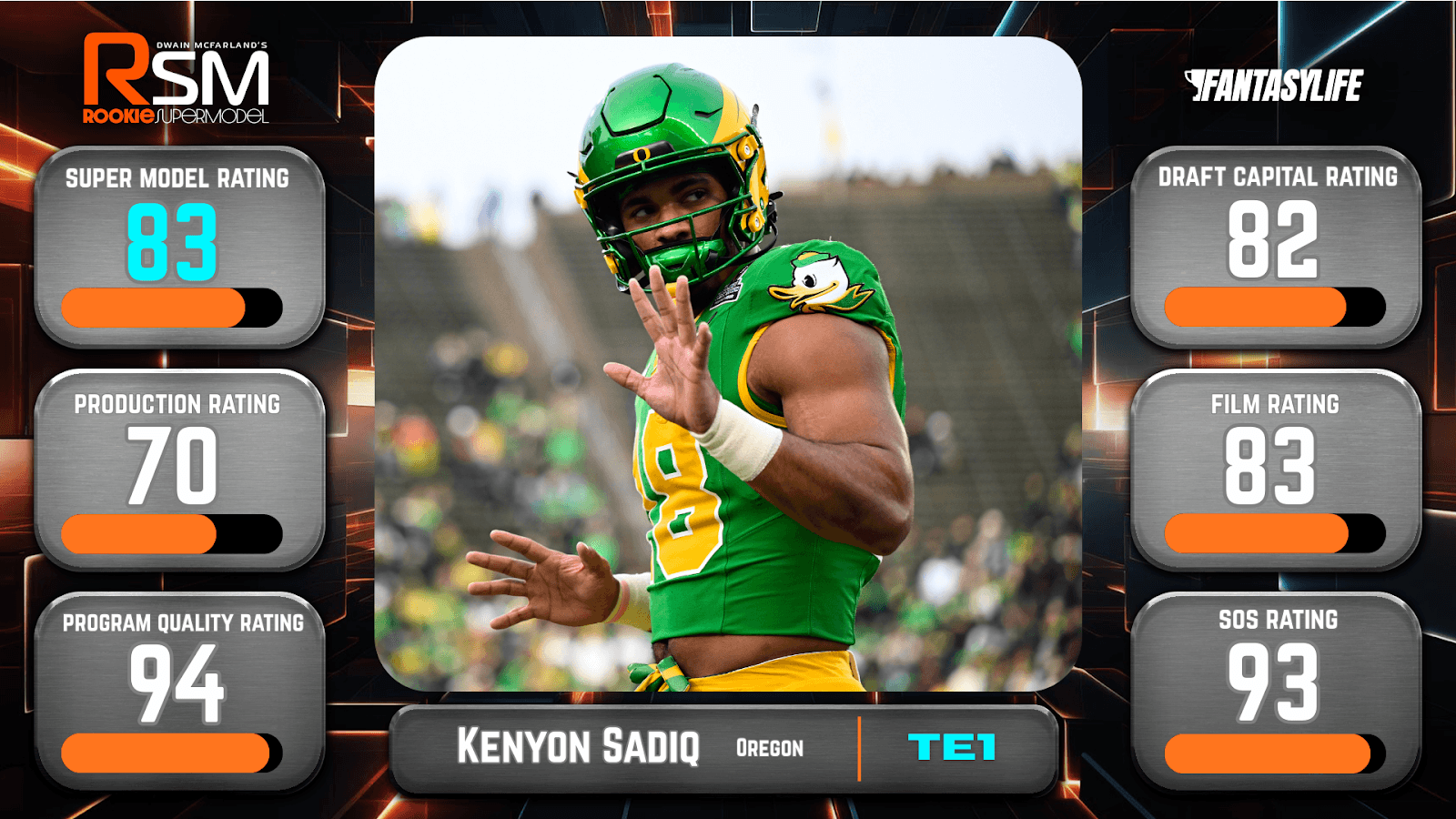
- Super Model Rating: 85 (6th since 2018)
- Draft Pick (based on Mock Draft data): 17
- Rookie Age: 21.5
- Height: 75 inches
- Weight: 241 pounds
- Complete Rookie Super Model Prospect Profile
Fantasy Outlook For Kenyon Sadiq
Since 2018, four TEs have posted a Super Model rating between 80 and 90, with 75% delivering a top-12 finish by Year 3. Because of the small sample size (four TEs), we have expanded the range, looking at Super Model ratings between 75 and 95:
- Top-six finishes: 30%
- Top-nine finishes: 60%
- Top-12 finishes: 70%
Sadiq's closest Super Model comps:
Bottom line: The Rookie Super Model views Sadiq as a mid-to-late Round 1 NFL Draft pick. He is a traits-based prospect who didn't get going until his final season in Year 3. Sadiq was never the alpha at Oregon, which is a significant red flag. He offers YAC upside, but could face playing-time restrictions, and the high drop rate is a concern. However, he is an elite athlete, and his Film Rating suggests untapped potential. Ideally, he lands with a creative offensive mind that views playmaking upside as the primary criteria for snaps. Sadiq profiles as a low-end TE1 with mid-range TE1 upside.
Kenyon Sadiq complete Rookie Model Prospect Profile
Tier 2: High-End TE2 to Mid-Range TE1 Prospects
Eli Stowers | Vanderbilt
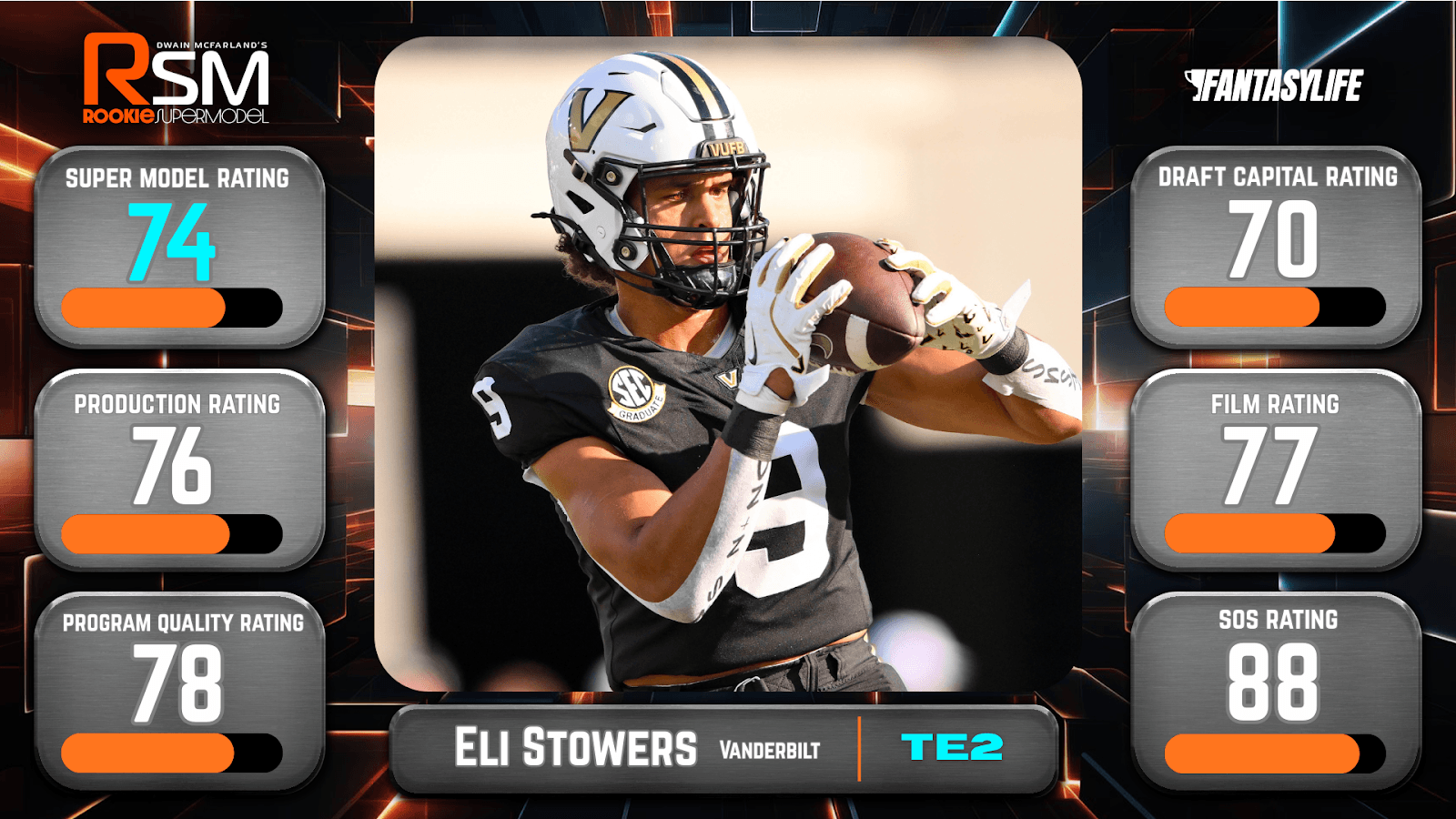
- Super Model Rating: 74 (19th)
- Draft Pick: 47
- Rookie Age: 23.4
- Height: 76 inches
- Weight: 239 pounds
- Complete Rookie Super Model Prospect Profile
Fantasy Outlook For Eli Stowers
Disclaimer: While I haven't changed Stowers' rating in the model, I will use a slightly higher rating to capture his range of outcomes. He is an outlier scenario because he played QB his first two years.
Since 2018, 14 TEs have posted a Super Model rating between 73 and 83, with 50% delivering a top-12 finish by Year 3.
- Top-six finishes: 21%
- Top-nine finishes: 43%
- Top-12 finishes: 50%
Stowers' closest Super Model comps:
Bottom line: The Rookie Super Model sees Stowers as a mid- to late-Round 2 NFL Draft pick. However, the model doesn't know he played QB for two seasons before switching to TE. Stowers is the best receiving TE prospect in this class. He has demonstrated target-hog upside and is a plus athlete with the ball in his mitts. Ultimately, the landing spot could be critical early due to blocking concerns. To unlock an early full-time role, we need a creative offensive coordinator who sees his receiving skillset as a reason to figure out how to keep him on the field. If he adds weight and improves as a blocker, the sky is the limit. Stowers is a borderline TE1 with mid-range TE1 upside.
Eli Stowers complete Rookie Model Prospect Profile
Tier 3: Mid-Range TE2 to Low-End TE1 Prospects
Max Klare | Ohio State
- Super Model Rating: 72 (25th since 2018)
- Draft Pick: 72
- Rookie Age: 23.2
- Height: 76 inches
- Weight: 246 pounds
- Complete Rookie Super Model Prospect Profile
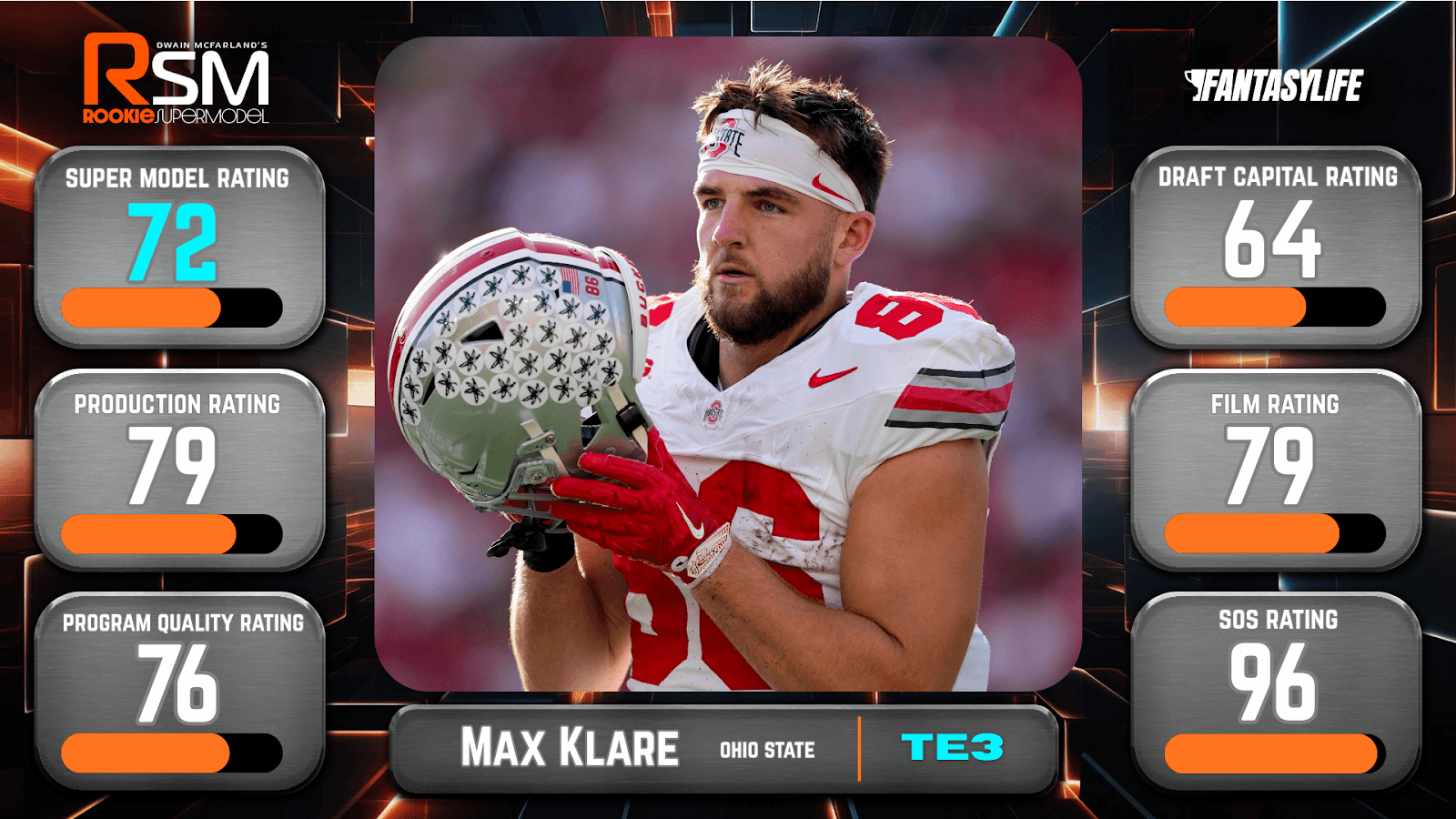
Fantasy Outlook For Max Klare
Since 2018, 33 TEs have posted a Super Model rating between 67 and 77, with 26% delivering a top-12 finish by Year 3.
- Top-six finishes: 13%
- Top-nine finishes: 13%
- Top-12 finishes: 26%
Klare's closest Super Model comps:
- Pat Freiermuth
- Harrison Bryant
Bottom line: The Rookie Super Model views Klare as a borderline Round 2 NFL Draft pick. He is a great example of a prospect who wasn't great in any facet of his game but was good enough across multiple model inputs. That gives him a shot at the next level, but he will need to improve as a blocker, plus unlock deeper looks and additional YAC to become a difference maker. Klare is a mid-range TE2 with TE1 upside in fantasy football.
Max Klare complete Rookie Model Prospect Profile
Justin Joly | NC State
- Super Model Rating: 69 (37th since 2018)
- Draft Pick: 110
- Rookie Age: 22.2
- Height: 75.5 inches
- Weight: 241 pounds
- Complete Rookie Super Model Prospect Profile
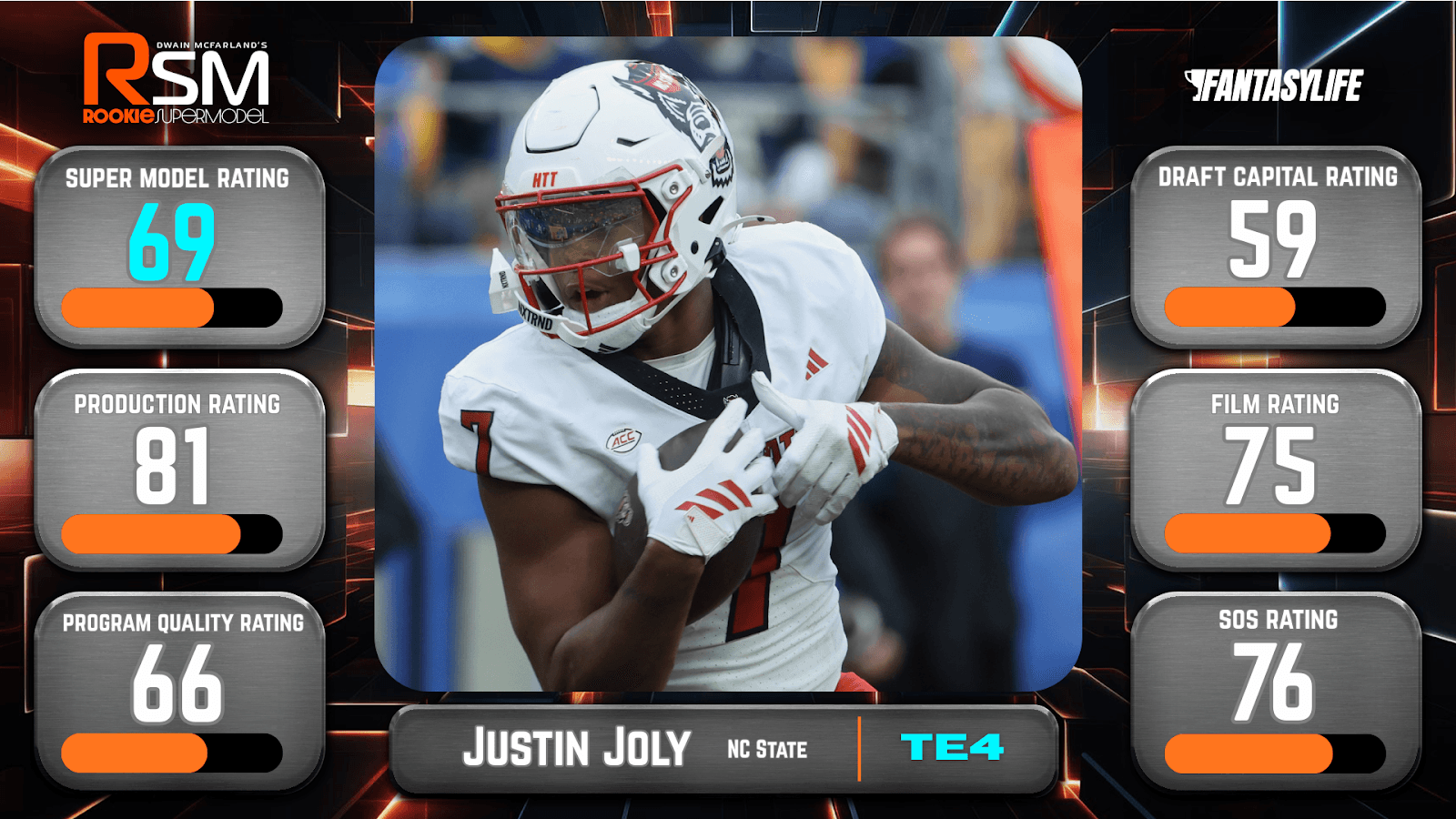
Fantasy Outlook For Justin Joly
Since 2018, 40 TEs have posted a Super Model rating between 64 and 74, with 15% delivering a top-12 finish by Year 3.
- Top-six finishes: 5%
- Top-nine finishes: 10%
- Top-12 finishes: 15%
Joly's closest Super Model comps:
Bottom line: The Rookie Super Model rates Joly as an underrated TE who is worthy of a Round 3 NFL Draft Pick. But he must improve as a blocker to unlock a full-time role at the next level. Still, we are aiming for receiving upside in fantasy, so this is the type of profile that can pay dividends when we get it right, versus a less productive player that is a better blocker. Joly profiles as a mid-range TE2 with low-end TE1 upside in fantasy.
Justin Joly complete Rookie Model Prospect Profile
Tier 4: Borderline TE2 Prospects
Jack Endries | Texas
- Super Model Rating: 67 (49th since 2018)
- Draft Pick: 133
- Rookie Age: 22.4
- Height: 77 inches
- Weight: 245 pounds
- Complete Rookie Super Model Prospect Profile
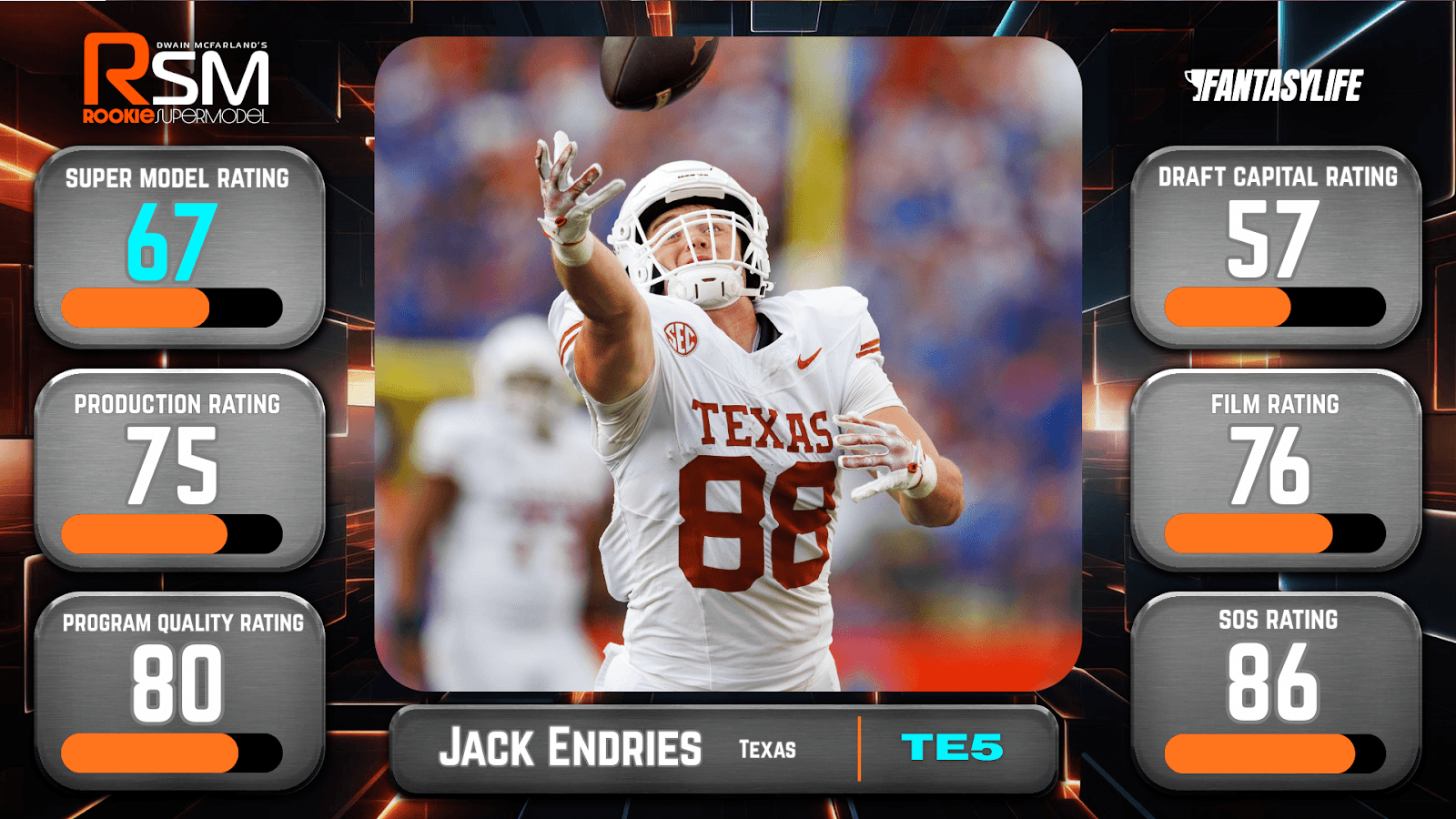
Fantasy Outlook For Jack Endries
Since 2018, 49 TEs have posted a Super Model rating between 62 and 72, with 12% delivering a top-12 finish by Year 3.
- Top-six finishes: 4%
- Top-nine finishes: 8%
- Top-12 finishes: 12%
Endries' closest Super Model comps:
Bottom line: Endries profiles as a mid-round NFL Draft pick in the Rookie Super Model. He flashed solid production early in his career and will only be 22 when the next NFL season kicks off. However, his production regressed at a stronger program after transferring to Texas. Endries has good hands and is a proven underneath receiver, but is an average operator after the catch. His blocking needs work, which could limit playing time early, but he has potential to develop into a full-time player based on his Film Rating. Endries is a borderline TE2 prospect with low-end TE1 upside in fantasy football.
Jack Endries complete Rookie Model Prospect Profile
Michael Trigg | Baylor
- Super Model Rating: 66 (55th since 2018)
- Draft Pick: 105
- Rookie Age: 24.2
- Height: 76 inches
- Weight: 240 pounds
- Complete Rookie Super Model Prospect Profile
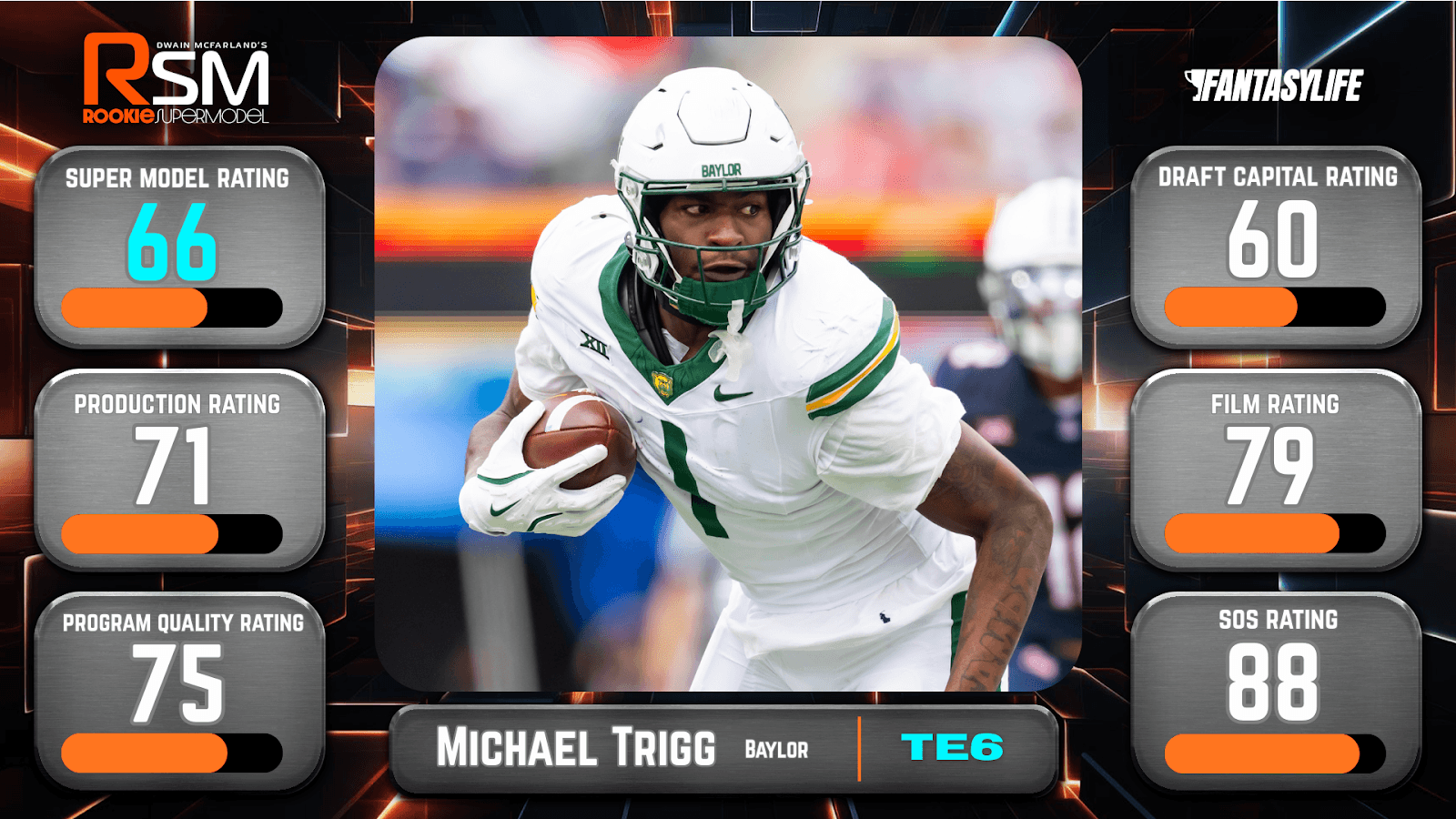
Fantasy Outlook For Michael Trigg
Since 2018, 51 TEs have posted a Super Model rating between 61 and 71, with 10% delivering a top-12 finish by Year 3.
- Top-six finishes: 2%
- Top-nine finishes: 6%
- Top-12 finishes: 10%
Trigg's closest Super Model comps:
- Charlie Kolar
- Hunter Bryant
Bottom line: Trigg profiles as a Day 3 NFL Draft pick in the Rookie Super Model. He was a slow starter with injuries and conduct derailing his first three years, but was solid over his final two seasons at Baylor. The model is docking him for that, but his Film Rating and his underlying per-route data provide some optimism. For NFL teams looking for a vertical TE threat or a big-bodied man-coverage-beater, Trigg fits the bill. He must grow as a blocker and clean up the drops to unlock a full-time role. Trigg is a borderline TE2 with a glimmer of TE1 hope in fantasy football.
Michael Trigg complete Rookie Model Prospect Profile
Tier 5: TE3 Dart-Throw Prospects
Sam Roush | Stanford
- Super Model Rating: 65 (66th since 2018)
- Draft Pick: 107
- Rookie Age: 23
- Height: 78 inches
- Weight: 267 pounds
- Production Rating: 66
- Film Rating: 78
- Program Quality Rating: 66
- Recruiting Pedigree: 4-star
Fantasy Outlook For Sam Roush
Roush's closest Super Model comps:
Bottom line: The Rookie Super Model rates Roush as a Round 4 NFL Draft pick. But most of that is getting carried by his Film Rating (78) rather than his Production Rating (66). He offers a unique blend of size (267 lbs) and played in-line (59%) more than most TEs in the class. So teams could view him as an every-down-ready player. His PFF Career Run Block Grade of 55.6 (35th percentile) aligns more with smaller players, but Lance Zierlein sees him as a "pro-ready" blocker. Roush could find his way into a starting role that gives him borderline TE1 potential on a pass-catcher-poor team, but his upside is limited. Roush is a low-upside, playing-time bet as a TE3 in fantasy football.
Tanner Koziol | Houston
- Super Model Rating: 64 (71st since 2018)
- Draft Pick: 180
- Rookie Age: 22.4
- Height: 78.5 inches
- Weight: 247 pounds
- Production Rating: 80
- Film Rating: 70
- Program Quality Rating: 63
- Recruiting Pedigree: 2-star
Fantasy Outlook For Tanner Koziol
Koziol's closest Super Model comps:
- Kylen Granson
- Kaden Smith
Bottom line: The Rookie Super Model rates Koziol as a Day 3 NFL Draft pick. His 80 Production Rating ranks 21st in the model's history. He was not a dynamic player after the catch, as indicated by his -1.6 YAC over expected. But he was a high-end target earner with a 25% career TPRR (73rd percentile). He was highly active in the short and medium depths of the field and was exceptional in contested catch situations (61%). He rarely let the pigskin hit the ground (3%). He isn't known for blocking (27th percentile), which could limit his playing time. Koziol is a receiving-upside Hail Mary in fantasy football as a TE3.
Dae'Quan Wright | Ole Miss
- Super Model Rating: 63 (77th since 2018)
- Draft Pick: 181
- Rookie Age: 23
- Height: 76 inches
- Weight: 246 pounds
- Production Rating: 75
- Film Rating: 71
- Program Quality Rating: 81
- Recruiting Pedigree: 3-star
Fantasy Outlook For Dae'Quan Wright
Wright's closest Super Model comps:
- Jaheim Bell
Bottom line: Wright projects as a Day 3 NFL Draft pick in the Rookie Super Model. His high passer rating when targeted is helping fuel his 75 Production Rating. Wright is a run-after-catch guru who posted the seventh-best YAC over expected (+3.1) in the model's history. He can add value around the line of scrimmage and the short game, but also showed the versatility to attack deep at a rate on par with historical prospects. However, his hands are suspect. His 7.1% drop rate was higher than the 5.6% average, and he wrangled only 27% of his contested opportunities. He is also a below-average blocker. Wright is a TE3 dart-throw in fantasy football.
Oscar Delp | Georgia
- Super Model Rating: 63 (80th since 2018)
- Draft Pick: 142
- Rookie Age: 23.1
- Height: 77 inches
- Weight: 245 pounds
- Production Rating: 67
- Film Rating: 72
- Program Quality Rating: 95
- Pedigree: 4-star
Fantasy Outlook For Oscar Delp
Delp's closest Super Model comps:
- Jared Wiley
- Davis Allen
Bottom line: The Rookie Super Model views Delp as a Day 3 NFL Draft pick. He was a below-average producer in college with a 67 Production Rating, despite an 83rd-percentile targeted passer rating. He was a plus player after the catch with a +1.2 YAC over expected, but was rarely targeted with a 13% career TPRR. Lance Zierlein sees "untapped upside" as a soft-handed pass catcher who is a "fluid athlete". He played inline on 64% of snaps, but was below-average as a blocker per his 59.6 career PFF Run Block Grade (44th percentile). But Zierlein sees three-down potential with time. Delp is a TE3 dart-throw in dynasty leagues in fantasy football.
Eli Raridon | Notre Dame
- Super Model Rating: 62 (89th)
- Draft Pick: 168
- Rookie Age: 22.6
- Height: 78 inches
- Weight: 245 pounds
- Production Rating: 63
- Film Rating: 75
- Program Quality Rating: 92
- Pedigree: 4-star
Fantasy Outlook For Eli Raridon
Raridon's closest Super Model comps:
- Davis Allen
- Mitchell Evans
Bottom line: The Rookie Super Model rates Raridon as a Day 3 NFL Draft prospect. The consensus four-star recruit didn't register a meaningful RYPTPA (1.47) until Year 4 for the Fighting Irish. However, he suffered his second ACL tear in his right knee during his freshman season. While that can't fully explain his 0.20 Year 3 RYPTPA, it provides some leeway in our evaluation. He was primarily an underneath target, but 15% of his looks (+3) were of the 20-plus variety. He played in-line on 55% of snaps, but his PFF Run Block Grade of 57.3 was in the 38th percentile. Lance Zierlein sees him as a potential "ascending" talent with every-down TE skills in the NFL, with a 50th-percentile prospect grade. Raridon is a TE3 dart-throw in fantasy football—he might still have his best football ahead.
Joe Royer | Cincinnati
- Super Model Rating: 62
- Draft Pick: 149
- Rookie Age: 24.5
- Height: 77 inches
- Weight: 247 pounds
- Production Rating: 65
- Film Rating: 76
- Program Quality Rating: 88
- Recruiting Pedigree: 4-star
Fantasy Outlook For Joe Royer
Royer's closest Super Model comps:
Bottom line: Royer battled through injuries but ultimately never found playing time at Ohio State in three years. He delivered his first significant production in Years 4 and 5 after transferring to Cincinnati, with 44 and 32 YPG, respectively. However, his RYPTPAs (1.32 and 1.14) were low for a late-breakout. While his 65 Production Rating is lackluster, his 76 Film Rating keeps him on the radar. He is a TE3 long shot in fantasy football.
TE Prospect Quick Hits:
- RJ Maryland | SMU: Solid Production Rating (78) and notched a 114.1 Speed Score. So there are some interesting traits, but he was a liability as a blocker and might not get drafted.
- Jaren Kanak | Oklahoma: Decent Production Rating (81) and Speed Score (112.1), but was a liability as a blocker and might not get drafted.
- Josh Cuevas | Alabama: Flashed with a Year 2 RYPTPA of 1.44 at Cal Poly in the FCS, but production fell off in the FBS at Washington and Alabama.
- John Michael Gyllenborg | Wyoming: Average Production Rating (74), but posted a 1.96 YPRR (65th percentile) and 24% TPRR (68th percentile). He can work deep: 22% of targets were 20-plus yards. Has size (78 inches) and can run (11.2 Speed Score).
- Bauer Sharp | LSU: Gadget weapon who saw 24% of targets behind the line of scrimmage and scored five rushing TDs.
- Nate Boerkircher | Texas A&M: Solid Film Rating (76) but a lackluster Production Rating (62). One of the better run blockers in the class, and played in-line 64%.
- Riley Nowakowski | Indiana: Largely overshadowed by other playmakers with a 62 Production Rating. But a solid run blocker.
- Dallen Bentley | Utah: Had a best-target share season of 22% with a career 20% TPRR despite a bad Production Rating (66).
- Marlin Klein | Michigan: Bad Production Rating (57), but had a 21% TPRR and notched a 109.8 Speed Score.
Data Glossary:
- Adjusted Career RYPTPA: Career receiving yards per team pass attempt adjusted for age, strength of schedule, QB play, teammate competition, aDOT, and alignment. Doesn't count games missed.
- aDOT: Average depth of target in yards.
- Career Targeted QB Passer Rating: Passer rating on WR's targets.
- Contested catch rate: Percentage of contested targets caught.
- Contested catch rate over expected: Percentage of contested targets caught after adjusting for aDOT.
- Draft Capital Rating: Based on Chase Stuart's Draft Value Chart, an improved version of what many know as the Jimmy Johnson trade chart. It accounts for the larger drop-off in the first round and a flatter drop-off around the end of the second round.
- FDPRR: First downs per route run. Often shown as a percentage (first downs divided by routes).
- Film Rating: Based on NFL.com prospect grades from Lance Zierlein.
- PFF Run Block Grade: Weighted average of run blocking grades based on run-block snaps each season.
- Production Rating: A combination of adjusted career RYPTPA and career targeted QB passer rating.
- Program Quality Rating: ESPN's College Football Power Index is used to assess program quality. The model accounts for each school a prospect attended.
- RYPTPA: Receiving yards per team pass attempt.
- SOS Rating: Based on strength of schedule (SOS) from Sports Reference. The model accounts for each school the prospect attended.
- Speed Score: Speed normalized for weight; invented by Bill Barnwell. Formula: (Weight * 200) / (40-yard dash time)4
- Target Share: A player's percentage of team targets in games played.
- TPRR: Targets per route run.
- YAC: Average yards after the catch.
- YAC over expected: YAC over expected after adjusting for aDOT.
- YPG: Yards per game.
- YPRR: Yards per route run.

Join Our Newsletter
Trusted by 400,000+ fantasy football players. Get access to Fantasy Life's free award winning newsletter and tools, all in one step.
By registering or logging in, you agree to our Terms of Use and Privacy Policy.
Players Mentioned in this Article







Published Updated